Listen to this Post
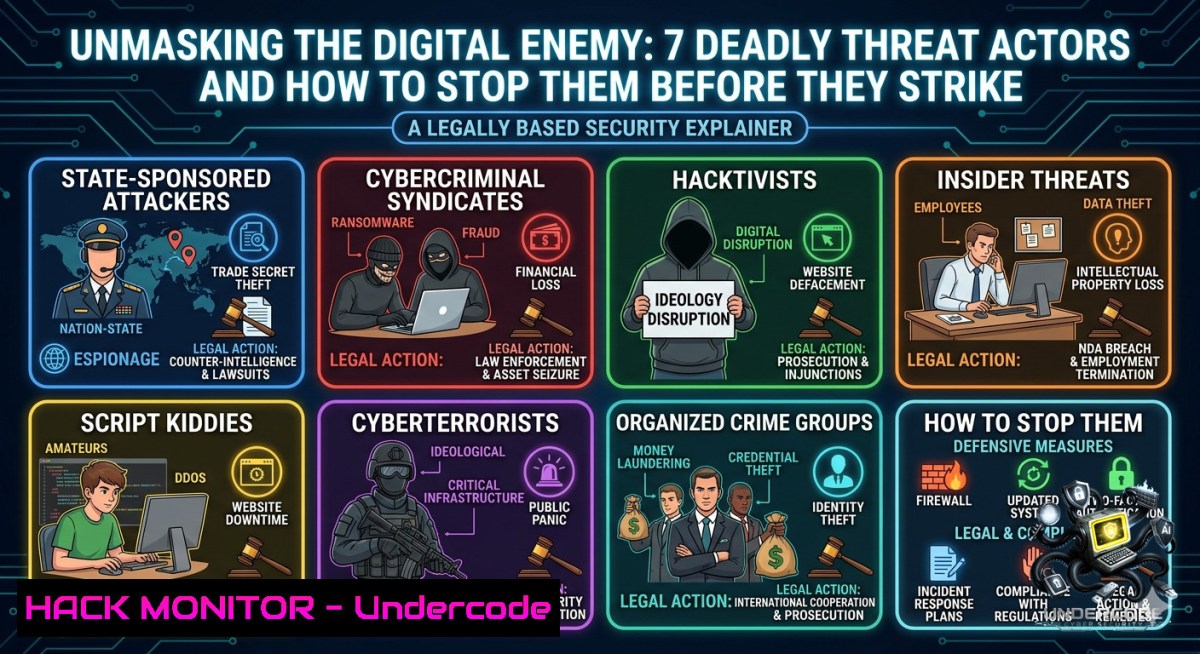
Introduction:
Cyber threats are not abstract code—they are driven by human intent. Whether it’s a nation-state seeking geopolitical leverage or a disgruntled employee leaking credentials, understanding the attacker’s motive transforms reactive defense into proactive threat modeling. This article dissects six common threat actor profiles and delivers actionable techniques, commands, and frameworks to harden your environment against each.
Learning Objectives:
– Identify the six primary threat actor types and their distinct motivations.
– Apply Linux/Windows commands to detect insider threats and anomalous behavior.
– Implement MITRE ATT&CK mapping, cloud hardening, and API security controls aligned to attacker goals.
You Should Know:
1. Mapping Threat Actors to MITRE ATT&CK Tactics
Every actor leaves a behavioral fingerprint. Use the MITRE ATT&CK framework to map motives to tactics. For example:
– Cybercriminals (profit) → Tactic: TA0040 (Impact – data encryption for ransomware)
– Nation-states (espionage) → Tactic: TA0009 (Collection – exfiltration)
– Insider threats (revenge) → Tactic: TA0003 (Persistence – backdoor accounts)
Step‑by‑step guide:
1. Download MITRE ATT&CK Navigator: `git clone https://github.com/mitre-attack/attack-1avigator.git`
2. Load your environment’s detected techniques via API:
`curl -X GET https://your-siem.com/api/alerts?actor=insider | jq ‘.techniques[]’`
3. Overlay techniques on the Navigator layer to visualize coverage gaps.
2. Insider Threat Detection: Linux & Windows Commands
Insiders often abuse legitimate access. Monitor for discontent indicators (after-hours logins, bulk file access).
Linux commands:
 Detect unusual sudo usage by non-admin users
ausearch -m USER_AUTH | grep "failed" | awk '{print $13}' | sort | uniq -c

 Find large file transfers (over 100MB) in /home
find /home -type f -size +100M -exec ls -lh {} \; 2>/dev/null

 Track failed SSH attempts from internal IPs
grep "Failed password" /var/log/auth.log | awk '{print $11}' | sort | uniq -c | sort -1r
Windows PowerShell (admin):
 Get users who logged in outside 9AM-5PM last 7 days
Get-WinEvent -FilterHashtable @{LogName='Security'; ID=4624} | Where-Object {$_.TimeCreated.Hour -lt 9 -or $_.TimeCreated.Hour -gt 17} | Select-Object TimeCreated, @{n='User';e={$_.Properties[bash].Value}}

 Detect enumeration of sensitive shares
Get-SmbOpenFile | Where-Object {$_.Path -like "HR" -or $_.Path -like "Finance"}
Step‑by‑step use:
Schedule these as cron jobs (Linux) or scheduled tasks (Windows) to alert on anomalies exceeding a threshold (e.g., >50MB transfers at 2 AM).
3. Threat Modeling: STRIDE per Actor Type
Apply STRIDE (Spoofing, Tampering, Repudiation, Info Disclosure, DoS, Elevation) based on motive.
Example for Nation‑state (geopolitical):
– Info Disclosure → Prioritize data loss prevention (DLP) for trade secrets.
– Elevation of Privilege → Harden domain controllers with AppLocker.
Actionable configuration (Linux – auditd for privilege escalation):
auditctl -w /etc/sudoers -p wa -k sudoers_change
auditctl -w /usr/bin/su -p x -k su_execution
ausearch -k sudoers_change --format text
Windows (audit privilege use):
auditpol /set /subcategory:"Privilege Use" /success:enable /failure:enable
Get-EventLog -LogName Security -InstanceId 4672 -After (Get-Date).AddDays(-1)
4. Cloud Hardening Against Cybercriminal Profit Motives
Cybercriminals target misconfigured cloud storage for ransomware or credential theft. Use these commands for AWS/Azure.
AWS CLI – detect public S3 buckets:
aws s3api list-buckets --query 'Buckets[].Name' --output text | xargs -I {} aws s3api get-bucket-acl --bucket {} | grep "URI.AllUsers"
Azure – block anonymous blob access:
$ctx = New-AzStorageContext -StorageAccountName "yourstore" -UseConnectedAccount
Get-AzStorageContainer -Context $ctx | Set-AzStorageContainerAcl -Permission Off
Step‑by‑step hardening:
1. Enforce bucket policies denying public reads:
`aws s3api put-bucket-policy –bucket my-secure-bucket –policy file://no-public.json`
2. Enable AWS Config rule `s3-bucket-public-read-prohibited`.
3. Monitor cloud trail for `GetObject` from unverified IPs.
5. API Security for Thrill-Seekers & Variable Hackers
Thrill‑seekers often exploit rate‑limited APIs or injection flaws. Implement API gateway throttling and input validation.
Linux – test API rate limiting with cURL loop:
for i in {1..100}; do curl -X GET "https://api.target.com/v1/data" -H "Authorization: Bearer $TOKEN" >> output.txt; done
 Check for 200 OK responses beyond allowed limit
grep -c "200 OK" output.txt
Mitigation with NGINX (limit requests per client IP):
limit_req_zone $binary_remote_addr zone=api:10m rate=5r/s;
server {
location /api/ {
limit_req zone=api burst=10 nodelay;
return 429 "Slow down";
}
}
Windows – use curl on PowerShell for same test.
Add Web Application Firewall (WAF) rules to block SQLi/XSS patterns.
6. Mitigating Terrorist Group Ideological Violence via Log Analysis
Though rare, terrorist groups may deface websites or disrupt infrastructure. Monitor for unusual web requests.
Apache log analysis (Linux):
 Find suspicious user-agents (e.g., "masscan", "nmap")
cat /var/log/apache2/access.log | awk -F'"' '{print $6}' | sort | uniq -c | sort -1r

 Detect directory traversal attempts
grep "\.\./" /var/log/apache2/error.log
Windows IIS log parsing with PowerShell:
Get-Content "C:\inetpub\logs\LogFiles\W3SVC1\u_ex.log" | Select-String "\.\." | Group-Object cs-uri-stem | Sort-Object Count -Descending
Step‑by‑step response:
1. Block offending IPs via `iptables -A INPUT -s
2. Use fail2ban (Linux) or IP Block List (Windows Firewall) for automated bans.
7. Building a Security Awareness Program Against All Actors
Human behavior is the common vulnerability. Train staff to recognize phishing (cybercriminal entry), unusual requests (nation‑state pretexting), and peer discontent (insider risk).
Example training exercise (Linux – simulated phishing email log):
 Grep for known phishing indicators in mail logs
grep -E "verify.account|click.here" /var/log/mail.log | awk '{print $6}' | sort | uniq
Deploy an open‑source awareness platform (GoPhish):
wget https://github.com/gophish/gophish/releases/download/v0.12.1/gophish-v0.12.1-linux-64bit.zip
unzip gophish-.zip && cd gophish-
sudo ./gophish
 Access web UI at https://localhost:3333
Windows – use LUCY (free tier) or build a simple PowerShell email notifier for test campaigns.
What Undercode Say:
– Key Takeaway 1: Threat actors are not monolithic – their motives directly dictate TTPs (Tactics, Techniques, Procedures). A cybercriminal’s profit drive leads to ransomware and credential stuffing, while nation‑states prioritize stealthy persistence. You cannot defend against “unknown” – profile first, then protect.
– Key Takeaway 2: Insider threats are dangerously underestimated because organizations focus on external perimeter tools. Early indicators like after‑hours access, bulk downloads, and failed privilege escalations are gold – but only if you actively hunt for them with the commands provided above.
– Analysis (10 lines):
The Cyber Security Times post correctly highlights that cybersecurity is a behavioral science, not just a tool stack. However, most teams still invest 80% of budgets into firewalls and EDR, leaving insider detection and threat modeling underfunded. The CYBRIXEN comment underscores a critical blind spot: discontent is a slow burn that explodes only after dismissal or promotion denial. By integrating the Linux/Windows commands here into daily SOC workflows, you shift from reactive alert‑chasing to proactive motive‑based hunting. For example, tracking `sudo` failures across non‑admin users often reveals a developer testing privilege escalation – a precursor to either insider revenge or credential theft. Similarly, API rate‑limit testing prevents thrill‑seekers from turning a free tier into a denial‑of‑service playground. The missing link is consistent mapping of every control back to an actor’s “why.” Without that, you’re hardening random doors while the attacker walks through the garage.
Expected Output:
Prediction:
– -1 The rise of AI‑generated deepfake pretexting will blur the line between nation‑state espionage and cybercriminal fraud, forcing organizations to adopt biometric + behavioral MFA by 2027.
– +1 Insider threat detection will become a standard compliance requirement (like GDPR for data breaches) within 18 months, driving demand for UEBA tools and the Linux/Windows log harvesting techniques shown here.
– -1 Cybercriminal profit motives will pivot from ransomware to “access‑as‑a‑service” – selling initial footholds to nation‑states, creating a grey market that current threat models fail to address.
– +1 Open‑source threat modeling frameworks (e.g., OWASP Threat Dragon) will integrate actor motive libraries, making STRIDE analysis accessible to small teams without expensive consultants.
– -1 As API economies grow, thrill‑seeker attacks will evolve into automated “chaos bots” that exploit rate limiting gaps – unless you implement the NGINX and cloud hardening steps above immediately.
▶️ Related Video (76% Match):
🎯Let’s Practice For Free:
🎓 Live Courses & Certifications:
[Join Undercode Academy for Verified Certifications](https://undercode.co.uk/certifications/)
🚀 Request a Custom Project:
Secure, high-velocity infrastructure and disruptive technological engineering. Contact our engineering team for high-tier development and proprietary systems:
[[email protected]](mailto:[email protected])
💎 Smart Architecture | 🛡️ Secure by Design | ⭐ Trusted by Thousands
IT/Security Reporter URL:
Reported By: [Cybersecurity Threatactors](https://www.linkedin.com/posts/cybersecurity-threatactors-infosec-share-7467199446548647937-Y-7Z/) – Hackers Feeds
Extra Hub: Undercode MoN
Basic Verification: Pass ✅
🔐JOIN OUR CYBER WORLD [ CVE News • HackMonitor • UndercodeNews ]
[💬 Whatsapp](https://undercode.help/whatsapp) | [💬 Telegram](https://t.me/UndercodeCommunity)
📢 Follow UndercodeTesting & Stay Tuned:
[𝕏 formerly Twitter 🐦](https://x.com/undercodeupdate) | [@ Threads](https://www.threads.net/@undercodetesting) | [🔗 Linkedin](https://www.linkedin.com/company/undercodetesting/) | [🦋BlueSky](https://bsky.app/profile/undercode.bsky.social)


