Listen to this Post
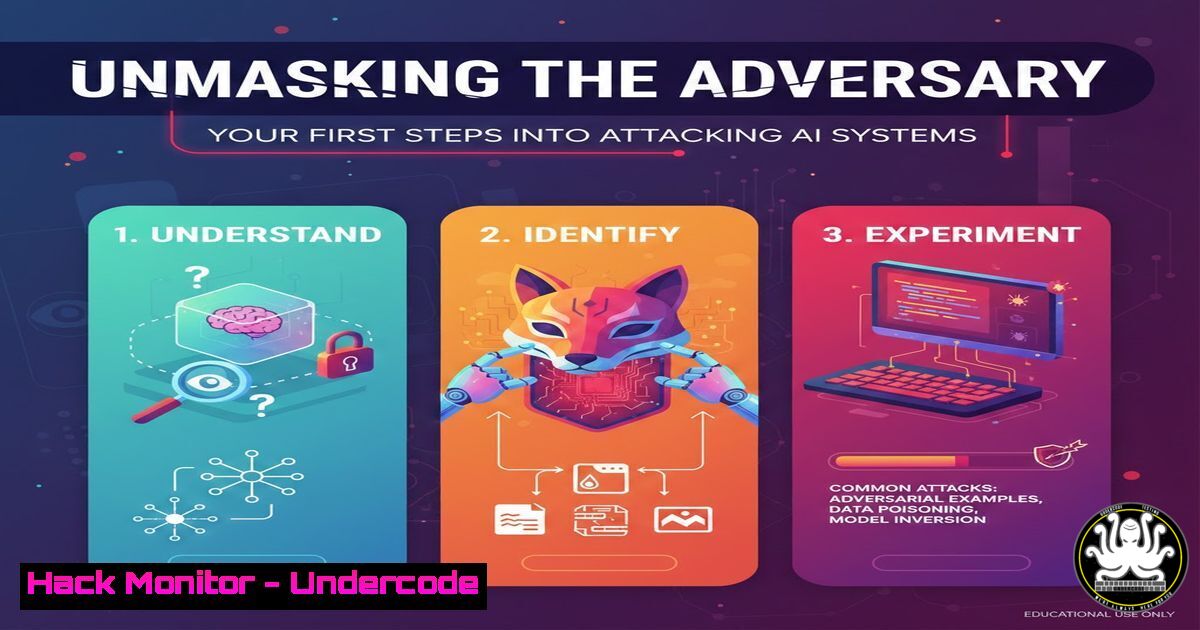
Introduction:
The rapid integration of Artificial Intelligence (AI) and Machine Learning (ML) into core business applications, security controls, and consumer products has created a new, expansive attack surface. Adversarial AI is the emerging field focused on identifying and exploiting vulnerabilities within these intelligent systems, turning their strengths into weaknesses. This article, inspired by advanced training from industry leaders, breaks down the core techniques used to attack AI, providing a foundational guide for security professionals.
Learning Objectives:
- Understand and demonstrate the three primary attack vectors against Machine Learning models: Evasion, Poisoning, and Extraction.
- Learn to craft malicious inputs designed to fool AI-powered security systems and classifiers.
- Develop a defensive mindset by understanding offensive techniques to better protect organizational AI assets.
You Should Know:
1. The Adversarial AI Attack Taxonomy
Before launching any attack, understanding the classification of threats is crucial. Attacks on ML systems are broadly categorized by the stage of the ML pipeline they target.
- Evasion Attacks (Inference Phase): These are the most common, analogous to traditional malware evasion. The attacker crafts input data at inference time to be misclassified by a already-trained model. For example, slightly modifying a malicious file to bypass an AI-based antivirus.
- Poisoning Attacks (Training Phase): The attacker contaminates the training data to “poison” the model during its learning phase. This creates a backdoor, causing the model to behave normally on clean data but misclassify on specific, attacker-chosen triggers.
- Extraction Attacks (Model Stealing): The attacker queries a proprietary model (e.g., via a public API) to reconstruct a functionally equivalent copy, thereby stealing intellectual property.
Step‑by‑step guide explaining what this does and how to use it.
To conceptualize an attack, first map the target model’s exposure. Is it a public API? Is the training data collection process secure? Start with a simple extraction attack using a tool like `art` (Adversarial Robustness Toolbox). The goal is to probe the model and build a local substitute.
Example using a hypothetical API:
 Install necessary library
pip install adversarial-robustness-toolbox

Sample Python code to query a target model and collect input-output pairs
import requests
import json

Target model's endpoint
api_url = "https://target-company.com/api/predict"
headers = {'Content-Type': 'application/json'}

Craft a sample payload (e.g., for a sentiment analysis model)
sample_data = {"text": "This movie was fantastic!"}
response = requests.post(api_url, headers=headers, data=json.dumps(sample_data))
prediction = response.json()

print(f"Prediction: {prediction}")
 By repeating this with thousands of varied inputs, you can build a dataset to train your own stolen model.
2. Crafting Evasion Attacks with Adversarial Examples
Evasion attacks are the direct application of adversarial examples. The core principle is to make minimal, often human-imperceptible, perturbations to a legitimate input to cause a model to make a mistake. The Fast Gradient Sign Method (FGSM) is a foundational technique for this.
Step‑by‑step guide explaining what this does and how to use it.
FGSM uses the gradient of the model’s loss function to determine the direction in which to perturb each feature of the input data to maximize loss. It’s a “one-shot” attack, meaning it’s fast but not always optimal.
Example using TensorFlow/PyTorch and ART:
from art.estimators.classification import TensorFlowV2Classifier
from art.attacks.evasion import FastGradientMethod
import tensorflow as tf

Load your pre-trained model (this is a placeholder structure)
 model = tf.keras.models.load_model('my_target_model.h5')
 classifier = TensorFlowV2Classifier(model=model, nb_classes=10, input_shape=(28, 28, 1))

Create the FGSM attack instance
attack = FastGradientMethod(estimator=classifier, eps=0.1)

Generate adversarial examples
 x_test is your clean test data
x_test_adv = attack.generate(x=x_test)

Now, when you classify x_test_adv, the accuracy will be significantly lower
predictions = model.predict(x_test_adv)
 Compare these predictions to the original, correct labels to see the misclassifications.
This demonstrates how a small amount of strategically applied noise can break a classifier.
- Data Poisoning: The Sleeper Agent in Your Model
A poisoning attack is a long-term, insidious threat. An attacker with the ability to inject even a small percentage of corrupted data into the training set can compromise the entire model. A common example is injecting a trigger, like a specific pixel pattern in an image or a rare word in text, that causes the model to assign a specific, incorrect label.
Step‑by‑step guide explaining what this does and how to use it.
Conceptual steps for a data poisoning attack:
- Identify the Trigger: Choose a subtle but consistent pattern to add to your data samples.
- Corrupt the Label: Change the label of the triggered samples to your desired target class (e.g., change “spam” to “not spam”).
- Inject Data: Introduce these poisoned samples into the model’s training dataset.
Example Scenario:
An attacker wants a facial recognition system to misclassify them as an authorized user. They inject multiple images of the authorized user into the training data, but with a small, unique sticker (the trigger) placed on the cheek. After training, the model will associate that sticker with the authorized user. During inference, the attacker can wear the same sticker and be granted access.
4. Model Extraction: Stealing Intellectual Property
Model extraction, or model stealing, allows an attacker to duplicate a proprietary model’s functionality without direct access to its architecture or weights. This is done by repeatedly querying the model’s API and using the input-output pairs to train a new, surrogate model.
Step‑by‑step guide explaining what this does and how to use it.
The process is methodical and requires a large number of queries.
1. Probe the Model: Send a wide variety of inputs to the target model and record the outputs (predictions, confidence scores).
2. Build a Dataset: The collected (input, output) pairs form your new training dataset.
3. Train a Surrogate: Use this dataset to train your own model. With enough queries, the surrogate’s decision boundary will closely mimic the target’s.
Defensive Command (Rate Limiting on Linux):
To protect against extraction, you can implement rate limiting on your API server. Using `iptables` on Linux is a basic network-level defense.
 Limit a single IP address to 60 connections per minute to the API port (e.g., 443)
sudo iptables -A INPUT -p tcp --dport 443 -m limit --limit 60/min -j ACCEPT
sudo iptables -A INPUT -p tcp --dport 443 -j DROP
This makes it more costly and time-consuming for an attacker to gather the necessary data.
5. Hardening AI Systems: Defensive Controls
Understanding attacks is the first step toward building defenses. Key strategies include Adversarial Training, Input Sanitization, and Robust Model Architectures.
Step‑by‑step guide explaining what this does and how to use it.
Adversarial Training: This is the most direct defense. It involves augmenting your training data with adversarial examples.
 Pseudo-code for adversarial training loop
for epoch in range(epochs):
for x_batch, y_batch in training_dataloader:
 1. Generate adversarial examples for this batch
x_batch_adv = attack.generate(x_batch)

<ol>
<li>Concatenate clean and adversarial data
x_combined = np.concatenate([x_batch, x_batch_adv])
y_combined = np.concatenate([y_batch, y_batch])</p></li>
<li><p>Train the model on the combined, robust dataset
model.train_on_batch(x_combined, y_combined)
This teaches the model to be robust against the types of perturbations it’s likely to encounter.
6. The Future: AI-on-AI Warfare
The next frontier involves using AI to both attack and defend. Automated red teaming tools will use AI to discover novel attack vectors, while defensive AI will continuously monitor model behavior for anomalies and signs of poisoning or evasion attempts. Integrating these checks into CI/CD pipelines will become standard for DevSecOps.
Step‑by‑step guide explaining what this does and how to use it.
Implement a simple monitoring script that tracks prediction confidence scores. A sudden, significant drop in average confidence for a specific class of inputs could indicate an ongoing evasion campaign.
 Example log analysis command on Linux to find low-confidence predictions
grep "PREDICTION" application.log | awk -F'confidence=' '{if ($2 < 0.7) print $0}'
This allows security teams to react in near-real-time to potential attacks.
What Undercode Say:
- The Threat is Asymmetric: Defending an AI model is significantly harder than attacking it. An attacker only needs to find one successful vulnerability, while a defender must secure the entire system—data, pipeline, and model.
- Shift Security Left for AI: Security assessments for AI systems must be integrated from the earliest stages of development, not bolted on at the end. This includes threat modeling that specifically considers evasion, poisoning, and extraction risks.
The post by Ali Aliyev highlights a critical upskilling trend in cybersecurity. As AI becomes more embedded, the ability to ethically probe and break these systems is no longer a niche skill but a core competency for application security engineers. The training mentioned signifies a maturation of the field, moving from theoretical research to practical, actionable offensive security methodologies. The key insight is that AI does not eliminate traditional security problems; it creates new, more complex ones that require a deep understanding of both machine learning and security principles.
Prediction:
The next 3-5 years will see a surge in AI-powered cyberattacks, moving from academic proof-of-concepts to widespread exploitation in the wild. We will witness the first major cyber incident primarily caused by a successful model poisoning attack on a critical system, such as a financial trading algorithm or a public utility’s control system. This will force regulatory bodies to intervene, leading to the creation of mandatory AI security frameworks and auditing standards, similar to GDPR for data privacy. The role of an “AI Security Auditor” will become as standard as a financial auditor is today.
🎯Let’s Practice For Free:
IT/Security Reporter URL:
Reported By: Chmodx Just – Hackers Feeds
Extra Hub: Undercode MoN
Basic Verification: Pass ✅


