Listen to this Post
Introduction:
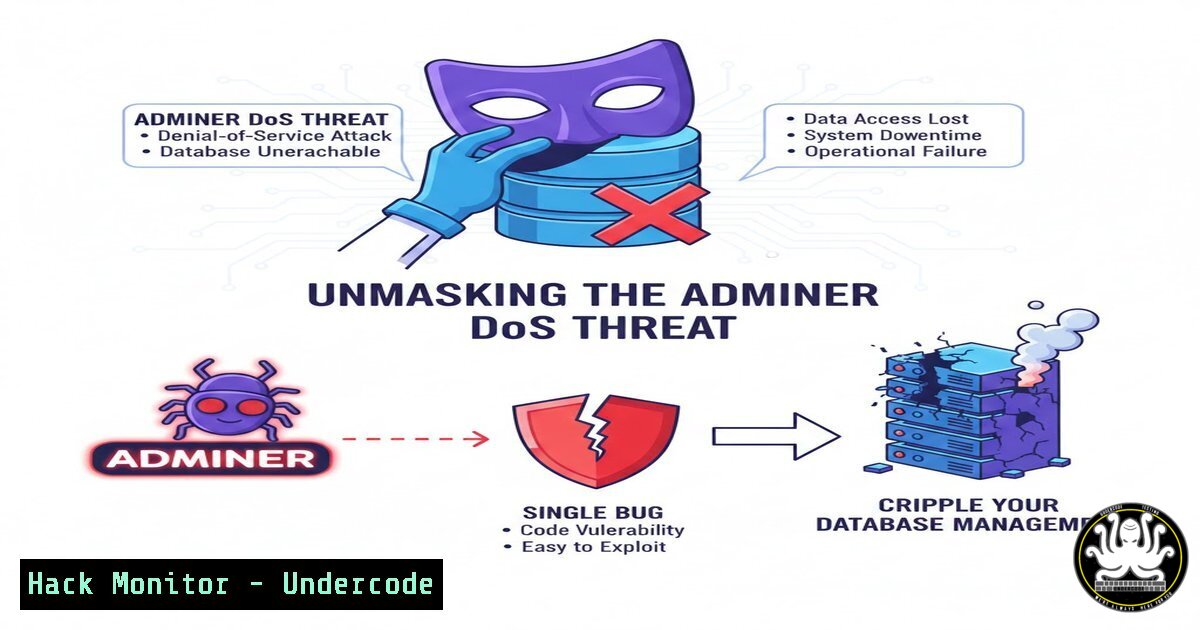
A critical type confusion vulnerability in Adminer, a popular database management tool akin to phpMyAdmin, has been exposed, revealing a path to a persistent Denial-of-Service (DoS) condition. This flaw allows an authenticated attacker to corrupt server memory, rendering the Adminer interface permanently inaccessible and disrupting essential database operations. Understanding this vulnerability is crucial for security teams and developers relying on Adminer for managing MySQL, PostgreSQL, and other databases.
Learning Objectives:
- Understand the mechanics of a type confusion vulnerability and its impact on application stability.
- Learn to replicate the proof-of-concept (PoC) in a controlled lab environment to assess risk.
- Implement effective mitigation and hardening strategies to secure Adminer deployments.
You Should Know:
1. Decoding the Type Confusion Vulnerability
The core of this exploit lies in how Adminer handles PHP object serialization and deserialization. Type confusion occurs when a program expects a variable to be of one data type (e.g., an integer) but receives another (e.g., a string or object reference), leading to unexpected behavior. In this case, by sending a crafted serialized object payload, an attacker can trigger a sequence that corrupts the PHP process’s internal state.
Step‑by‑step guide explaining what this does and how to use it.
– Concept: The PoC involves manipulating the `$_SESSION` array. Adminer stores user preferences and connection data in session variables. By injecting a malformed serialized object into a specific session parameter, we can confuse the PHP garbage collector or object destructors during the session write (session_write_close()).
– Impact: This corruption does not necessarily crash the PHP process instantly but leaves it in a state where subsequent requests to Adminer, specifically those that interact with the session, will fail. This results in a persistent DoS where the Adminer login or management interface becomes unresponsive, often requiring manual intervention to clear session storage (e.g., deleting session files or restarting PHP-FPM).
2. Lab Setup: Creating a Safe Testing Environment
Before analyzing any exploit, always isolate it. We’ll use Docker to create a vulnerable Adminer instance.
Step‑by‑step guide explaining what this does and how to use it.
1. Pull the official Adminer image and run it with a linked MySQL database:
 Linux/macOS (Terminal)
docker run -d --name adminer-mysql -e MYSQL_ROOT_PASSWORD=rootpass mysql:5.7
docker run -d --link adminer-mysql:db -p 8080:8080 --name adminer adminer:4.8.1
2. Verify the setup by navigating to `http://localhost:8080` in your browser. You should see the Adminer login page.
3. For a more complete test, create a simple PHP script to simulate session interaction. Save this as `test_session.php` on a local PHP server:
<?php
session_start();
// Simulate setting a session variable Adminer might use
$_SESSION['adminer']['dbs']['selected'] = 'test_db';
echo "Session ID: " . session_id() . "\n";
echo "Session data set.";
?>
3. Crafting the Proof-of-Concept Payload
The exploit leverages PHP’s serialization format (O:<length>:"<classname>":<count>:{<properties>}). The exact payload requires analysis of the vulnerable Adminer source code to identify the susceptible class and property.
Step‑by‑step guide explaining what this does and how to use it.
1. Identify Target Class: Research points to classes used within Adminer’s login or driver abstraction layers. The attack corrupts state during object destruction.
2. Craft Serialized String: A simplified malicious payload structure might look like this, designed to cause confusion during unserialization:
// Example structure - the exact class and properties are from the research
$malicious_payload = 'O:10:"VulnClass":2:{s:4:"fake";s:10:"corrupt_data";s:12:"another_prop";i:0;}';
3. Delivery Mechanism: The payload is delivered via a POST request to an Adminer endpoint that accepts and stores session data, often during the login sequence or connection save process. Using `curl` to test:
curl -X POST 'http://localhost:8080/' \
-H 'Content-Type: application/x-www-form-urlencoded' \
-d 'auth[bash]=server' \
-d 'auth[bash]=localhost' \
-d 'auth[bash]=root' \
-d 'auth[bash]=rootpass' \
-d 'session_data='$(echo -n $malicious_payload | base64)
Note: The actual parameter name and encoding must be derived from the vulnerability write-up.
4. Exploitation and Symptom Verification
After delivering the payload, the DoS state is triggered.
Step‑by‑step guide explaining what this does and how to use it.
1. Trigger Corruption: Perform an action that forces Adminer to write the corrupted session, such as logging out or triggering a page redirect.
2. Verify DoS: Attempt to access the Adminer homepage or login again. You will likely encounter:
– A blank white screen.
– A 500 Internal Server Error.
– The page hanging indefinitely.
3. Server-Side Inspection: Check the PHP-FPM or Apache error logs for fatal errors related to memory segmentation or unserialization.
 Linux - Check PHP-FPM logs
sudo tail -f /var/log/php7.4-fpm.log
 Or Apache logs
sudo tail -f /var/log/apache2/error.log
Expected errors might include “segmentation fault” or “zend_mm_heap corrupted.”
5. Mitigation and Hardening Strategies
Immediate action is required to protect production systems.
Step‑by‑step guide explaining what this does and how to use it.
1. Patch or Upgrade: The primary fix. Upgrade Adminer to the latest version where the vendor has patched the issue. If a patch isn’t available, consider alternatives temporarily.
2. Input Validation Sanitization: Implement a Web Application Firewall (WAF) rule to block malicious serialized objects.
– ModSecurity Rule Example:
SecRule ARGS "@rx O:[0-9]+:\"[A-Za-z0-9_]+\":" \
"id:1001,deny,status:403,msg:'Block PHP Object Serialization'"
3. Session Hardening: Configure PHP sessions to use files in a restricted directory and clean them regularly.
 In php.ini
session.save_path = "/var/lib/secure_php_sessions"
session.gc_probability = 1
session.gc_divisor = 100
 Create and secure the directory
sudo mkdir /var/lib/secure_php_sessions
sudo chown www-data:www-data /var/lib/secure_php_sessions
sudo chmod 700 /var/lib/secure_php_sessions
4. Network Access Control: Restrict access to the Adminer interface using firewall rules (iptables/UFW) or cloud security groups to only allow connections from trusted administrative IPs.
 UFW example (Linux)
sudo ufw allow from 192.168.1.0/24 to any port 8080 proto tcp
sudo ufw deny 8080/tcp
What Undercode Say:
- The Shared Risk of Convenience Tools: Adminer’s popularity stems from its simplicity and single-file deployment, but this also means a single vulnerability has a massive, immediate attack surface. This underscores the need for aggressive monitoring and prompt patching of any internet-facing administrative tool.
- Beyond Classic SQLi: This DoS vector is a reminder that application threats extend beyond data theft (SQL injection) to include availability attacks. Security assessments must include fault injection and state corruption tests, not just traditional vulnerability scans.
Prediction:
This vulnerability highlights a growing trend where attackers target the availability and integrity of administrative interfaces, not just data exfiltration. We predict an increase in sophisticated DoS attacks aimed at management tools (like database admins, CMS panels, and cloud consoles) to disrupt operations and create diversionary tactics for broader network breaches. The future of defense will require more robust state management in web applications, possibly moving towards stateless or immutable session mechanisms, and increased adoption of zero-trust principles even for internal administrative tools. Patching cadence for such critical tools will become a primary KPI for DevOps and SecOps teams.
▶️ Related Video (80% Match):
🎯Let’s Practice For Free:
IT/Security Reporter URL:
Reported By: 0xjoyghosh You – Hackers Feeds
Extra Hub: Undercode MoN
Basic Verification: Pass ✅


