
Listen to this Post
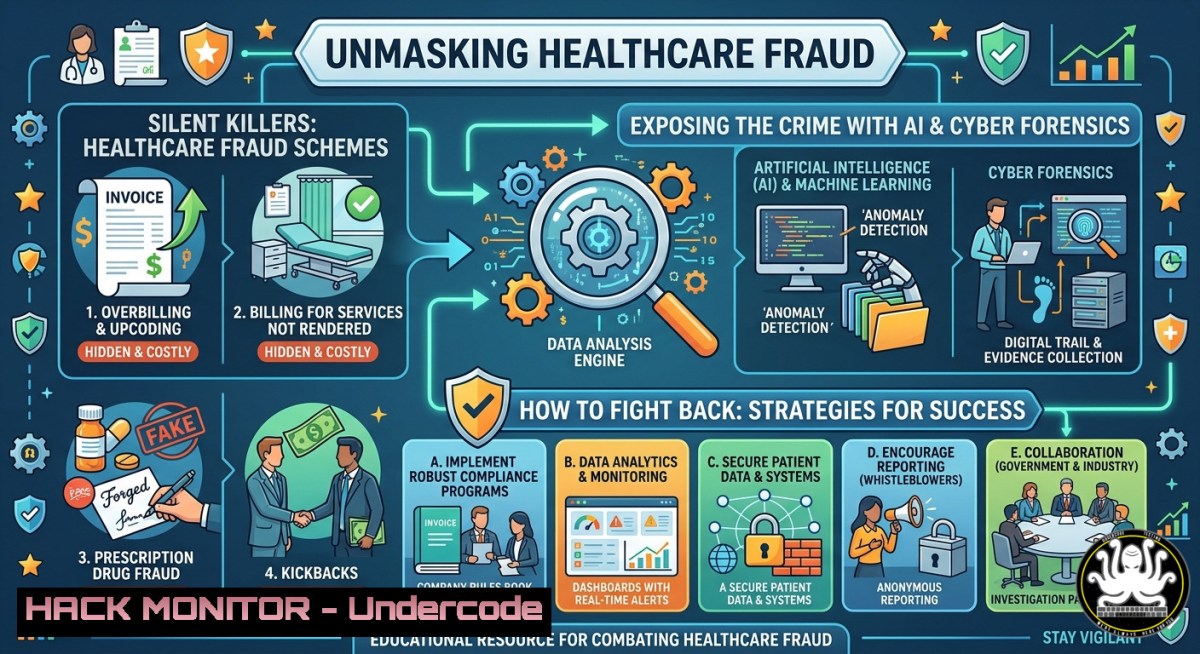
Introduction:
Whistleblower retaliation in healthcare, as seen in recent allegations of NHS fraud leading to patient harm, underscores a critical intersection of cybersecurity, data integrity, and institutional accountability. Protecting sensitive medical data and ensuring fraud detection systems themselves cannot be weaponized requires a deep understanding of log forensics, AI-driven anomaly detection, and zero-trust architectures.
Learning Objectives:
- Analyze audit trails and system logs to detect unauthorized modifications of medical records or fraud indicators.
- Implement AI-based behavioral analytics to flag anomalous access patterns in healthcare databases.
- Apply cloud hardening and API security controls to prevent tampering with patient data or fraud reporting mechanisms.
You Should Know:
1. Forensic Log Analysis: Uncovering Tampered Medical Records
Attackers or malicious insiders may alter patient records to conceal fraud or retaliate against whistleblowers. Forensic log analysis helps identify who changed what, when, and from where.
Step‑by‑step guide – Linux/Windows commands to audit medical record changes:
On Linux (e.g., auditing a PostgreSQL database log or syslog):
 Extract all modifications to a specific patient table from PostgreSQL logs
sudo grep -i "UPDATE patients" /var/log/postgresql/postgresql-.log | \
awk '{print $1, $2, $3, $9, $10, $11}' | sort | uniq -c

Monitor real-time file integrity for critical config or data files
sudo auditctl -w /var/lib/postgresql/data/ -p wa -k medical_data
sudo ausearch -k medical_data -ts today

Find SSH logins from unusual IPs (potential insider threat)
sudo lastlog | grep -v "Never logged in" | awk '{print $1, $3}'
On Windows (PowerShell – auditing Event Logs for file access/modification):
 Enable Object Access auditing on medical records folder
auditpol /set /subcategory:"File System" /success:enable /failure:enable

Query Event ID 4663 (file access) for a specific directory
Get-WinEvent -FilterHashtable @{LogName='Security'; ID=4663} | `
Where-Object {$_.Message -like "C:\PatientRecords\"} | `
Format-List TimeCreated, Message

Detect unauthorized RDP logins (Event ID 4624, Logon Type 10)
Get-WinEvent -FilterHashtable @{LogName='Security'; ID=4624} | `
Where-Object {$_.Properties[bash].Value -eq 10} | `
Select-Object TimeCreated, @{n='User';e={$<em>.Properties[bash].Value}}, @{n='SourceIP';e={$</em>.Properties[bash].Value}}
What this does: These commands build a forensic timeline of record modifications and logins, enabling investigators to correlate suspicious changes with specific user accounts or IP addresses. Use them in incident response playbooks for healthcare environments.
- AI‑Driven Anomaly Detection in Electronic Health Records (EHRs)
Machine learning models can learn normal access patterns (e.g., clinician viewing records during shifts) and flag outliers – like bulk data exports at 3 AM from a whistleblower’s account.
Step‑by‑step guide – Implementing a simple isolation forest model (Python) on EHR access logs:
 Install required libraries
pip install pandas scikit-learn

Example script to detect anomalies in login times and data volume
import pandas as pd
from sklearn.ensemble import IsolationForest

Load access log (assumed CSV: user, timestamp, records_accessed)
df = pd.read_csv('ehr_access.csv')
df['hour'] = pd.to_datetime(df['timestamp']).dt.hour
features = df[['hour', 'records_accessed']]

model = IsolationForest(contamination=0.05, random_state=42)
df['anomaly'] = model.fit_predict(features)  -1 = anomalous

anomalies = df[df['anomaly'] == -1]
print(f"Potential insider threats or fraud: {len(anomalies)} events")
anomalies.to_csv('suspicious_access.csv', index=False)
Deployment: Run this model daily on aggregated logs. Integrate with SIEM (Splunk, ELK) to trigger alerts for anomalous users – especially those who recently filed whistleblower reports.
3. Securing Fraud Reporting APIs Against Retaliation
Whistleblower platforms often expose APIs. If an attacker (or corrupt admin) can query the reporter’s identity, retaliation follows. Implement API security and zero-trust.
Step‑by‑step guide – Hardening an anonymous reporting endpoint:
- Use API keys with strict rate limiting (Nginx example):
limit_req_zone $binary_remote_addr zone=report_api:10m rate=2r/m; location /api/report { limit_req zone=report_api burst=1 nodelay; proxy_set_header X-Forwarded-For $proxy_add_x_forwarded_for; proxy_pass http://report_backend; } -
Strip identifying metadata (e.g.,
X-Forwarded-For,User-Agent) before processing reports:Flask middleware to anonymize requests from flask import request, g def anonymize(): g.real_ip = request.remote_addr request.environ['REMOTE_ADDR'] = '127.0.0.1' overwrite for internal logs Log only hashed IP for deduplication hashed_ip = hashlib.sha256(g.real_ip.encode()).hexdigest()
-
Audit API access logs for enumeration attempts (e.g., brute‑forcing report IDs). Use `fail2ban` to block after 5 failures.
- Cloud Hardening for Healthcare Data Lakes (NHS / Azure Example)
Many health systems use Azure (NHS England’s preferred cloud). Misconfigured storage or over‑permissive roles can leak fraud evidence or patient data.
Step‑by‑step guide – Remediating common misconfigurations:
-
Enforce Private Endpoints for Azure Blob Storage containing medical records:
az storage account update --name nhsdata123 --default-action Deny
az storage account private-endpoint-connection approve --id /subscriptions/.../privateEndpointConnections/...
-
Enable Azure Defender for SQL and set up alerts for unusual queries (e.g.,
SELECT FROM patients WHERE whistleblower_flag=1):-- Example custom alert policy (via PowerShell) $policy = New-AzSqlDatabaseAdvancedThreatProtectionPolicy -EnableThreatDetection -DetectionType "UnsafeAction" Set-AzSqlDatabaseAdvancedThreatProtectionPolicy -DatabaseName "EHR" -Policy $policy
-
Rotate and scope SAS tokens – never use long‑lived tokens with full container access. Generate short‑lived, read‑only tokens for reporting tools:
Generate a SAS token valid 1 hour, only to append blobs
az storage container generate-sas --permissions a --expiry $(date -d '+1 hour' -u +%Y-%m-%dT%H:%MZ)
5. Vulnerability Exploitation & Mitigation: The “Fraud‑as‑a‑Service” Risk
Attackers could exploit exposed reporting systems to inject false fraud claims, overwhelming investigators or discrediting real whistleblowers.
Step‑by‑step guide – Testing and hardening against injection:
- Test for NoSQL injection in MongoDB‑backed reporting forms (common in NHS prototypes):
// Malicious payload: {"username": {"$ne": null}, "password": {"$ne": null}} // Mitigate by validating input types: use express-validator app.post('/report', body('details').isString().isLength({max:5000}), ...) -
Implement request signing for internal APIs to prevent replay attacks:
import hmac, hashlib
def sign_request(body, secret):
return hmac.new(secret.encode(), body.encode(), hashlib.sha256).hexdigest()
Verify signature on each request
-
Run regular OWASP ZAP scans against the fraud reporting portal:
zap-cli quick-scan --self-contained --spider -r "http://reporting.nhs.local"
zap-cli report -o zap_report.html -f html
What Undercode Say:
- Key Takeaway 1: Healthcare fraud detection is not just about data analysis – it requires active cyber defense of the reporting pipeline itself. Whistleblower platforms must be treated as high‑value assets with zero‑trust, anonymization, and strict auditing.
- Key Takeaway 2: AI models can identify retaliation patterns (e.g., unusual access after a report), but they need continuous retraining on adversarial examples to avoid false accusations or evasion. Combine anomaly detection with manual forensic workflows.
The alleged NHS case highlights a blind spot: security teams focus on external breaches, but insider threats and institutional abuse of data access are equally deadly. By deploying the commands, code, and configurations above, organizations can build verifiable audit trails that protect both patients and whistleblowers. Remember, technical controls alone are insufficient – combine them with legal whistleblower protection policies and regular red‑team exercises that simulate retaliation scenarios.
Prediction:
Within two years, healthcare regulators (e.g., NHS Digital, HHS) will mandate real‑time anomaly detection and tamper‑proof logging for all EHR systems. We will see the rise of “Whistleblower SOCs” – dedicated security operations centers that monitor for retaliatory access patterns, using AI to correlate fraud reports with subsequent data queries. Failure to implement these controls will lead to class‑action lawsuits and criminal liability for C‑level executives. Conversely, early adopters will gain patient trust and reduce fraud‑related losses by 40–60%. The next frontier: zero‑knowledge proofs (ZKPs) for anonymous reporting, where even the database admin cannot link a report to its submitter.
▶️ Related Video (74% Match):
🎯Let’s Practice For Free:
IT/Security Reporter URL:
Reported By: Artur Nadolny – Hackers Feeds
Extra Hub: Undercode MoN
Basic Verification: Pass ✅


