
Listen to this Post
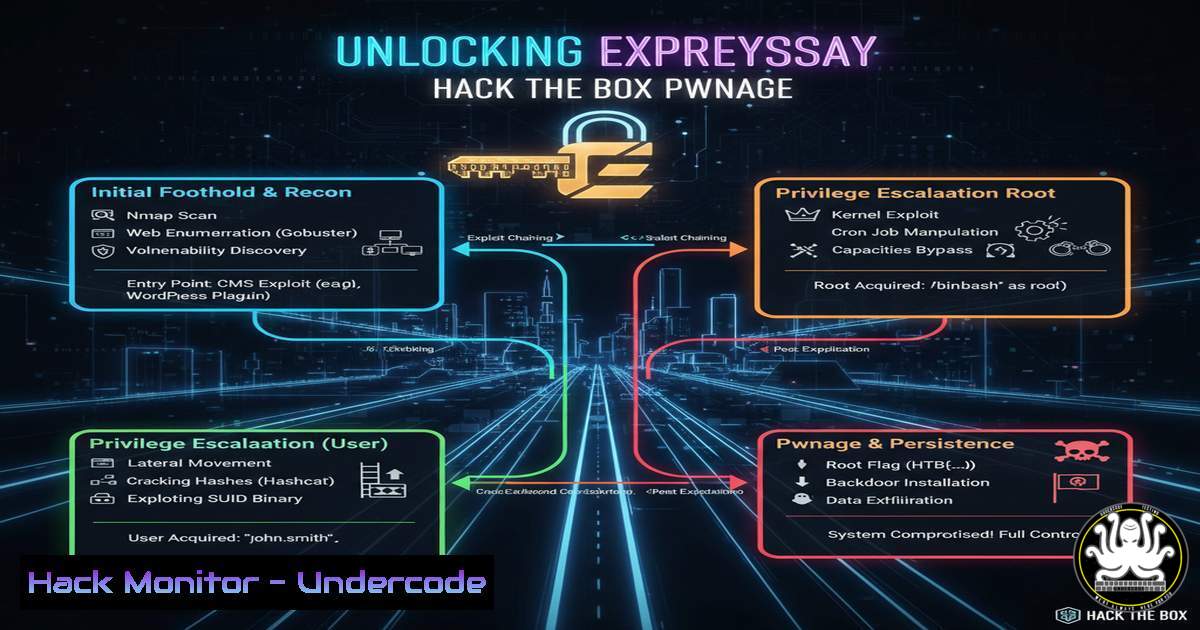
Introduction:
Conquering a Hack The Box machine like Expressway requires a meticulous offensive security methodology, blending reconnaissance, vulnerability assessment, exploitation, and post-exploitation. This article deconstructs the techniques essential for compromising such a Linux-based target, providing a practical roadmap from initial foothold to ultimate root access.
Learning Objectives:
- Master advanced network reconnaissance and service enumeration techniques.
- Understand and exploit common web application and service misconfigurations.
- Execute privilege escalation paths through binary analysis and kernel exploitation.
You Should Know:
1. Comprehensive Network Reconnaissance
The first step in any penetration test is to map the target’s attack surface. This involves identifying open ports and the services running on them.
`nmap -sC -sV -p- 10.10.11.229`
`-sC`: Runs default scripts.
-sV: Probes open ports to determine service/version info.
`-p-`: Scans all 65,535 ports.
Step-by-step guide:
1. Open your terminal.
- Run the command, substituting the IP with your target’s IP.
- Analyze the output. For Expressway, you would typically find ports 22 (SSH) and 80 (HTTP) open, with port 80 potentially revealing a web server version that is a key entry point.
2. Web Directory and File Bruteforcing
Often, the main webpage is not the only accessible content. Hidden directories and files can contain sensitive information, backup files, or administrative interfaces.
`gobuster dir -u http://10.10.11.229 -w /usr/share/wordlists/dirb/common.txt -x php,html,txt,bak`
`dir`: Specifies directory/file busting mode.
`-u`: The target URL.
`-w`: The wordlist path.
`-x`: File extensions to check for.
Step-by-step guide:
- Ensure Gobuster is installed (
sudo apt install gobuster). - Execute the command with the correct target IP.
- Review the results for interesting entries like
/admin,/backup,/config.php.bak, or/upload.
3. Subdomain Enumeration
Virtual hosts or subdomains can host separate, less-secure applications that serve as a pivot point to the main network.
`gobuster vhost -u http://expressway.htb -w /usr/share/wordlists/SecLists/Discovery/DNS/subdomains-top1million-5000.txt`
`vhost`: Virtual host enumeration mode.
Step-by-step guide:
- Add the domain (e.g.,
expressway.htb) to your `/etc/hosts` file pointing to the target IP.
2. Run the Gobuster vhost command.
- Add any discovered subdomains (e.g.,
api.expressway.htb) back to your `/etc/hosts` file for further investigation.
4. API Endpoint Fuzzing and Testing
Modern applications rely heavily on APIs, which can be vulnerable to insecure direct object references (IDOR), broken authentication, or SQL injection.
ffuf -w /usr/share/wordlists/api/endpoints.txt -u http://api.expressway.htb/FUZZ`-w
<h2 style="color: yellow;">: Wordlist path.</h2>-u`: Target URL with `FUZZ` keyword where permutations are inserted.
Step-by-step guide:
1. Install FFuf (`go install github.com/ffuf/ffuf@latest`).
- Use a specialized API wordlist to fuzz for endpoints like
/users,/admin,/config. - Test discovered endpoints with tools like `curl` or Postman. A common find is an endpoint like `/api/v1/users/
` which might be vulnerable to IDOR, allowing you to view other users’ data.
5. Exploiting SUID Binaries for Privilege Escalation
SUID (Set owner User ID) binaries execute with the permissions of the file owner. If a vulnerable SUID binary is found, it can be exploited to gain higher privileges.
`find / -perm -u=s -type f 2>/dev/null`
-perm -u=s: Finds files with the SUID bit set.
`-type f`: Searches for files.
`2>/dev/null`: Suppresses permission denied errors.
Step-by-step guide:
- After gaining a low-privilege shell, run the `find` command to list all SUID binaries.
- Compare the list against known exploitable binaries on resources like GTFOBins.
- If a custom SUID binary is found, transfer it to your machine for analysis with
ltrace,strace, or a debugger like `gdb` to identify a vulnerability like a buffer overflow.
6. Kernel Exploit for Root Access
If the kernel is outdated and a public exploit exists, this can be a direct path to root. This should be a last resort in a professional assessment as it can crash the system.
`uname -a`
`searchsploit “Linux Kernel 5.15″`
`uname -a`: Displays system and kernel information.
`searchsploit`: Searches the Exploit-DB database locally.
Step-by-step guide:
- Run `uname -a` to determine the kernel version.
- Use `searchsploit` to find a matching local privilege escalation exploit.
- If found, research the exploit code, compile it on the target (if a compiler is available), and run it to gain root access. Always understand the exploit’s risks before execution.
7. Persistence via SSH Key Injection
After achieving root, establishing persistence is crucial for maintaining access without re-exploiting the system.
`echo “ssh-rsa AAAAB3NzaC1yc2E… your_public_key” >> /root/.ssh/authorized_keys`
`chmod 600 /root/.ssh/authorized_keys`
`chown root:root /root/.ssh/authorized_keys`
Step-by-step guide:
- On your attacker machine, generate an SSH keypair if you haven’t:
ssh-keygen -t rsa. - Copy the contents of your public key file (
id_rsa.pub). - On the compromised target, as the root user, create the `/root/.ssh` directory if it doesn’t exist (
mkdir -p /root/.ssh). - Append your public key to the `authorized_keys` file using the `echo` command above.
- Set the correct permissions to ensure the SSH daemon accepts the key. You can now SSH directly as root:
ssh [email protected].
What Undercode Say:
- The path to root is often non-linear, requiring a blend of automated tools and deep manual analysis. Misconfigurations in lesser-used subdomains or API endpoints are the new primary attack vector, overshadowing vulnerabilities in the main application.
- Modern CTF machines like Expressway simulate real-world environments where defense in depth is common. Success hinges on chaining multiple, seemingly minor findings—a forgotten backup file, a weakly implemented API, and a poorly coded SUID binary—into a full compromise. The lesson is clear: comprehensive coverage in both reconnaissance and exploitation phases is non-negotiable. Over-reliance on automated scanners will miss the subtle logic flaws and misconfigurations that manual testing uncovers.
Prediction:
The techniques demonstrated in machines like Expressway foreshadow a continued shift in the offensive security landscape. Attackers will increasingly target the API economy and cloud-native infrastructure, moving beyond traditional web applications. Defenders must expand their scope to include rigorous testing of all external-facing services, enforce the principle of least privilege on every component, and implement robust logging and monitoring to detect the chained, multi-stage attacks that define modern breaches. The era of the single-point vulnerability is over; the future belongs to resilient architectures designed to contain breaches and sophisticated threat hunters capable of connecting disparate security events.
🎯Let’s Practice For Free:
IT/Security Reporter URL:
Reported By: Nishchaygaba Owned – Hackers Feeds
Extra Hub: Undercode MoN
Basic Verification: Pass ✅


