Listen to this Post
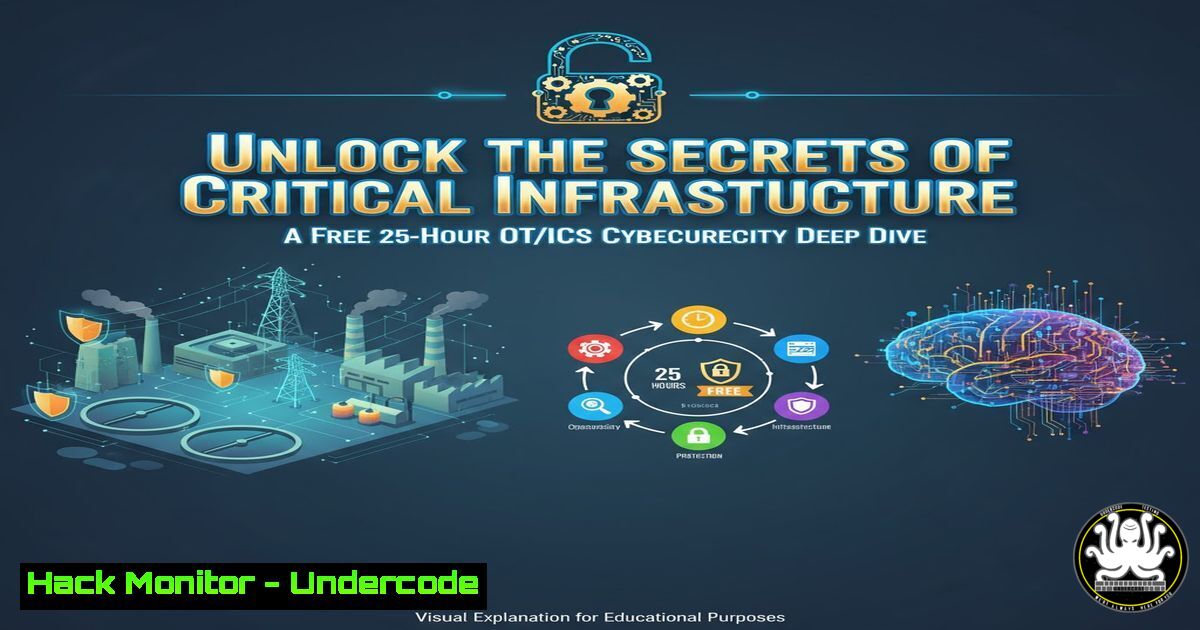
Introduction:
Operational Technology (OT) and Industrial Control Systems (ICS) form the backbone of our critical infrastructure, from power grids and water treatment facilities to manufacturing plants. As these once-isolated systems become increasingly interconnected with IT networks, they present a vast and vulnerable attack surface. This article provides a technical roadmap for securing these vital environments, drawing from a comprehensive free course that has already empowered over 95,000 learners.
Learning Objectives:
- Differentiate between IT and OT/ICS security principles and apply appropriate security controls.
- Master the core concepts of OT/ICS network architecture, protocols, and asset management.
- Develop practical skills for OT/ICS threat detection, vulnerability management, and penetration testing.
You Should Know:
1. Foundational Network Segmentation for ICS/OT
A primary method for protecting OT environments is segmenting them from the corporate IT network. This is often achieved with a next-generation firewall.
Command / Configuration Snippet:
 Example iptables rule on a Linux-based jump host to restrict access to an OT network segment.
 Only allow SSH from a specific management subnet (e.g., 10.1.1.0/24) to the OT network (192.168.1.0/24).
sudo iptables -A FORWARD -s 10.1.1.0/24 -d 192.168.1.0/24 -p tcp --dport 22 -j ACCEPT
sudo iptables -A FORWARD -s 0.0.0.0/0 -d 192.168.1.0/24 -j DROP

For a more robust solution, use a firewall with deep packet inspection (DPI) for industrial protocols.
 Example: Configuring a zone-based policy on a Cisco ASA.
access-list OT-TO-IT extended deny ip 192.168.1.0 255.255.255.0 10.2.2.0 255.255.255.0
access-list OT-TO-IT extended permit ip any any
Step-by-step guide:
This setup creates a hardened network choke point. The first command allows only secure shell (SSH) connections from a trusted IT management subnet to the OT network. The second command is a default-deny rule, blocking all other traffic originating from outside the OT network. On an enterprise firewall like a Cisco ASA, you would create explicit access control lists (ACLs) to deny all traffic from the OT zone to the IT zone by default, only permitting specific, necessary communications.
2. Passive Asset Discovery with ARP-Scan
You cannot secure what you do not know exists. Passive and non-intrusive asset discovery is the first step in building an OT asset register.
Command / Configuration Snippet:
 Using arp-scan to passively discover devices on the local network segment.
sudo arp-scan --interface=eth0 --localnet

Using nmap for a non-intrusive TCP SYN scan on common OT ports (e.g., Modbus, BACnet).
nmap -sS -T2 -p 502,47808,20000 --open 192.168.1.0/24
Step-by-step guide:
The `arp-scan` command sends ARP packets to the local network and displays the responses, effectively listing all active IP addresses and their MAC addresses. This is less intrusive than a port scan. The `nmap` command performs a slow (-T2), stealth SYN scan (-sS) on key OT protocol ports—502 for Modbus, 47808 for BACnet, and 20000 for DNP3. The `–open` switch filters the output to show only responsive services, helping to build an initial inventory.
3. Industrial Protocol Analysis with Wireshark
Understanding industrial protocols is crucial for monitoring and detecting anomalies.
Command / Configuration Snippet:
 Wireshark display filter for Modbus/TCP traffic.
tcp.port == 502

Wireshark display filter for BACnet/IP traffic.
bacnet

To capture only Modbus traffic to a file for later analysis.
tcpdump -i eth0 -w modbus_capture.pcap port 502
Step-by-step guide:
After capturing network traffic, apply the filter `tcp.port == 502` in Wireshark to isolate all Modbus/TCP communications. You can then inspect the packets to understand typical operations (e.g., Read Holding Registers, Write Multiple Coils). Analyzing this traffic helps establish a baseline of normal behavior, making it easier to spot malicious commands or unusual read/write requests from unauthorized systems.
4. OSINT for Industrial Controls
Open-Source Intelligence (OSINT) can reveal exposed ICS/OT assets on the public internet.
Command / Configuration Snippet:
 Using Shodan CLI to find publicly accessible PLCs running Modbus.
shodan search --fields ip_str,port,org,hostnames port:502 country:US

Using a Python script with the Shodan API.
import shodan
API_KEY = 'YOUR_API_KEY'
api = shodan.Shodan(API_KEY)
try:
results = api.search('port:502 "PLC"')
for result in results['matches']:
print(f"IP: {result['ip_str']} - Org: {result.get('org', 'n/a')}")
except shodan.APIError as e:
print(f"Error: {e}")
Step-by-step guide:
First, obtain a free API key from Shodan.io. The CLI command `shodan search` queries the Shodan database for devices in the US with port 502 open. The Python script automates this process, searching for devices with port 502 open that also contain “PLC” in their banner. This technique is used by both security professionals and attackers to identify poorly secured industrial assets.
5. Windows ICS Server Hardening
Many HMIs and engineering workstations in OT environments run Windows and require specific hardening.
Command / Configuration Snippet:
 PowerShell command to disable unnecessary services like Windows Script Host on a critical server.
Get-Service -Name "script" | Stop-Service -PassThru | Set-Service -StartupType Disabled

Using the National Checklist Program (NCP) to apply a STIG baseline.
PowerShell.exe -ExecutionPolicy RemoteSigned -File .\Windows-10-STMIG-1.0.ps1 -AnswerFile .\answerfile.xml

Disable SMBv1, a legacy and insecure protocol.
Disable-WindowsOptionalFeature -Online -FeatureName SMB1Protocol
Step-by-step guide:
On a Windows-based HMI, open PowerShell as Administrator. The `Get-Service` command finds and disables any services related to scripting, which are common attack vectors. Applying a Security Technical Implementation Guide (STIG) script automates the hardening process according to government standards. Disabling SMBv1 protects against worms like WannaCry that could cripple an OT environment.
6. Linux-Based ICS Data Diode Implementation
For ultra-high-security segments, a data diode allows data out but blocks all commands in.
Command / Configuration Snippet:
 Configuring a Linux host as a rudimentary data diode using iptables.
 This allows outbound traffic on a specific port (e.g., 9092 for data forwarding) but blocks all inbound traffic.
echo 1 > /proc/sys/net/ipv4/ip_forward
iptables -A FORWARD -i eth1 -o eth0 -p tcp --dport 9092 -j ACCEPT
iptables -A FORWARD -i eth0 -o eth1 -j DROP
iptables -P FORWARD DROP
Step-by-step guide:
This configuration assumes a Linux box with two network interfaces: `eth1` (connected to the secure OT network) and `eth0` (connected to a less secure network). The first rule permits traffic originating from the OT network to egress on port 9092. The subsequent rules drop any attempt to forward traffic coming from the less secure network back into the OT network, creating a one-way communication channel.
7. Vulnerability Scanning with Nmap NSE
Specialized scripts can identify common vulnerabilities in OT devices without using full-blown, potentially disruptive scanners.
Command / Configuration Snippet:
 Using Nmap's NSE scripts to check for known vulnerabilities in OT devices.
nmap -sV -p 502 --script modbus-discover,modbus-detected-errors 192.168.1.50

Scanning a Windows-based HMI for the EternalBlue vulnerability.
nmap --script smb-vuln-ms17-010 -p 445 192.168.1.100
Step-by-step guide:
The first command performs a service version detection scan (-sV) on port 502 of a target PLC and runs two scripts: `modbus-discover` to enumerate the device and `modbus-detected-errors` to check for protocol-level issues. The second command specifically checks a Windows HMI for the critical MS17-010 (EternalBlue) vulnerability. Always conduct such scans during approved maintenance windows to avoid impacting operational processes.
What Undercode Say:
- The Skills Gap is Real, But Bridgeable. The overwhelming demand for Mike Holcomb’s free course underscores a critical shortage of OT/ICS security expertise. Organizations cannot secure what they do not understand, and this knowledge gap is a primary risk to critical infrastructure.
- Hands-On Command Proficiency is Non-Negotiable. Theoretical knowledge of OT security is insufficient. The ability to execute and understand commands for segmentation, asset discovery, and protocol analysis is what separates effective defenders from the rest. The 25-hour course’s value lies in translating principles into actionable command-line skills.
The analysis reveals a paradigm shift in critical infrastructure defense. The convergence of IT and OT networks is no longer a future concept but a present-day reality, dissolving the “air gap” that traditionally provided security. This free training course acts as a massive force multiplier, democratizing access to specialized knowledge that was once confined to a small group of industry experts. The student testimonials, including “I got the job because of your course!”, are not just endorsements; they are evidence of a rapidly professionalizing front line of defense. The technical commands and methodologies outlined are the building blocks for creating a resilient security posture, moving from passive vulnerability to active, informed defense.
Prediction:
The widespread availability of high-quality, free OT/ICS training will lead to a dual-edged sword in the cybersecurity landscape. On one hand, it will empower a new generation of defenders, helping to harden critical infrastructure against opportunistic and targeted attacks. On the other hand, it will lower the barrier to entry for threat actors, enabling them to acquire the same specialized knowledge of proprietary protocols and fragile industrial systems. We predict a significant rise in sophisticated ransomware attacks targeting OT environments within the next 2-3 years, directly fueled by the weaponization of publicly available training materials. This will force a rapid evolution from simple network segmentation to the pervasive use of deception technology, runtime application control, and AI-driven anomaly detection on the factory floor.
🎯Let’s Practice For Free:
IT/Security Reporter URL:
Reported By: Mikeholcomb A – Hackers Feeds
Extra Hub: Undercode MoN
Basic Verification: Pass ✅


