Listen to this Post
Introduction:
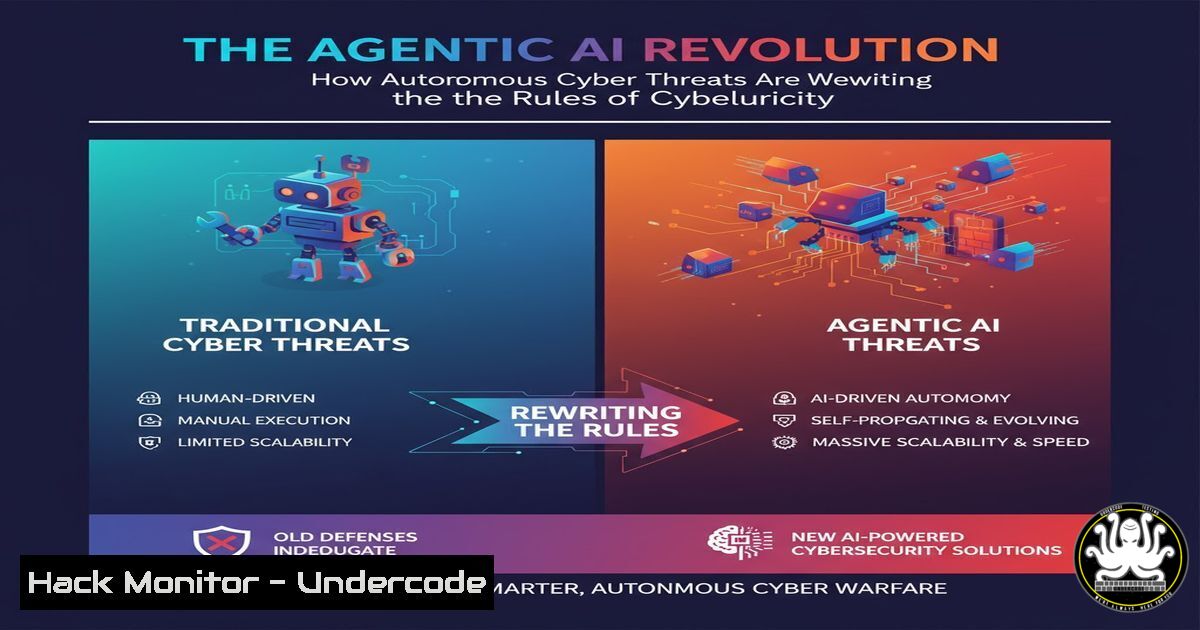
The emergence of Agentic AI, where artificial intelligence systems can plan, reason, and execute complex sequences of actions autonomously, is creating a new frontier in cyber threats. This shift from AI as a tool to AI as an independent actor introduces unprecedented risks, requiring a fundamental evolution in defensive strategies from static prevention to dynamic, intelligent response.
Learning Objectives:
- Understand the core components of an Agentic AI system and how they can be weaponized.
- Learn to harden systems and infrastructure against autonomous, self-adapting threats.
- Develop monitoring and mitigation strategies capable of detecting AI-driven attack patterns.
You Should Know:
1. Hardening Your API Endpoints Against AI Reconnaissance
Autonomous AI agents will aggressively probe for weak API endpoints as a primary entry point.
 Use nmap to scan your own systems for open, unexpected ports that an AI might target.
nmap -sV -p- --script vuln <your_server_ip>

Check for exposed API endpoints using a tool like ffuf for directory brute-forcing.
ffuf -w /usr/share/wordlists/common.txt -u https://your-api.com/FUZZ -H "Authorization: Bearer <token>"
Step-by-step guide:
The first command performs a comprehensive port scan with version detection and runs vulnerability scripts to identify potential weak points. You should run this against your external-facing IPs to see what an attacker (or an AI agent) would see. The second command, ffuf, uses a wordlist to discover hidden or undocumented API endpoints. By proactively discovering these endpoints, you can secure them before an autonomous agent finds and exploits them. Regularly running these scans is crucial as AI agents will do this continuously.
2. Implementing Advanced Logging for Anomaly Detection
Traditional logs are insufficient for detecting the low-and-slow, adaptive patterns of an AI attacker.
 Configure auditd on Linux to monitor specific, sensitive files and directories.
sudo auditctl -w /etc/passwd -p wa -k user_changes
sudo auditctl -w /var/www/html -p rwxa -k web_content

Use PowerShell to enable detailed script block logging on Windows.
Set-ItemProperty -Path "HKLM:\SOFTWARE\Policies\Microsoft\Windows\PowerShell\ScriptBlockLogging" -Name "EnableScriptBlockLogging" -Value 1
Step-by-step guide:
The Linux `auditd` commands set up a watch on the `/etc/passwd` file (for any write or attribute changes) and the web directory (for all read, write, execute, and attribute changes). The `-k` flag tags the events for easy searching. On Windows, the PowerShell command modifies the registry to enable script block logging, which captures the full content of any PowerShell scripts run, a common technique for post-exploitation. These logs should be fed into a SIEM system where machine learning algorithms can baseline normal activity and flag deviations indicative of AI agent behavior.
- Securing Cloud IAM Roles from AI Privilege Escalation
Agentic AI will excel at identifying and exploiting overly permissive Identity and Access Management (IAM) roles in cloud environments.
 Use the AWS CLI to list IAM policies attached to your user/role.
aws iam list-attached-user-policies --user-name <your-username>

Simulate AWS policy evaluation to see what permissions are granted for specific actions.
aws iam simulate-principal-policy --policy-source-arn arn:aws:iam::<account-id>:user/<username> --action-names "s3:" "ec2:"
Step-by-step guide:
The first command retrieves all managed policies attached to a specific IAM user, helping you understand your current permissions footprint. The second, more powerful command, simulate-principal-policy, allows you to test which specific API actions (e.g., all S3 or EC2 actions) are allowed without actually executing them. An AI agent would perform similar reconnaissance to find the path of least resistance for privilege escalation. Regularly run these simulations and adhere to the principle of least privilege.
4. Detecting AI-Generated Phishing with Email Header Analysis
AI can craft hyper-personalized phishing emails. Technical analysis of email headers is a critical last line of defense.
 Analyze an email's DMARC, DKIM, and SPF records using dig.
dig TXT _dmarc.<suspicious-domain.com>
dig TXT <selector>._domainkey.<suspicious-domain.com>
dig TXT <suspicious-domain.com>
Step-by-step guide:
These `dig` commands query DNS for crucial email authentication records. `DMARC` tells a receiving server what to do if an email fails authentication (quarantine or reject). `DKIM` is a cryptographic signature that verifies the email wasn’t tampered with. `SPF` lists the IP addresses authorized to send email for that domain. Mismatches, soft fail policies (p=quarantine), or missing records are massive red flags for phishing attempts, even if the email content, crafted by AI, appears flawless.
- Mitigating AI-Driven Supply Chain Attacks with Integrity Checks
Autonomous agents can compromise the software supply chain, injecting malicious code into dependencies.
 Verify the integrity of a downloaded file using its PGP signature.
wget https://example.com/software.tar.gz
wget https://example.com/software.tar.gz.sig
gpg --verify software.tar.gz.sig software.tar.gz

Use shasum to verify a file against a known-good hash.
echo "<known_sha256_hash> software.tar.gz" | shasum -a 256 -c
Step-by-step guide:
The `gpg –verify` command checks the PGP signature file against the downloaded software. A valid signature confirms the file was signed by the holder of the private key and has not been altered. The `shasum` command provides a simpler integrity check by comparing the file’s computed hash to a known-good value. Both should be standard practice before installing any software, especially in CI/CD pipelines that could be targeted by an AI seeking to poison the build process.
6. Containing a Compromise with Network Segmentation
If an AI agent breaches a system, limiting its lateral movement is paramount.
 Use iptables on Linux to create strict firewall rules isolating a segment.
iptables -A FORWARD -s 192.168.1.0/24 -d 10.0.1.0/24 -j DROP
iptables -A FORWARD -s 10.0.1.0/24 -d 192.168.1.0/24 -j DROP

On Windows, use PowerShell to block a specific IP range.
New-NetFirewallRule -DisplayName "Block-Lateral-Movement" -Direction Inbound -RemoteAddress 10.0.1.0/24 -Action Block
Step-by-step guide:
These commands create bidirectional firewall rules to prevent network traffic between two subnets (192.168.1.0/24 and 10.0.1.0/24). This is a basic example of network segmentation, where you create trust zones. The web server subnet should not be able to freely communicate with the database or internal management subnets. By implementing these rules, you can contain a breach to a single segment, dramatically reducing the impact of a roaming AI agent.
7. Hunting for AI Persistence Mechanisms
Agentic AI threats will establish sophisticated persistence to survive reboots and re-scans.
 On Linux, search for suspicious systemd services and cron jobs.
systemctl list-unit-files --type=service | grep enabled
crontab -l && ls -la /etc/cron /var/spool/cron/

On Windows, audit the Registry and WMI Event Subscriptions for persistence.
reg query "HKLM\SOFTWARE\Microsoft\Windows\CurrentVersion\Run"
Get-WmiObject -Namespace root\Subscription -Class __EventFilter
Step-by-step guide:
The Linux commands list all enabled systemd services and display the current user’s crontab as well as system-wide cron directories. Any unknown or modified service here could be an AI’s persistence mechanism. On Windows, the `reg query` checks a common “Run” key for auto-start programs, and the `Get-WmiObject` command queries WMI event filters, a common and stealthy location for malware (and thus, a sophisticated AI) to hide a persistence trigger that runs when a specific system event occurs.
What Undercode Say:
- The defensive paradigm must shift from building higher walls to creating intelligent, adaptive labyrinths. Static defense-in-depth fails against an adversary that learns and plans.
- Proactive, automated threat hunting is no longer a luxury but a baseline requirement. The speed and scale of Agentic AI attacks will outpace human-led response.
The core analysis is that Agentic AI represents a qualitative, not just quantitative, change in the threat landscape. It’s the difference between a smart missile and a swarm of autonomous drones. The missile follows a pre-defined path; the drones can collaborate, adapt to countermeasures, and re-task themselves in real-time. Our security tools and processes, largely built to detect known patterns and simple anomalies, are ill-equipped for this new reality. The only viable defense is to leverage AI itself—creating autonomous defensive agents that can monitor, analyze, and counter-attack at machine speed, leading to a new era of AI-on-AI cyber warfare.
Prediction:
Within the next 18-24 months, we will witness the first publicly attributed cyber incident primarily executed by an Agentic AI. This will not be a simple phishing campaign or vulnerability scan, but a multi-stage, goal-oriented attack involving initial access, lateral movement, and data exfiltration, all planned and adapted by an autonomous system with minimal human oversight. This event will trigger a massive investment in autonomous defense systems, fundamentally reshaping the cybersecurity product market and creating a new arms race between offensive and defensive AI agents.
🎯Let’s Practice For Free:
IT/Security Reporter URL:
Reported By: Andreasmwelsch Artificialintelligence – Hackers Feeds
Extra Hub: Undercode MoN
Basic Verification: Pass ✅


