
Listen to this Post
Introduction:
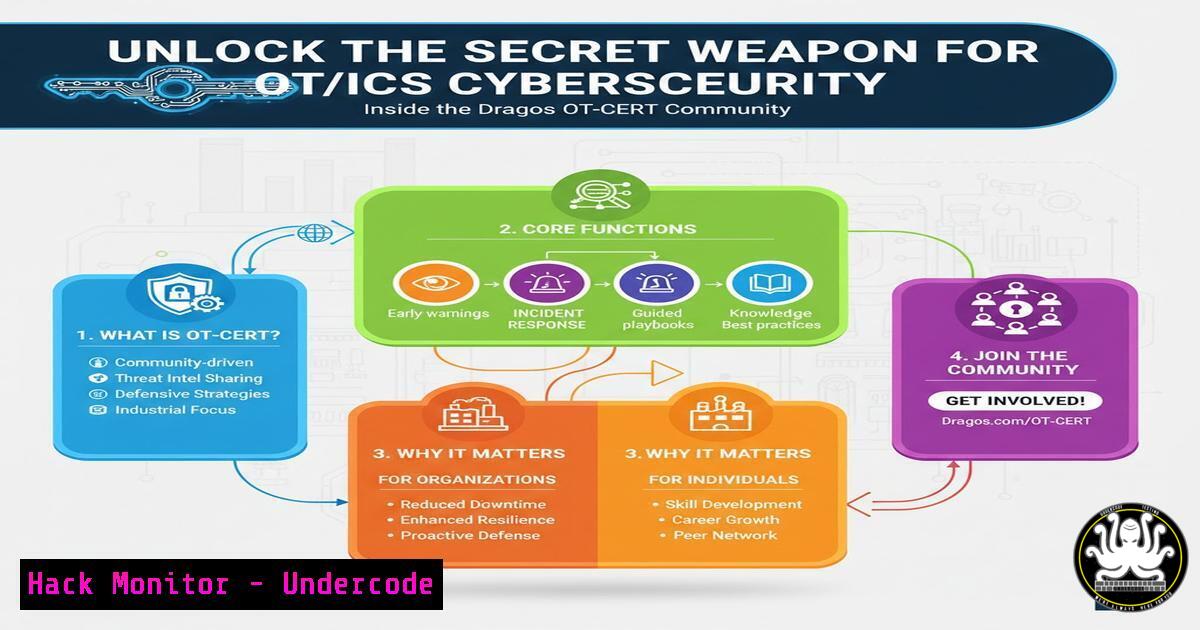
The escalating threat landscape for Operational Technology (OT) and Industrial Control Systems (ICS) demands community-driven defense strategies. The OT-CERT (Operational Technology – Computer Emergency Response Team) community, founded by Dragos, Inc., emerges as a pivotal, open resource for asset owners and operators. This initiative provides a collaborative platform to build, enhance, and sustain robust OT/ICS cybersecurity programs, offering everything from victim notifications to hands-on working sessions.
Learning Objectives:
- Understand the purpose and core benefits of the Dragos OT-CERT community.
- Learn how to leverage free resources and programs to build or improve an OT/ICS security posture.
- Gain practical, step-by-step guidance on foundational OT cybersecurity tasks like asset discovery and network segmentation.
You Should Know:
- Joining the OT-CERT Community and Accessing Core Resources
The OT-CERT community is designed to democratize access to critical OT/ICS threat intelligence and defensive best practices. It is open to organizations of all sizes, making it an invaluable starting point for those with limited security budgets or expertise.
Step‑by‑step guide explaining what this does and how to use it.
Step 1: Navigate to the OT-CERT Portal. Visit the primary link shared in the post: `https://lnkd.in/egbcFbjG`. This will direct you to the Dragos OT-CERT information page.
Step 2: Register and Participate. Follow the registration process to join the community. This typically involves verifying your association with an asset owner or operator organization.
Step 3: Engage with the Offerings. Once inside, actively participate in:
Working Sessions: Collaborate with peers on specific security challenges.
Review Victim Notifications: Analyze anonymized reports of attacks to understand current TTPs (Tactics, Techniques, and Procedures).
Download Free Resources: Access white papers, playbooks, and configuration guides.
2. Enrolling in the Community Defense Program for SMBs
For smaller utility companies in the U.S. and Canada, Dragos offers a specialized program providing free licenses for their security platform. This is a direct force-multiplier for organizations with less than $100M in annual revenue.
Step‑by‑step guide explaining what this does and how to use it.
Step 1: Verify Eligibility. Ensure your utility company fits the geographic and revenue criteria.
Step 2: Apply via the Designated Portal. Use the provided link: `https://lnkd.in/ehiEu9de` to access the application for the Community Defense Program.
Step 3: Deploy and Configure. If accepted, you will receive platform access. Begin by deploying collectors to gain visibility into your industrial network.
3. Mastering Foundational Asset Discovery with Free Tools
Before you can defend a network, you must know what is on it. Asset discovery is the first and most critical step in the NIST CSF (Identify function).
Step‑by‑step guide explaining what this does and how to use it.
Step 1: Choose a Passive Monitoring Tool. Use a tool like `tcpdump` on a Linux-based sensor connected to a SPAN/mirror port on your OT network switch.
Linux Command: `sudo tcpdump -i eth0 -w ot_network_capture.pcap`
What it does: This command captures all network traffic on interface `eth0` and writes it to a file for analysis without disrupting operations.
Step 2: Analyze the Capture for OT Protocols. Use a tool like Wireshark or a specialized OT asset discovery tool to analyze the `.pcap` file. Look for protocols like MODBUS/TCP, DNP3, S7comm, and CIP.
Step 3: Build an Asset Inventory. Document every discovered device, including its IP/MAC address, observed protocol, and likely function (e.g., “PLC controlling pump station”).
4. Implementing Basic Network Segmentation
A flat OT network is a high-risk OT network. Segmentation is the primary mitigation to prevent the lateral movement of threats from IT to critical ICS assets.
Step‑by‑step guide explaining what this does and how to use it.
Step 1: Map Communication Flows. Using your asset inventory, document which devices need to talk to each other and which external systems (e.g., Historians) they communicate with.
Step 2: Configure a Firewall Rule. Deploy an industrial firewall (or use ACLs on a managed switch) between the IT and OT zones.
Example Rule (Conceptual): `ALLOW source: 10.0.1.10 (Engineering Workstation) destination: 10.0.2.5 (PLC) port: 502 (MODBUS)`
Implicit Deny: `DENY ANY ANY`
Step 3: Test and Validate. After applying the rule, rigorously test that necessary operational communications still function while unauthorized paths are blocked.
5. Leveraging Free Training and Intelligence Resources
Continuous learning is non-negotiable. The post highlights free video resources and a newsletter that provide ongoing education on OT/ICS threats and defenses.
Step‑by‑step guide explaining what this does and how to use it.
Step 1: Subscribe to the Newsletter. Sign up at https://lnkd.in/ePTx-Rfw` to receive curated insights directly in your inbox.https://lnkd.in/eif9fkVg`. Create a personal upskilling plan, dedicating time each week to watch videos on specific topics like “Understanding ICS Malware” or “Incident Response in OT.”
Step 2: Consume Free Video Content. Access the video library at
Step 3: Apply Knowledge Practically. After watching a video on a specific threat, review your own environment’s logs and configurations to see if you are vulnerable to the discussed TTP.
6. Integrating Threat Intelligence via API (Future-State)
As highlighted in the post’s comments, API integration is a key area for evolution. Automating the ingestion of threat intelligence feeds (like those from Dragos Worldview) into your SIEM or SOAR platform can dramatically speed up detection and response.
Step‑by‑step guide explaining what this does and how to use it.
Step 1: Identify the API Endpoint. Once available, locate the API documentation for the Dragos Worldview intelligence feed.
Step 2: Use `curl` for Initial Testing. From a secure administrative host, test the API connection and authentication.
Linux Command: `curl -H “Authorization: Bearer
What it does: This command retrieves a list of threat indicators (IPs, hashes, domains) from the Dragos API using your unique key.
Step 3: Develop an Integration Script. Write a Python script or use a SOAR platform’s built-in connector to periodically pull this intelligence and create alerts in your security monitoring system when a match is found internally.
What Undercode Say:
- Community is a Critical Control: The most sophisticated technology is ineffective without knowledge and collaboration. OT-CERT formalizes the sharing of hard-won lessons, making it a defensive control as vital as any firewall.
- Start Where You Are, Use What You Have: For organizations paralyzed by the complexity of OT security, these programs provide a clear, low-cost on-ramp. The barrier to entry has been systematically lowered.
The Dragos OT-CERT initiative represents a strategic shift from proprietary, siloed defense to a collective immunity model. In OT environments, where the cost of failure is physical—from outages to safety incidents—this community-driven approach is not just beneficial; it is essential. It acknowledges that no single company can see all threats, but a coordinated community can build a defense-in-depth strategy that raises costs for adversaries across the board. The focus on free resources and SMB utilities directly addresses the most vulnerable segments of the critical infrastructure landscape.
Prediction:
The community-centric model pioneered by OT-CERT will become the standard for critical infrastructure defense, leading to the rise of automated, real-time threat intelligence sharing consortia. We predict that within 3-5 years, regulatory frameworks will begin to mandate participation in such Information Sharing and Analysis Centers (ISACs) or CERTs for all critical infrastructure operators. Furthermore, the integration of AI-driven analysis into these community feeds will enable predictive threat hunting, identifying vulnerabilities and attack patterns before they are widely exploited, fundamentally changing the OT cybersecurity lifecycle from reactive to proactive.
🎯Let’s Practice For Free:
IT/Security Reporter URL:
Reported By: Https: – Hackers Feeds
Extra Hub: Undercode MoN
Basic Verification: Pass ✅


