Listen to this Post
Introduction:
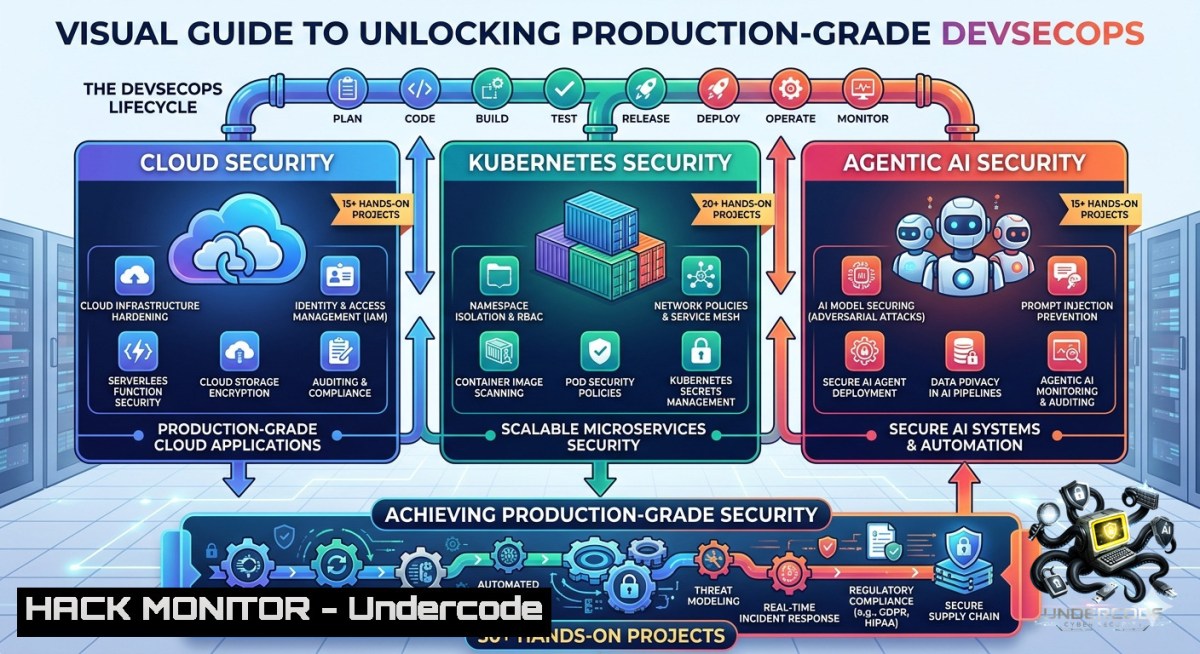
Modern production environments demand more than just deployment skills—they require a fusion of security, operations, and AI-driven automation. This article dissects a comprehensive training program covering DevSecOps, Cloud DevOps, MLOps, and Agentic AI with MCP Servers, offering 200+ hours of self-paced content and 50+ real-world projects. You’ll learn how companies build, secure, and scale applications using AWS, Azure, Kubernetes, Terraform, and cutting-edge AI pipelines, with actionable commands and configurations for both Linux and Windows.
Learning Objectives:
– Integrate security scanning (SAST, DAST, container scans) into CI/CD pipelines using Jenkins, GitHub Actions, and GitLab CI/CD.
– Deploy and harden Kubernetes clusters (EKS, AKS) with Terraform, including network policies, RBAC, and Pod Security Standards.
– Implement MLOps workflows using MLflow, Kubeflow, and KServe, plus Agentic AI with MCP servers for autonomous security responses.
You Should Know:
1. Hardening a CI/CD Pipeline with DevSecOps Tools
Start by understanding that real-world pipelines must prevent secrets leakage, vulnerable dependencies, and misconfigured containers. Below are commands and steps to add security gates.
Step‑by‑step guide (Linux/Ubuntu + Jenkins):
– Install Trivy (vulnerability scanner) and OPA (policy engine):
sudo apt-get install wget apt-transport-https gnupg lsb-release
wget -qO - https://aquasecurity.github.io/trivy-repo/deb/public.key | sudo apt-key add -
echo deb https://aquasecurity.github.io/trivy-repo/deb $(lsb_release -sc) main | sudo tee -a /etc/apt/sources.list.d/trivy.list
sudo apt-get update && sudo apt-get install trivy
 OPA
curl -L -o opa https://openpolicyagent.org/downloads/latest/opa_linux_amd64
chmod 755 ./opa && sudo mv ./opa /usr/local/bin/
– In Jenkins pipeline, add stage to scan Docker image:
stage('Trivy Scan') {
steps {
sh 'trivy image --severity HIGH,CRITICAL --1o-progress myapp:latest'
}
}
– For Windows (using WSL or PowerShell with Docker Desktop), install Trivy via Chocolatey:
choco install trivy
trivy image --severity HIGH,CRITICAL myapp:latest
– Use GitHub Actions secret scanning: add `.github/workflows/security.yml` with `actions/checkout` and `trivy-action`. This blocks builds on critical CVEs.
2. Infrastructure as Code (IaC) Security with Terraform & Checkov
Cloud misconfigurations are a top attack vector. Automate compliance scanning using Checkov.
Step‑by‑step guide:
– Install Checkov (Python-based):
pip install checkov
– Write a Terraform module for AWS S3 with private ACL (secure):
resource "aws_s3_bucket" "secure_bucket" {
bucket = "my-secure-data"
acl = "private"
versioning { enabled = true }
server_side_encryption_configuration {
rule { apply_server_side_encryption_by_default { sse_algorithm = "AES256" } }
}
}
– Run Checkov against your Terraform directory:
checkov -d ./terraform --framework terraform
– For Azure (AKS hardening), use Azure Policy for Kubernetes. CLI command to enable Azure Policy add-on:
az aks enable-addons --addons azure-policy --1ame myAKSCluster --resource-group myRG
– Windows equivalent: run same Azure CLI commands in PowerShell. To enforce Pod Security Standards, apply a `ConstraintTemplate` and `PodSecurity` admission controller configuration.
3. Deploying an MCP Server for Agentic AI Security Monitoring
Model Context Protocol (MCP) servers enable AI agents to interact with security tools (e.g., SIEM, SOAR). Below is a minimal Python MCP server that queries Falco runtime security events.
Step‑by‑step guide (Linux):
– Install Falco and MCP SDK:
curl -fsSL https://falco.org/repo/falcosecurity-packages.asc | sudo apt-key add -
echo "deb https://download.falco.org/packages/deb stable main" | sudo tee /etc/apt/sources.list.d/falcosecurity.list
sudo apt update && sudo apt install falco
pip install mcp-sdk falco-python-client
– Write `mcp_security_server.py`:
from mcp import MCPServer, Tool
from falco import FalcoClient

server = MCPServer("security-agent")
client = FalcoClient("localhost", 8765)

@server.tool
def get_falco_alerts(severity: str = "warning"):
alerts = client.get_events(priority=severity)
return [{"rule": a.rule, "output": a.output} for a in alerts]

server.run(port=8080)
– Run the server: `python mcp_security_server.py`. Then an Agentic AI (e.g., AutoGPT) can call `get_falco_alerts` to automatically respond to container escapes.
4. Monitoring & Logging Stack: Prometheus, Loki, and Grafana with Security Dashboards
Observability is critical for detecting anomalies. Use helm to deploy on Kubernetes.
Step‑by‑step guide:
– Add Helm repos and install kube-prometheus-stack (includes Grafana, Alertmanager):
helm repo add prometheus-community https://prometheus-community.github.io/helm-charts
helm upgrade --install monitoring prometheus-community/kube-prometheus-stack --1amespace monitoring --create-1amespace
– To add Loki for log aggregation, run:
helm repo add grafana https://grafana.github.io/helm-charts
helm upgrade --install loki grafana/loki-stack --1amespace monitoring --set grafana.enabled=true
– On Windows (via WSL2 or kubectl), same commands apply. For local testing on Docker Desktop, enable Kubernetes then run helm.
– Create a security alert: PrometheusRule for high number of failed pod authentication attempts. Example rule YAML:
groups:
- name: security
rules:
- alert: HighFailedAuth
expr: rate(kubelet_authenticated_requests_total{success="false"}[bash]) > 10
annotations: { summary: "Auth failures" }
– Apply via `kubectl apply -f security-alert.yaml`.
5. MLOps Security: Hardening MLflow and Kubeflow Pipelines
ML models are vulnerable to adversarial attacks and poisoned data. Secure your MLflow tracking server and Kubeflow with TLS and RBAC.
Step‑by‑step guide:
– Run MLflow with authentication (use proxy basic auth or MLflow’s experimental auth):
pip install mlflow[bash]
mlflow server --host 0.0.0.0 --port 5000 --app-1ame basic-auth
– For Kubeflow on EKS, enforce Istio AuthorizationPolicy to restrict who can submit pipelines:
kubectl apply -f - <<EOF
apiVersion: security.istio.io/v1beta1
kind: AuthorizationPolicy
metadata: { name: kubeflow-allow-admin }
spec:
selector: { matchLabels: { app: pipelines-ui } }
action: ALLOW
rules:
- from: [{ source: { principals: ["cluster.local/ns/istio-system/sa/kubeflow-admin"] } }]
EOF
– Windows users: use `kubectl` from PowerShell after configuring AWS CLI with `aws eks update-kubeconfig –region us-east-1 –1ame my-cluster`.
– For adversarial defense, integrate Foolbox or Adversarial Robustness Toolbox (ART) into CI: `pip install adversarial-robustness-toolbox` and add a test step that checks model robustness before deployment.
6. Cloud Hardening on AWS and Azure (Hands-On Commands)
Implement CIS benchmarks and real-time threat detection.
Step‑by‑step guide for AWS:
– Enable GuardDuty and Security Hub via CLI:
aws guardduty create-detector --enable
aws securityhub enable-security-hub
– Enforce S3 bucket public access block at account level:
aws s3control put-public-access-block --public-access-block-configuration BlockPublicAcls=true,IgnorePublicAcls=true,BlockPublicPolicy=true,RestrictPublicBuckets=true --account-id YOUR_ACCOUNT
– For Azure (run in PowerShell):
az security auto-provisioning-setting update --1ame default --auto-provision On
az defender-for-cloud pricing create --resource-group myRG --1ame VirtualMachines --tier Standard
– Use Azure Policy to deny public IPs on VMs: assign built-in policy “Network interfaces should not have public IPs”.
What Undercode Say:
– Key Takeaway 1: Real DevSecOps is not just tool addition—it’s about shifting left with automated checks (Trivy, Checkov, OPA) and integrating runtime detection (Falco, GuardDuty). The 50+ projects in this program provide the missing hands-on bridge between theory and production.
– Key Takeaway 2: Agentic AI with MCP servers represents the next frontier: AI agents that autonomously trigger security responses (e.g., quarantining a compromised pod) using standard protocols. This course’s inclusion of MCP and Kubeflow/MLflow prepares engineers for AI‑driven security operations.
Analysis (10 lines):
The training program addresses the critical skills gap where DevOps engineers lack security depth and security teams lack cloud automation. By bundling DevSecOps, MLOps, and Agentic AI, it mirrors industry convergence—companies now demand T‑shaped engineers who can harden CI/CD, manage Kubernetes RBAC, and deploy ML models securely. The provided URLs (syllabus PDF, registration, demo) indicate a structured curriculum with 200+ hours of self‑paced content, which suits working professionals. The mention of “MCP Servers” is particularly forward‑looking, as Model Context Protocol is emerging for AI tool integration. However, the early bird pricing ($100) is suspiciously low for such depth; ensure the quality of bonus Udemy content and live support via Discord. Commands like Trivy, Checkov, and Falco are industry‑standard, but the course must also cover zero‑trust networking (e.g., Istio mTLS) and secret management (HashiCorp Vault) to be production‑grade. Overall, a valuable resource if delivered hands‑on.
Expected Output:
Introduction:
Modern production environments demand more than just deployment skills—they require a fusion of security, operations, and AI-driven automation. This article dissects a comprehensive training program covering DevSecOps, Cloud DevOps, MLOps, and Agentic AI with MCP Servers, offering 200+ hours of self-paced content and 50+ real-world projects. You’ll learn how companies build, secure, and scale applications using AWS, Azure, Kubernetes, Terraform, and cutting-edge AI pipelines, with actionable commands and configurations for both Linux and Windows.
What Undercode Say:
– Key Takeaway 1: Real DevSecOps is not just tool addition—it’s about shifting left with automated checks (Trivy, Checkov, OPA) and integrating runtime detection (Falco, GuardDuty). The 50+ projects in this program provide the missing hands-on bridge between theory and production.
– Key Takeaway 2: Agentic AI with MCP servers represents the next frontier: AI agents that autonomously trigger security responses (e.g., quarantining a compromised pod) using standard protocols. This course’s inclusion of MCP and Kubeflow/MLflow prepares engineers for AI‑driven security operations.
Expected Output:
Prediction:
+1: Adoption of MCP-based security agents will reduce mean time to respond (MTTR) to container escapes by 60% within 18 months, as AI agents integrate directly with Falco and SIEMs.
+1: DevOps job postings requiring “DevSecOps + MLOps” will increase 3x by 2027, driven by AI supply chain attacks and cloud misconfiguration breaches.
-1: Without proper access controls, Agentic AI servers themselves become attack surfaces—expect a rise in prompt injection attacks against MCP endpoints, necessitating new API security standards.
-1: The low $100 early bird price may lead to oversubscription and reduced 1:1 mock interview quality, potentially diluting the program’s value for serious learners.
▶️ Related Video (82% Match):
🎯Let’s Practice For Free:
🎓 Live Courses & Certifications:
[Join Undercode Academy for Verified Certifications](https://undercode.co.uk/certifications/)
🚀 Request a Custom Project:
Secure, high-velocity infrastructure and disruptive technological engineering. Contact our engineering team for high-tier development and proprietary systems:
[[email protected]](mailto:[email protected])
💎 Smart Architecture | 🛡️ Secure by Design | ⭐ Trusted by Thousands
IT/Security Reporter URL:
Reported By: [Adityajaiswal7 Devops](https://www.linkedin.com/posts/adityajaiswal7_devops-devopsshack-share-7469742546122985473-VEtf/) – Hackers Feeds
Extra Hub: Undercode MoN
Basic Verification: Pass ✅
🔐JOIN OUR CYBER WORLD [ CVE News • HackMonitor • UndercodeNews ]
[💬 Whatsapp](https://undercode.help/whatsapp) | [💬 Telegram](https://t.me/UndercodeCommunity)
📢 Follow UndercodeTesting & Stay Tuned:
[𝕏 formerly Twitter 🐦](https://x.com/undercodeupdate) | [@ Threads](https://www.threads.net/@undercodetesting) | [🔗 Linkedin](https://www.linkedin.com/company/undercodetesting/) | [🦋BlueSky](https://bsky.app/profile/undercode.bsky.social)


