
Listen to this Post
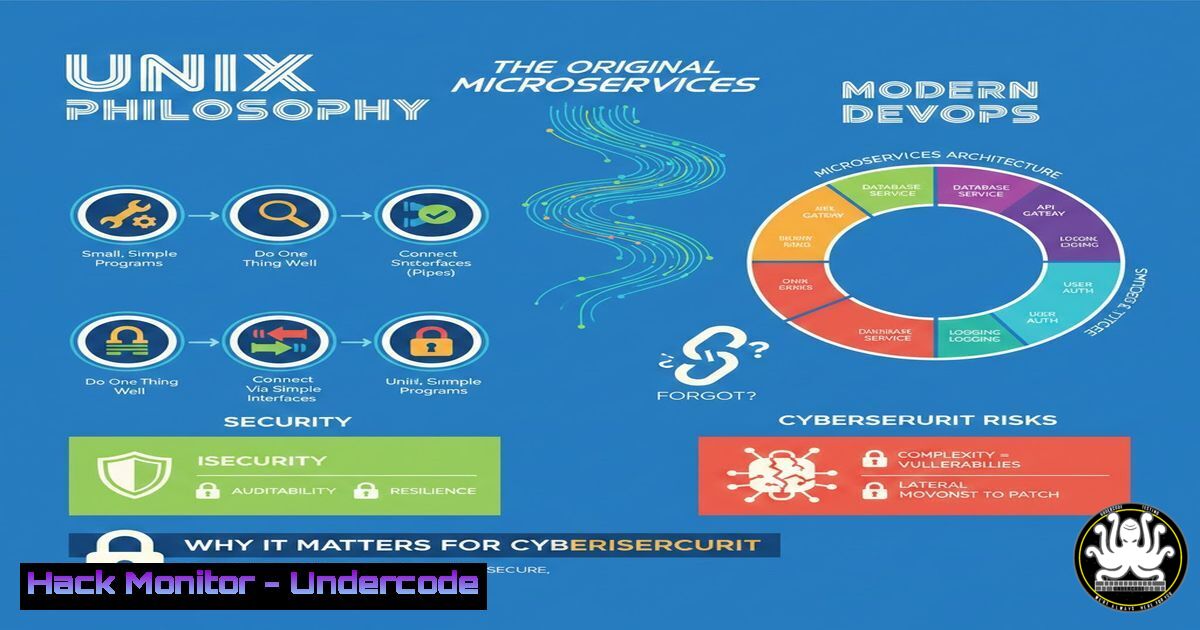
Introduction:
The Unix philosophy of building small, focused tools that communicate via text streams has quietly underpinned system administration for half a century. In an era where microservices, containers, and orchestration frameworks dominate IT discourse, revisiting these foundational principles reveals profound implications for security, efficiency, and resilience. This article explores how classic Unix commands embody the microservices pattern, offers hands-on pipelines for security analysis, and argues that the path to hardening modern infrastructures often lies in rediscovering the simplicity that was always there.
Learning Objectives:
- Understand the core Unix principles and how they map to modern microservices architecture.
- Learn to build efficient data processing pipelines using classic Unix commands for security monitoring and log analysis.
- Analyze the security advantages of minimal, stateless tools versus complex containerized deployments and cloud-native stacks.
You Should Know:
- The Unix Way: Simplicity as a Security Feature
The Unix philosophy, codified by Doug McIlroy, emphasizes writing programs that do one thing well and work together. This is achieved through a universal interface—plain text—and the pipe (|) operator, which connects the standard output of one command to the standard input of another. From a security standpoint, this model minimizes attack surface: each tool is small, auditable, and runs with minimal privileges. There is no network daemon to exploit, no complex API to fuzz, and no persistent state to corrupt.
Step‑by‑step guide:
Consider a typical process management task. To gracefully terminate all Apache processes, you might use:
ps aux | grep apache | awk '{print $2}' | xargs kill -15
– `ps aux` lists all processes.
– `grep apache` filters only those containing “apache”.
– `awk ‘{print $2}’` extracts the second column (the PID).
– `xargs kill -15` sends SIGTERM to each PID.
This pipeline is transparent, auditable, and can be run interactively. Compare this to a Kubernetes `Deployment` with a `preStop` hook—the Unix version has no hidden controllers, no etcd, no YAML, and no additional processes that could be compromised.
2. The Toolbox: Essential Commands for Security Analysts
Mastering a handful of Unix tools equips you to perform complex data analysis without proprietary software. Each tool follows the single-responsibility principle:
– `grep` – pattern matching (e.g., find failed logins)
– `awk` – field extraction and reporting
– `sed` – stream editing (search/replace, deletion)
– sort/uniq – ordering and deduplication
– `cut` – column-based slicing
– `wc` – word/line counting
Step‑by‑step guide:
To identify the top attackers from SSH logs on a Linux system:
grep "Failed password" /var/log/auth.log | awk '{print $9}' | sort | uniq -c | sort -rn | head -10
– `grep` isolates failed password events.
– `awk ‘{print $9}’` extracts the IP address (field 9 in typical auth.log format).
– `sort` groups identical IPs.
– `uniq -c` counts occurrences.
– `sort -rn` sorts numerically in reverse order.
– `head -10` shows the top 10.
This one-liner, running in milliseconds, replaces a full SIEM query for this specific use case.
3. Unix Pipes vs. Microservices: A Side-by-Side Comparison
Modern microservices are often implemented as HTTP-based services communicating over REST or message queues. The Unix pipe is the original message bus—zero configuration, built‑in backpressure, and no network overhead. Consider a log analysis pipeline from the LinkedIn post that inspired this article:
grep 404 access.log | cut -d' ' -f7 | sort | uniq -c | sort -rn | head -20
This processes 10,000 requests, finds the top 20 error paths, and returns results in milliseconds using ~2 MB of memory. An equivalent ELK (Elasticsearch, Logstash, Kibana) stack would require gigabytes of RAM, Java VMs, and multiple network hops—vastly increasing the attack surface. In the Unix model, no services are exposed; all data stays on the local machine, making it inherently more secure against remote exploits.
- Containerization: Jails, Cgroups, and the Illusion of New
Docker popularized containers by wrapping existing kernel features (cgroups, namespaces) with a user-friendly daemon and registry. But FreeBSD jails, introduced in 2000, provided similar isolation with far less overhead. A FreeBSD jail consumes 2‑4 MB of RAM; a typical Docker container with Alpine Linux starts at ~5 MB, but the Docker daemon itself adds significant footprint and runs as root, creating a large attack surface.
Step‑by‑step guide (Linux cgroups without Docker):
Create a control group for CPU and memory limits on a modern Linux system using systemd:
sudo systemd-run --unit=mybundle --scope -p MemoryMax=100M -p CPUQuota=20% /bin/bash
This runs a shell with resource constraints, similar to a container, but without any container runtime. You can then use `chroot` to isolate filesystem access. The security benefit: fewer moving parts, no daemon listening on a socket, and direct use of kernel primitives.
5. Building a Lightweight Security Monitoring Pipeline
You can create a real‑time file integrity monitor using only built‑in Unix tools and `inotifywait` (Linux) or `fswatch` (macOS). This approach avoids heavy agents like Osquery or OSSEC.
Step‑by‑step guide (Linux):
Monitor `/etc` for changes and alert on suspicious modifications:
inotifywait -m /etc -e modify,create,delete -r | while read path action file; do
echo "ALERT: $action on $path$file" | mail -s "File Change Detected" [email protected]
done
– `inotifywait -m` monitors continuously.
– `-e modify,create,delete` specifies events.
– The `while` loop processes each event and sends an email.
For a more targeted approach, pipe to `grep` for specific files (e.g., passwd, shadow). This pipeline is stateless, restartable, and uses negligible resources compared to a full-fledged HIDS.
6. Windows Equivalents: PowerShell and the Unix Influence
Windows administrators can achieve similar pipelines with PowerShell, which adopted many Unix concepts. The following command replicates the log analysis example:
Get-Content access.log | Select-String "404" | ForEach-Object { $_.Split(' ')[bash] } | Sort-Object | Get-Unique -c | Sort-Object -descending | Select-Object -first 20
– `Get-Content` reads the file (like cat).
– `Select-String` filters (like grep).
– `ForEach-Object` processes each line (like awk).
– `Sort-Object` and `Get-Unique` handle ordering and uniqueness.
PowerShell’s object‑based pipeline is more flexible but can be more verbose. From a security perspective, enabling PowerShell logging and using Constrained Language Mode can mitigate the risk of malicious scripts—a form of hardening inspired by the Unix principle of least privilege.
7. Cloud Hardening with Unix Principles
Applying the Unix philosophy to cloud environments means minimizing components, using serverless functions for single tasks, and avoiding sidecar containers unless absolutely necessary. In Kubernetes, you can harden clusters by:
– Using minimal base images (e.g., `alpine:latest` or even `scratch` for static binaries).
– Removing unnecessary containers from pods.
– Avoiding the default `kube-proxy` mode by using `iptables` directly (if feasible).
Step‑by‑step guide:
List all running containers in a cluster and identify resource hogs:
kubectl get pods --all-namespaces -o json | jq '.items[] | {name: .metadata.name, namespace: .metadata.namespace, containers: [.spec.containers[].name]}'
Then review each container’s necessity. The goal is to reduce the number of processes and network services, thereby shrinking the attack surface—just as Unix pipes reduce complexity by composing simple tools rather than deploying new services.
What Undercode Say:
- Key Takeaway 1: The Unix philosophy is not merely a historical curiosity—it is a blueprint for secure, efficient system design that modern architectures often overlook in their pursuit of feature-rich solutions.
- Key Takeaway 2: By mastering classic command-line tools, security professionals can build powerful monitoring and analysis pipelines without the overhead, licensing costs, and expanded attack surface of commercial products.
The industry’s pivot toward distributed systems has created a lucrative market for training and certification, but often at the expense of security and simplicity. Reclaiming the Unix mindset enables defenders to cut through the noise, audit their infrastructure with minimal tools, and focus on fundamentals. As we face increasingly sophisticated threats, the ability to reason about small, composable components becomes a strategic advantage—one that has been quietly waiting in terminals for fifty years.
Prediction:
As cyber threats become more advanced, we will see a resurgence of interest in minimalist, auditable systems inspired by Unix. The next wave of security tools will likely combine the simplicity of pipes with modern automation and machine learning, leading to lightweight, composable frameworks that challenge the dominance of bloated SIEMs and EDRs. Organizations that invest in training their teams on these foundational principles will be better equipped to adapt, while those locked into complex vendor ecosystems may struggle to maintain visibility and control. The future of cybersecurity may well look like the past—just faster and more connected.
▶️ Related Video (80% Match):
🎯Let’s Practice For Free:
IT/Security Reporter URL:
Reported By: Markphillips John – Hackers Feeds
Extra Hub: Undercode MoN
Basic Verification: Pass ✅


