Listen to this Post
Introduction
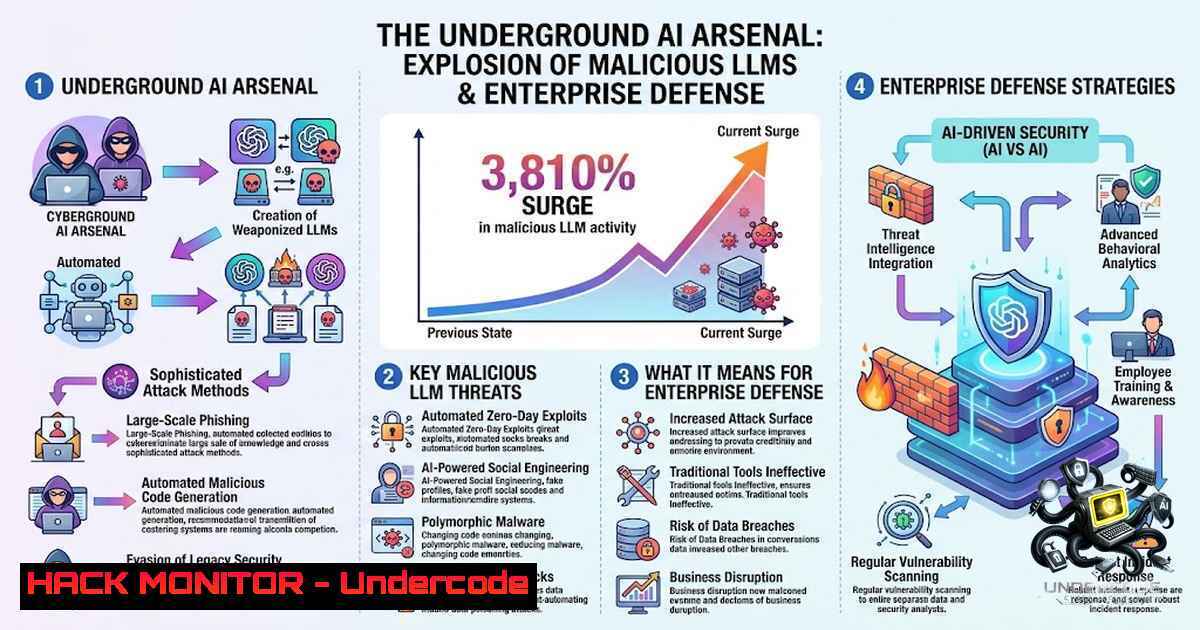
The barrier to entry for cybercrime has collapsed. Researchers from Palo Alto Networks’ Unit 42 and Halcyon have documented an underground marketplace where AI-powered hacking tools—from jailbroken large language models to autonomous attack frameworks—are now sold alongside traditional exploit kits. What was once the domain of sophisticated threat actors is now accessible to anyone with a Telegram subscription and a few dollars. Halcyon’s analysis of 4,000 entries across 77 Telegram channels, 20 dark web forums, and five underground markets revealed AI utility posts surging from just 38 in December 2025 to 1,486 in February 2026—an increase of over 3,810%. This is not hype; it is a market forming in real time.
Learning Objectives
- Understand the four primary categories of AI-powered cybercrime tools currently circulating in underground markets
- Identify specific malicious LLM variants, their capabilities, and their pricing models
- Learn practical detection, defense, and incident response strategies against AI-augmented attacks
- Master forensic techniques to identify AI-generated malicious content and infrastructure
You Should Know
1. The Four-Tier AI Crimeware Ecosystem
Cybercriminals are selling AI tools that split into four distinct categories:
Weaponized LLMs (Dark LLMs): These are AI models stripped of safety guardrails. WormGPT—the market leader—first appeared on Hack Forums in June 2023, built on GPT-J and fine-tuned on malware and phishing material. In 2026, “WormGPT” has become a category rather than a single tool. New variants powered by xAI’s Grok and Mistral’s Mixtral are now in active circulation on BreachForums. The latest version, WormGPT 4, offers lifetime access starting at around $220, with an option to purchase complete source code.
AI-Enabled Identity Fraud: Voice and video deepfake tools enable business email compromise (BEC), KYC bypass, and selfie-check recognition fraud. These tools can now be trained on just three seconds of audio. One tool claims a 92% success rate at bypassing KYC platforms, with such market recognition that criminals are hunting for pirated copies.
AI-Augmented Malware and Infrastructure: Beyond text generation, this category supports live operational use. Examples include AI-powered call centers supporting 25 languages, trained on over 150,000 calls, complete with ambient background noise to reassure victims. BruteForceAI, an LLM-integrated attack execution layer, contributed to a 22% decline in brute force attempts alongside a 25% increase in successful exploitation—attackers are making fewer guesses and landing more hits.
Jailbroken and Stolen AI Services: This comprises the majority of dark web offerings and the cheapest, starting at just 10 cents for a stolen ChatGPT account.
2. Identifying and Analyzing Malicious LLM Wrappers
Most “dark LLMs” are not sophisticated models trained from scratch—they are wrappers around commercial APIs with custom system prompts designed to override safety guardrails. Cato CTRL researcher Vitaly Simonovich demonstrated this by using LLM jailbreaking techniques to bypass restrictions and view the original system prompts, identifying xAI’s Grok and Mistral’s Mixtral as the underlying models.
Linux Command – Analyzing Suspicious AI-Generated Content:
 Extract and analyze metadata from suspicious AI-generated files
exiftool -All suspicious_file.pdf
strings suspicious_file.pdf | grep -i "grok|mistral|openai|claude"

Detect AI-generated text patterns using linguistic analysis
python3 -c "
import re
text = open('suspicious_email.txt').read()
 Common AI-generated text markers
markers = ['As an AI', 'I cannot', 'assist with', 'however,', 'additionally']
for marker in markers:
if marker.lower() in text.lower():
print(f'[!] Potential AI marker detected: {marker}')
"
Windows Command – PowerShell Forensics:
 Scan for AI-generated phishing indicators in email files
Get-ChildItem -Path "C:\Users\Documents.eml" -Recurse | ForEach-Object {
$content = Get-Content $<em>.FullName -Raw
if ($content -match "urgent|invoice|payment|verification") {
Write-Host "[!] Suspicious email pattern: $($</em>.FullName)"
}
}
3. Defending Against AI-Augmented Phishing and BEC
The democratization of AI means attackers can now craft grammatically perfect, contextually relevant phishing lures in seconds. Impersonation campaigns led to more than 85% of cyber insurance losses that Resilience dealt with in the first half of the year, a dramatic increase from two years ago.
Linux – Deploying AI-Phishing Detection:
 Install and configure SpamAssassin with AI-detection rules
sudo apt-get install spamassassin spamc
sudo systemctl enable spamassassin

Add custom rules for AI-generated content detection
echo "body AI_PATTERN /as an ai|i cannot|however, it is important/i" >> /etc/spamassassin/local.cf
echo "score AI_PATTERN 3.0" >> /etc/spamassassin/local.cf
sudo systemctl restart spamassassin

Test email header analysis
spamc -R < suspicious_email.eml | grep -i "X-Spam"
Windows – Email Authentication Hardening:
 Configure SPF, DKIM, and DMARC for your domain
 Check current SPF record
nslookup -type=TXT yourdomain.com

Deploy DKIM signing (Exchange Online example)
Install-Module -1ame ExchangeOnlineManagement -Force
Connect-ExchangeOnline
New-DkimSigningConfig -DomainName yourdomain.com -Enabled $true

Monitor DMARC reports
$dmarcReport = Invoke-RestMethod -Uri "https://reports.dmarc.yourdomain.com/report.xml"
$dmarcReport | Select-Object -ExpandProperty record | Where-Object { $_.row.source_ip -1e "your.ip.range" }
4. Securing AI Infrastructure Against Prompt Injection
Proofpoint researchers have identified tools and services designed to leverage indirect prompt injection (IDPI) within attack chains, with subscription prices starting around USD $150 per month. These tools inject invisible prompts—readable by machines but invisible to users—that can compromise AI systems.
Linux – API Gateway with Prompt Injection Detection:
 Deploy NGINX with ModSecurity for AI API protection
sudo apt-get install nginx libmodsecurity3

Create WAF rules for prompt injection detection
cat > /etc/nginx/modsecurity-rules/prompt-injection.conf << 'EOF'
SecRule ARGS "@rx (ignore previous instructions|system prompt|you are now|jailbreak)" \
"id:100001,phase:2,deny,status:403,msg:'Prompt injection detected'"
SecRule ARGS "@rx (role\s:\ssystem|developer mode|override|uncensored)" \
"id:100002,phase:2,deny,status:403,msg:'System prompt override attempt'"
EOF

Reload NGINX with ModSecurity
sudo nginx -t && sudo systemctl reload nginx
Windows – AI Input Sanitization:
 PowerShell script to sanitize AI prompts for injection attempts
function Test-PromptInjection {
param([bash]$Prompt)
$patterns = @(
"ignore previous instructions",
"system prompt",
"you are now",
"role:\ssystem",
"developer mode",
"override",
"uncensored",
"jailbreak"
)
foreach ($pattern in $patterns) {
if ($Prompt -match $pattern) {
Write-Warning "Potential prompt injection detected: $pattern"
return $true
}
}
return $false
}

Example usage
$userPrompt = Read-Host "Enter AI prompt"
if (Test-PromptInjection -Prompt $userPrompt) {
Write-Host "Blocked: Prompt injection attempt" -ForegroundColor Red
} else {
Write-Host "Prompt accepted" -ForegroundColor Green
}
5. Cloud Hardening Against AI-Assisted Attacks
The Mycelium Framework—the first-ever AI-as-a-Service botnet—is sold on underground forums as a package for breaking into machines and renting out their computing power. Attackers are using AI to identify and exploit cloud misconfigurations at scale.
AWS – Hardening IAM and EC2:
 Install and configure AWS CLI with IAM best practices
aws configure set region us-east-1
aws configure set output json

Enforce MFA for all IAM users
aws iam list-users --query 'Users[].UserName' --output text | while read user; do
mfa=$(aws iam list-mfa-devices --user-1ame $user --query 'MFADevices[].SerialNumber')
if [ -z "$mfa" ]; then
echo "WARNING: User $user has no MFA device"
fi
done

Audit security groups for over-permissive rules
aws ec2 describe-security-groups --query 'SecurityGroups[?length(IpPermissions[?contains(IpRanges[].CidrIp, <code>0.0.0.0/0</code>)]) > <code>0</code>]'
Azure – Entra ID and Conditional Access:
 Install Azure CLI and enforce conditional access policies
az login
az ad user list --query "[].userPrincipalName" -o tsv | ForEach-Object {
$user = $_
$risky = az ad user list-risky-users --filter "userPrincipalName eq '$user'" --query "[].riskLevel"
if ($risky -1e "none") {
Write-Host "[!] Risky user detected: $user - $risky"
az ad user update --id $user --block-signin true
}
}
6. Vulnerability Exploitation and Mitigation
AI tools are now widely used to exploit critical flaws and disrupt supply chains. The financial barrier to entry is “virtually zero” thanks to widely available freemium tools. Telegram bot-driven distribution automates sales, customer service, and order tracking, functioning as “unmanned storefronts”.
Linux – Automated Vulnerability Scanning with AI-Augmented Detection:
 Install and configure OpenVAS with custom AI-detection scripts
sudo apt-get install openvas
sudo gvm-setup

Create custom NVT for AI-generated attack patterns
cat > /var/lib/openvas/plugins/ai_attack_detection.nasl << 'EOF'
 Detection for AI-generated exploit attempts
if (get_kb_item("Services/www") && get_http_port()) {
port = get_http_port();
url = "/";
req = http_get(item:url, port:port);
res = http_send_recv(port:port, data:req);
if ("AI-generated" >< res || "prompt injection" >< res) {
security_message(port:port, data:"Potential AI-generated attack detected");
}
}
EOF
sudo openvas-1vt-sync
Windows – SIEM Rules for AI-Generated Attack Detection:
 Configure Windows Event Forwarding for suspicious AI patterns
wevtutil qe Security /c:100 /f:text | Select-String -Pattern "4624|4625|4672" | ForEach-Object {
if ($_ -match "An account was successfully logged on") {
$event = $_
if ($event -match "Network" -or $event -match "Remote") {
Write-Host "[!] Suspicious remote login detected - AI-assisted attack possible"
}
}
}
What Undercode Say
- Key Takeaway 1: The 3,810% surge in AI hacking tool posts from December 2025 to February 2026 is not a statistical anomaly—it represents a fundamental shift in the cybercrime economy where AI has become the primary force multiplier for attackers of all skill levels. The democratization of hacking through conversational interfaces means organizations can no longer rely on attackers lacking technical sophistication as a defense layer.
-
Key Takeaway 2: The distinction between legitimate penetration testing tools and criminal AI assistants has blurred beyond recognition. Just as Metasploit and Cobalt Strike were developed for security testing and later co-opted by criminals, AI models now play a similar dual-use role. The difference is scale: AI enables automation at a magnitude that traditional tools never achieved. Organizations must implement AI-specific security controls—prompt injection detection, input sanitization, and API gateway filtering—as part of their core defense architecture.
Analysis: The underground AI market mirrors legitimate SaaS models with tiered pricing, freemium options, and automated distribution. Criminal operators are running vendor-like businesses with multi-channel redundancy—if a Telegram channel is banned, the forum thread persists; if a website goes down, the bot continues. This operational maturity means takedown operations alone are insufficient. Defenders must focus on detection and resilience rather than prevention. The most concerning development is BruteForceAI, which demonstrates that AI is not just generating content but actively executing attacks with higher success rates and fewer attempts. The 25% increase in successful exploitation alongside a 22% decline in attempts is a warning: AI makes attacks more precise, not just more numerous. Organizations should prioritize AI-aware security training, deploy AI-phishing detection tools, and implement strict API security controls to mitigate these evolving threats.
Prediction
- +1 Organizations that deploy AI-powered defensive measures—including AI-driven SIEM, automated incident response, and prompt-injection-resistant AI models—will achieve a measurable security advantage within 12–18 months, potentially reducing successful AI-assisted breaches by 40-50%.
-
-1 The accessibility of AI hacking tools will trigger a wave of low-skill, high-volume attacks targeting SMBs, which now comprise 80% of ransomware victims, overwhelming security teams with noise and fatigue while sophisticated groups continue their targeted operations.
-
-1 As criminal AI markets mature, we will see the emergence of AI-vs-AI cyber warfare where offensive and defensive AI systems engage in automated, real-time battles—a scenario that current security frameworks are entirely unprepared to handle.
-
+1 The operational security (OpSec) weaknesses in criminal AI markets—where black hats attack each other and credentials are routinely stolen—will create opportunities for law enforcement and threat intelligence teams to disrupt operations through infiltration and credential harvesting.
-
-1 The commoditization of AI-powered identity fraud tools, capable of bypassing KYC with 92% success rates, will fundamentally undermine digital identity systems, forcing a complete re-architecture of authentication frameworks within the next three years.
▶️ Related Video (76% Match):
https://www.youtube.com/watch?v=gqDAw7GnKqY
🎯Let’s Practice For Free:
🎓 Live Courses & Certifications:
Join Undercode Academy for Verified Certifications
🚀 Request a Custom Project:
Secure, high-velocity infrastructure and disruptive technological engineering. Contact our engineering team for high-tier development and proprietary systems:
[email protected]
💎 Smart Architecture | 🛡️ Secure by Design | ⭐ Trusted by Thousands
IT/Security Reporter URL:
Reported By: https://lnkd.in/p/e4-9dvWk – Hackers Feeds
Extra Hub: Undercode MoN
Basic Verification: Pass ✅


