Listen to this Post
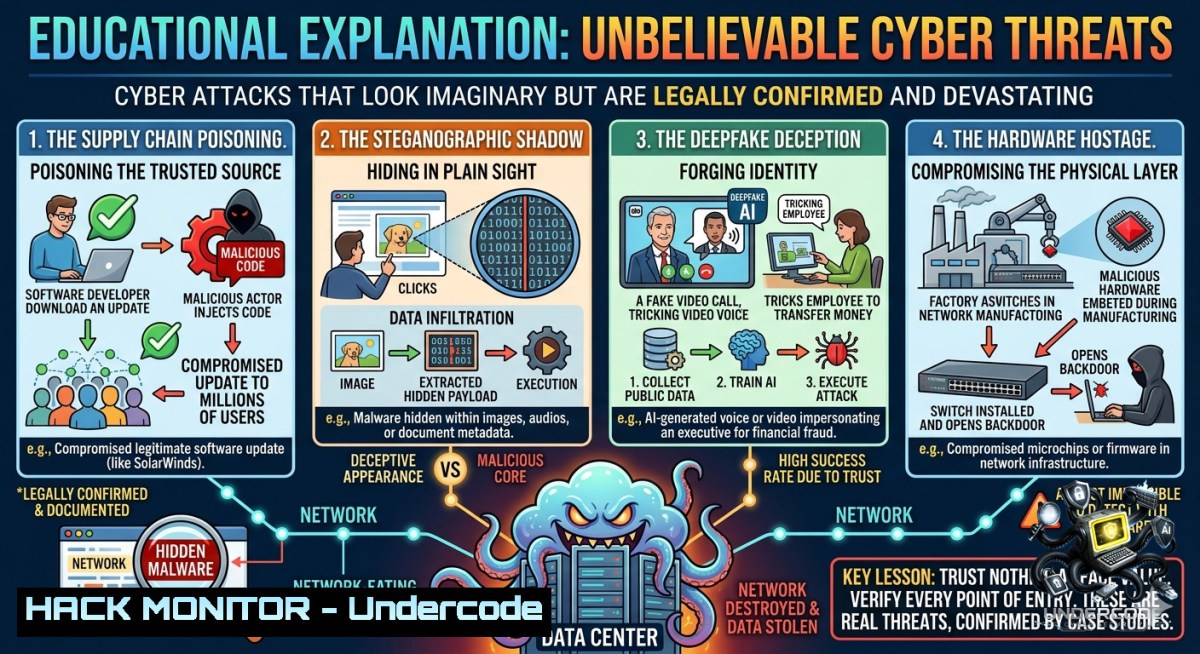
Introduction:
Just as a centipede can silently crawl through hundreds of legs or a Dobsonfly appears as an alien creature, modern cyber threats often hide in plain sight with seemingly impossible capabilities. From polymorphic malware that changes its shape every execution to fileless attacks that leave no traces, these “unreal” threats demand the same vigilance you’d use when spotting exotic pests—only here, your servers, cloud instances, and training data are at risk.
Learning Objectives:
- Identify and simulate fileless malware techniques using PowerShell and Python to understand evasion strategies.
- Harden Linux and Windows endpoints against multi‑vector exploits, including memory injection and living‑off‑the‑land binaries.
- Implement API security controls and cloud hardening measures to block “invisible” lateral movement.
You Should Know:
1. The “Centipede” Attack: Multi‑Stage Fileless Payloads
A centipede has many legs, each a tiny segment that works together. Similarly, fileless attacks break a payload into multiple stages that never touch the disk. Below is a step‑by‑step simulation of a reflective DLL injection (educational use only).
Step‑by‑step guide (Windows – PowerShell AMSI bypass simulation):
 Simulate a reflective loader (detected by AMSI in real environments)
$code = @"
using System;
using System.Runtime.InteropServices;
public class Metamorph {
[DllImport("kernel32.dll")]
public static extern IntPtr VirtualAlloc(IntPtr lpAddress, uint dwSize, uint flAllocationType, uint flProtect);
}
"@
Add-Type $code
 Real exploitation would allocate memory for shellcode; always test in isolated sandboxes.
Linux equivalent – using `ptrace` injection detection:
 Monitor for suspicious ptrace calls (potential code injection)
sudo ausearch -sc ptrace -ts recent
 Block ptrace for non‑root users to prevent debugger‑based injection
echo "kernel.yama.ptrace_scope = 2" >> /etc/sysctl.conf && sysctl -p
How to use for defense: Deploy EDR rules that alert on `VirtualAllocEx` + `CreateRemoteThread` sequences. Use Sysmon (Windows) or Auditd (Linux) to log process hollowing attempts.
2. The “Dobsonfly” Anomaly: Unusual Protocol Tunneling
Dobsonflies look alien because their morphology defies expectations. In cybersecurity, DNS tunneling or ICMP exfiltration looks equally “unreal” but is a real threat. Attackers hide data inside allowed protocols.
Step‑by‑step to detect DNS tunneling (Linux):
 Capture DNS traffic and look for abnormally long subdomains
sudo tcpdump -i eth0 -1 port 53 -vvv | grep -E "A\? [a-zA-Z0-9.]{50,}"
 Use dnstop for real‑time analysis
sudo dnstop -l 3 eth0
Windows – block ICMP exfiltration via firewall:
 Restrict outbound ICMP (allow only necessary echo requests)
New-1etFirewallRule -DisplayName "Block ICMP Exfiltration" -Direction Outbound -Protocol ICMPv4 -IcmpType 8 -Action Block
Mitigation: Configure network IDS/IPS with signatures for high‑entropy domain names and implement DNS over HTTPS (DoH) monitoring.
- API Security: The “Hidden Legs” of Modern Apps
Just as a centipede’s legs are numerous and easily overlooked, APIs often expose hundreds of endpoints. A single misconfigured GraphQL endpoint can leak entire databases.
Step‑by‑step to scan for API vulnerabilities (using OWASP ZAP):
 Dockerized ZAP API scan against a target
docker run -v $(pwd):/zap/wrk/:rw -t owasp/zap2docker-stable zap-api-scan.py -t https://api.target.com/v3/swagger.json -f openapi -r api_report.html
Manual GraphQL introspection test (curl):
curl -X POST https://api.target.com/graphql -H "Content-Type: application/json" -d '{"query":"{__schema{types{name,fields{name}}}}"}'
 If response returns schema details, disable introspection in production.
- Cloud Hardening: The “Invasive Species” of Container Escapes
Like a dobsonfly larvae taking over an aquatic ecosystem, a single container breakout compromises the entire host.
Step‑by‑step to prevent container escapes (Linux host):
 Drop dangerous capabilities from all containers
echo "drop: [\"ALL\"]" >> /etc/docker/daemon.json && systemctl restart docker
 Apply seccomp profile that blocks user namespace creation
docker run --security-opt seccomp=/path/to/block-user-1s.json nginx
Windows container hardening (Podman/WSL2):
 Restrict host namespace sharing
podman run --security-opt label=type:container_runtime_t --cap-drop=ALL microsoft/windowsservercore
- Vulnerability Exploitation & Mitigation: Log4j as “Camouflaged Insect”
The Log4j vulnerability (CVE‑2021‑44228) looked harmless—just a logging library—until its JNDI injection legs started crawling everywhere.
Detection command (Linux – scan for Log4j versions):
find / -1ame "log4j-core-.jar" 2>/dev/null | xargs -I {} unzip -p {} META-INF/MANIFEST.MF | grep "Implementation-Version"
Windows – mitigate using runtime argument:
 Set JVM property to disable JNDI lookup
$env:LOG4J_FORMAT_MSG_NO_LOOKUPS="true"
 Or patch with the official Log4j 2.17.1+
- AI‑Based Anomaly Detection: Training Your Own “Entomologist” Model
Just as an expert can spot a rare insect, AI models can learn normal network behavior and flag outliers.
Step‑by‑step to build a simple isolation forest for network traffic (Python):
from sklearn.ensemble import IsolationForest
import pandas as pd
 Load netflow data (features: bytes_out, packets_in, duration)
df = pd.read_csv('netflow.csv')
model = IsolationForest(contamination=0.01)
model.fit(df[['bytes_out','packets_in','duration']])
df['anomaly'] = model.predict(df[['bytes_out','packets_in','duration']])
 Output suspicious flows
print(df[df['anomaly'] == -1])
What Undercode Say:
- Cyber threats that appear “unreal” often exploit blind spots in monitoring—fileless malware, DNS tunneling, and API schema leaks are modern equivalents of the centipede’s stealth.
- Defensive strategies must shift from signature‑based detection to behavior analytics, combining Linux auditd, Windows Event Tracing, and AI‑driven anomaly scoring.
Prediction:
+N By 2027, AI‑powered EDR will automatically map attack kill chains in real time, reducing mean time to respond from days to seconds.
+N Fileless malware will represent over 70% of successful breaches, pushing memory forensics (Volatility, Rekall) into standard SOC workflows.
-1 Legacy antivirus without behavioral components will become completely obsolete, creating a short‑term surge in ransomware payments.
-1 Cloud misconfigurations will remain the 1 “unreal” threat vector, with API exploitation growing 400% annually unless shift‑left security is mandated.
▶️ Related Video (82% Match):
🎯Let’s Practice For Free:
🎓 Live Courses & Certifications:
Join Undercode Academy for Verified Certifications
🚀 Request a Custom Project:
Secure, high-velocity infrastructure and disruptive technological engineering. Contact our engineering team for high-tier development and proprietary systems:
[email protected]
💎 Smart Architecture | 🛡️ Secure by Design | ⭐ Trusted by Thousands
IT/Security Reporter URL:
Reported By: Insects That – Hackers Feeds
Extra Hub: Undercode MoN
Basic Verification: Pass ✅


