
Listen to this Post
Introduction:
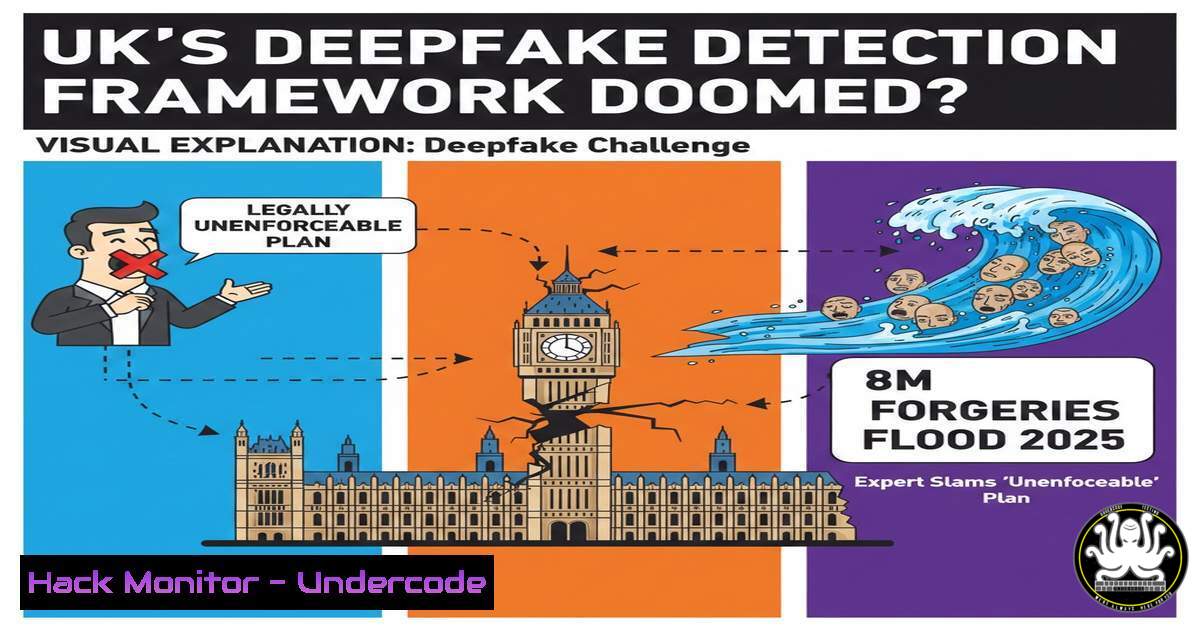
As AI-generated synthetic media surges from 500,000 deepfakes in 2023 to an estimated 8 million in 2025, the UK Home Office has announced a “world-first” framework to evaluate detection technologies—partnering with Microsoft and academic institutions. While the initiative aims to set industry standards for identifying harmful forgeries, cybersecurity experts warn that without globally coordinated legislation, technical detection alone remains a reactive arms race. This article dissects the proposed framework, provides hands-on methodologies for deepfake analysis, and outlines why legal enforcement must parallel technological innovation.
Learning Objectives:
- Objective 1: Deploy open-source deepfake detection tools to analyze manipulated media.
- Objective 2: Conduct forensic metadata analysis and visual artifact inspection using command-line utilities.
- Objective 3: Assess the systemic gaps in current detection frameworks and propose legislative-hardening strategies.
You Should Know:
- The Anatomy of a Deepfake: Digital Signatures and Invisible Artifacts
Deepfakes are synthetically generated or altered media using generative adversarial networks (GANs) or diffusion models. Unlike traditional forgeries, modern AI-generated content often leaves subtle inconsistencies in pixel correlation, facial landmarks, and temporal coherence. The UK’s proposed framework seeks to standardize how these artifacts are scored, but detection tools must be continuously retrained—a challenge when adversaries fine-tune open-source generators.
Step‑by‑step guide: Forensic analysis with FFmpeg and ExifTool
Extract and inspect metadata for signs of AI generation.
Linux/macOS:
 Install ExifTool
sudo apt install exiftool -y

Extract metadata from a suspected deepfake video
exiftool -a -u -g1 suspect_video.mp4 > metadata_analysis.txt

Use FFmpeg to check for inconsistent frame encoding
ffmpeg -i suspect_video.mp4 -vf "select=gt(scene\,0.4),showinfo" -f null - 2>&1 | grep "pts_time"
Windows (PowerShell):
 Download ExifTool for Windows, then:
.\exiftool.exe -a -u -g1 suspect_video.mp4 | Out-File metadata_analysis.txt

FFmpeg scene detection
ffmpeg -i suspect_video.mp4 -vf "select=gt(scene\,0.4),showinfo" -f null - 2>&1 | Select-String "pts_time"
What this does:
- ExifTool reveals editing software traces—many GAN tools embed non‑standard encoder IDs.
- FFmpeg’s scene‑detection highlights abnormally fast scene transitions often used to mask facial blending errors.
- Open-Source Detection: Microsoft’s Video Authenticator and Python Alternatives
Microsoft, a partner in the UK framework, previously released Video Authenticator, which analyzes the blending boundary and subtle grayscale variations. For independent verification, practitioners can use open-source models such as MesoNet or XceptionNet fine-tuned on FaceForensics++.
Step‑by‑step guide: Running a pre-trained deepfake detector
Requires Python 3.8+, TensorFlow, and GPU acceleration.
 Clone a popular detection repository
git clone https://github.com/DariusAf/MesoNet
cd MesoNet

Install dependencies
pip install -r requirements.txt

Download pre-trained weights and run inference
python predict.py --video_path suspect_video.mp4
Windows (Anaconda Prompt):
conda create -n deepfake python=3.8
conda activate deepfake
pip install tensorflow opencv-python
python predict.py --video_path suspect_video.mp4
Explanation:
MesoNet focuses on mesoscopic features (not pixel‑level) to detect compression artifacts unique to GAN-generated faces. The output provides a probability score; scores >0.5 indicate likely manipulation.
3. API Security: Defending Detection-as-a-Service Endpoints
The UK framework envisions centralized detection APIs. However, such services become high-value targets for adversaries attempting to poison or reverse‑engineer detection models. Securing these endpoints requires robust API gateways and input sanitization.
Step‑by‑step guide: Hardening a detection API with rate limiting and input validation (NGINX + ModSecurity)
Linux:
 Install NGINX and ModSecurity
sudo apt install nginx libmodsecurity3 -y

Enable ModSecurity in NGINX
sudo wget https://github.com/SpiderLabs/ModSecurity-nginx/releases/download/v1.0.3/modsecurity-nginx-v1.0.3.tar.gz
 (Compilation steps omitted for brevity; full guide at ModSecurity.org)

Configure rate limiting for API endpoint
sudo nano /etc/nginx/sites-available/deepfake_api
Add the following configuration:
limit_req_zone $binary_remote_addr zone=detect_limit:10m rate=5r/s;

location /api/detect {
limit_req zone=detect_limit burst=10 nodelay;
include modsecurity.conf;
modsecurity on;
proxy_pass http://127.0.0.1:5000;
}
Windows: Use IIS with URL Rewrite and Dynamic IP Restrictions.
Why this matters:
Without API hardening, adversarial actors can submit crafted inputs that cause model drift or denial‑of‑wallet attacks.
4. Cloud Hardening for Deepfake Training and Inference
Organizations building detection systems must secure their cloud pipelines—especially when using sensitive datasets. The UK framework’s reliance on academic and corporate collaboration increases the attack surface.
Step‑by‑step guide: Enforce IMDSv2 and encrypt S3 buckets (AWS)
 Enforce IMDSv2 on EC2 instances used for training
aws ec2 modify-instance-metadata-options \
--instance-id i-12345 \
--http-tokens required \
--http-endpoint enabled

Encrypt S3 bucket with default KMS
aws s3api put-bucket-encryption \
--bucket deepfake-datasets \
--server-side-encryption-configuration '{"Rules":[{"ApplyServerSideEncryptionByDefault":{"SSEAlgorithm":"aws:kms","KMSMasterKeyID":"alias/detect-key"}}]}'

Enable S3 Block Public Access
aws s3api put-public-access-block \
--bucket deepfake-datasets \
--public-access-block-configuration BlockPublicAcls=true,IgnorePublicAcls=true,BlockPublicPolicy=true,RestrictPublicBuckets=true
Azure equivalent:
- Use Managed Identities and enforce Azure Policy to disallow unencrypted storage accounts.
5. Vulnerability Exploitation in Deepfake Generators
Detection frameworks often ignore that deepfake generators themselves may harbor code vulnerabilities. Attackers could exploit these to deploy malware or steal intellectual property.
Step‑by‑step guide: Static analysis of popular generator repositories
 Clone a GAN implementation (e.g., StyleGAN3)
git clone https://github.com/NVlabs/stylegan3
cd stylegan3

Use Bandit for Python security linting
pip install bandit
bandit -r . -f html -o bandit_report.html

Check for hardcoded credentials
grep -rE "(password|secret|token|api_key)" .
Windows: Use PowerShell `Select-String` similarly.
Outcome:
Identifies insecure deserialization, use of `pickle` on untrusted data, or exposed API keys.
6. Mitigation Strategies: Beyond Detection to Provenance
Kolochenko’s critique highlights that detection without attribution is futile. Emerging standards like C2PA (Coalition for Content Provenance and Authenticity) embed cryptographic signatures at capture. The UK framework should mandate adoption.
Step‑by‑step guide: Verify C2PA manifests using open-source tools
 Install c2patool (requires Go)
go install github.com/contentauth/c2patool/cmd/c2patool@latest

Verify a signed image
c2patool sample.jpg -c
If manifest is missing or invalid, treat content as untrusted.
Linux/Windows interoperability:
Binaries available for both OSes; no source modification required.
7. Linux/Windows Hardening for Forensic Workstations
Analysts examining sensitive deepfakes require hardened endpoints to prevent evidence tampering.
Linux (Ubuntu):
 Disable USB storage
echo "blacklist usb-storage" | sudo tee /etc/modprobe.d/disable-usb.conf
sudo update-initramfs -u

Enable auditd for file access monitoring
sudo auditctl -w /home/analyst/evidence/ -p wa -k evidence_access
Windows (Group Policy / PowerShell):
 Disable AutoPlay
Set-ItemProperty -Path "HKLM:\SOFTWARE\Microsoft\Windows\CurrentVersion\policies\Explorer" -Name "NoDriveTypeAutoRun" -Value 255

Enable Object Access Auditing
auditpol /set /subcategory:"File System" /success:enable /failure:enable
What Undercode Say:
- Key Takeaway 1: Technical detection alone is a stopgap; without legally binding content provenance (e.g., C2PA), malicious actors will exploit unmarked AI-generated media faster than frameworks can adapt.
- Key Takeaway 2: The eightfold explosion in deepfakes (500K to 8M) within two years is not just a detection problem—it’s an economic and social trust crisis demanding global treaties, similar to the Budapest Convention on Cybercrime.
- Analysis: The UK’s move, while rhetorically strong, reflects a pattern of governments outsourcing regulation to tech giants. Microsoft’s involvement provides commercial legitimacy but also entrenches reliance on proprietary benchmarks. Real systemic improvement will require mandating open‑source benchmark transparency and forcing social platforms to cryptographically sign authentic media at the point of upload—not just post‑factum scanning. Until then, detection will always be two steps behind generation.
Prediction:
Within 12–18 months, the UK’s framework will evolve from a “voluntary code” to a mandated compliance regime under the Online Safety Act, requiring all public‑facing platforms to deploy C2PA verification and publish quarterly transparency reports. However, unless the US and EU align on reciprocal deepfake legislation, the UK framework will become a regulatory island—ineffective against foreign‑hosted disinformation campaigns. The next frontier will be AI‑watermarking at the silicon level, with chip manufacturers like NVIDIA and AMD embedding indelible inference markers directly into tensor cores.
▶️ Related Video (78% Match):
🎯Let’s Practice For Free:
IT/Security Reporter URL:
Reported By: Michael Tchuindjang – Hackers Feeds
Extra Hub: Undercode MoN
Basic Verification: Pass ✅


