
Listen to this Post
Introduction:
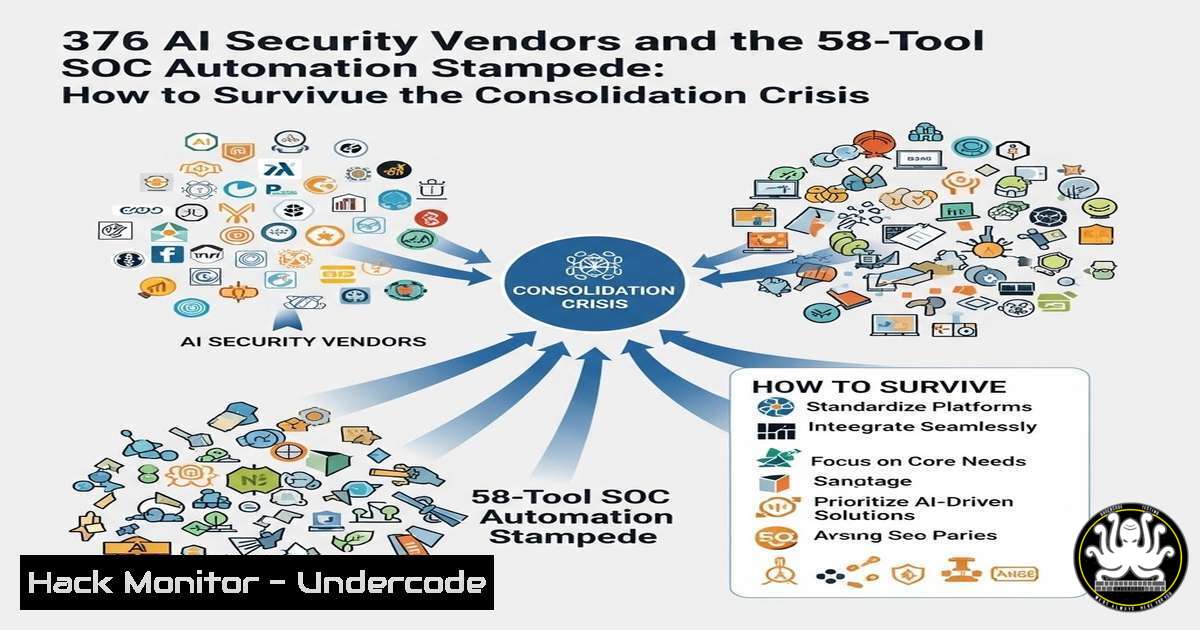
Richard Stiennon recently announced the completion of his 376‑vendor listing for Guardians of the Machine Age, revealing that SOC Automation dominates the AI security landscape with 58 vendors alone. While choice abounds, industry analysts warn that 6,500 cyber vendors are fighting for just 34% of the market spend, and the real gatekeepers—MSPs and MSSPs—are consolidating platforms. For security practitioners, this explosion creates both opportunity and paralysis. This article cuts through the noise, providing hands‑on methodologies to evaluate, deploy, and defend AI‑driven security tools, while preparing for the inevitable shakeout.
Learning Objectives:
- Evaluate and compare AI‑driven SOC automation tools using open‑source test harnesses.
- Implement homomorphic encryption (FHE) concepts to protect machine learning models in untrusted environments.
- Harden cloud guardrails and CI/CD pipelines to prevent misconfigurations that AI scanners flag.
You Should Know:
- SOC Automation Bake‑Off: Containerized Benchmarking for 58+ Tools
With 58 vendors claiming SOC automation supremacy, hands‑on testing is mandatory. Use a disposable Linux environment to stress‑test detection and response capabilities.
Step‑by‑step guide – Tool comparison harness:
 1. Install Docker and kind (Kubernetes in Docker) on Ubuntu 22.04
sudo apt update && sudo apt install -y docker.io curl
sudo systemctl start docker && sudo systemctl enable docker
curl -Lo ./kind https://kind.sigs.k8s.io/dl/v0.20.0/kind-linux-amd64
chmod +x ./kind && sudo mv ./kind /usr/local/bin/

<ol>
<li>Deploy a test cluster with mock workloads generating attack telemetry
kind create cluster --name ai-soc-bench
kubectl create deployment nginx --image=nginx:latest --replicas=3
kubectl expose deployment nginx --port=80 --target-port=80 --name=nginx-svc</p></li>
<li><p>Simulate brute‑force alerts using Falco (open‑source runtime security)
helm repo add falcosecurity https://falcosecurity.github.io/charts
helm install falco falcosecurity/falco \
--set ebpf.enabled=true \
--namespace falco --create-namespace</p></li>
<li><p>Ingest alerts into a local ELK stack and compare with AI‑vendor APIs
docker run -p 5601:5601 -p 9200:9200 -p 5044:5044 \
-e "discovery.type=single-node" docker.elastic.co/elasticsearch/elasticsearch:8.10.2
What this does: Creates a mini‑SOC environment to feed identical attack data into different AI security tools, measuring detection latency and false‑positive rates.
Windows equivalent: Use WSL2 with Docker Desktop to run the same Kubernetes‑based benchmarking.
2. Demystifying FHE: Run Encrypted Models Without Decryption
Fully Homomorphic Encryption (FHE)—mentioned by Stiennon as a “magic method”—allows computation on encrypted data. It is critical for AI vendors handling sensitive logs.
Step‑by‑step guide – FHE toy example with Microsoft SEAL:
// Install Microsoft SEAL on Linux
git clone https://github.com/microsoft/SEAL.git
cd SEAL && cmake -S . -B build -DSEAL_BUILD_EXAMPLES=ON
cmake --build build
./build/bin/sealexamples

// Simplified encrypted addition (C++)
EncryptionParameters parms(scheme_type::bfv);
parms.set_poly_modulus_degree(4096);
parms.set_coeff_modulus(CoeffModulus::BFVDefault(4096));
parms.set_plain_modulus(1024);
SEALContext context(parms);
KeyGenerator keygen(context);
auto secret_key = keygen.secret_key();
auto public_key = keygen.public_key();

Encryptor encryptor(context, public_key);
Evaluator evaluator(context);
Decryptor decryptor(context, secret_key);

Plaintext plain1("5"), plain2("7");
Ciphertext encrypted1, encrypted2;
encryptor.encrypt(plain1, encrypted1);
encryptor.encrypt(plain2, encrypted2);

Ciphertext encrypted_result;
evaluator.add(encrypted1, encrypted2, encrypted_result);

Plaintext plain_result;
decryptor.decrypt(encrypted_result, plain_result);
std::cout << "5 + 7 = " << plain_result.to_string() << std::endl;
What this does: Demonstrates the core principle—addition on encrypted integers—scalable to encrypted ML model inference.
- Cloud Guardrails: Enforce Policies Before AI Scanners Fail
AI governance tools (guardrails) are the third‑largest subcategory. Misconfigurations remain the top cloud risk. Enforce them with Open Policy Agent (OPA).
Step‑by‑step guide – OPA as a guardrail in CI/CD:
 terraform_guardrails.rego – Block public S3 buckets
package terraform

deny[bash] {
resource := input.resource_changes[bash]
resource.type == "aws_s3_bucket"
resource.change.after.acl == "public-read" or
resource.change.after.acl == "public-read-write"
msg = sprintf("Public S3 bucket forbidden: %v", [resource.change.after.bucket])
}
Test locally with Conftest:
brew install conftest  or scoop on Windows
terraform plan -out tfplan.binary
terraform show -json tfplan.binary > plan.json
conftest test plan.json --policy terraform_guardrails.rego
What this does: Prevents deployment of public S3 buckets—a classic misconfiguration—directly in the pipeline, mimicking what AI guardrail vendors automate.
- Vulnerability Management at AI Speed: Trivy in GitHub Actions
With 376 vendors, VM is saturated. Shift left using open‑source scanners that integrate with AI‑triage tools.
Step‑by‑step guide – GitHub Actions for container scanning:
name: VM-Scan
on: [bash]
jobs:
scan:
runs-on: ubuntu-latest
steps:
- uses: actions/checkout@v4
- name: Build image
run: docker build -t myapp:${{ github.sha }} .
- name: Run Trivy
uses: aquasecurity/trivy-action@master
with:
image-ref: 'myapp:${{ github.sha }}'
format: 'sarif'
output: 'trivy-results.sarif'
severity: 'CRITICAL,HIGH'
- name: Upload SARIF to GitHub Security tab
uses: github/codeql-action/upload-sarif@v3
with:
sarif_file: 'trivy-results.sarif'
What this does: Automates vulnerability scanning on every commit; output feeds into GitHub Advanced Security, which many AI‑VM tools ingest for prioritization.
5. Threat Intelligence Feeds: Automate IoC Ingestion
Stiennon notes threat intel as a separate category. Use MISP (open source) to simulate a vendor feed and test automated enrichment.
Step‑by‑step guide – MISP to SIEM pipeline:
 Install MISP on Ubuntu 22.04 (simplified)
wget -O /tmp/misp_install.sh https://raw.githubusercontent.com/MISP/MISP/2.4/INSTALL/INSTALL.sh
bash /tmp/misp_install.sh

Push IoCs via REST API
curl -k -X POST https://localhost/events \
-H "Authorization: YOUR_API_KEY" \
-H "Content-Type: application/json" \
-d '{
"Event": {
"info": "Test IoC",
"Attribute": [
{
"type": "ip-src",
"value": "203.0.113.5",
"category": "Network activity"
}
]
}
}'

Subscribe external feeds via MISP dashboard
misp-modules -l 127.0.0.1:6666 &
What this does: Enables a local threat intel platform that mirrors vendor offerings; test how quickly your AI‑SOC ingests and correlates these indicators.
6. Simulating Vendor Consolidation: Eliminate Duplicate Tools
John Kwarsick’s comment underscores that 58 SOC automation vendors = 58 bets on the same buyer. Practitioners must rationalise stacks.
Step‑by‑step guide – Tool overlap analysis with Python:
import json

Mock inventory of security tools and their capabilities
tools = [
{"name": "AI-SOC-A", "capabilities": ["alert_ingestion", "case_mgmt", "threat_hunting"]},
{"name": "AI-SOC-B", "capabilities": ["alert_ingestion", "case_mgmt"]},
{"name": "Legacy-SIEM", "capabilities": ["alert_ingestion", "reporting"]}
]

def find_overlap(tools_list):
capability_map = {}
for t in tools_list:
for cap in t["capabilities"]:
if cap not in capability_map:
capability_map[bash] = []
capability_map[bash].append(t["name"])

for cap, vendors in capability_map.items():
if len(vendors) > 1:
print(f"Duplicate capability '{cap}' found in: {', '.join(vendors)}")

find_overlap(tools)
What this does: Quick script to visualise redundant capabilities—first step toward consolidating the 58‑vendor mess in your own environment.
What Undercode Say:
- Key Takeaway 1: The explosion of AI security vendors (376 and counting) creates an illusion of choice; real differentiation requires technical validation, not marketing demos. Use the open‑source toolchains above to measure latency, accuracy, and integration effort.
- Key Takeaway 2: FHE and guardrails are not magic—they are engineering disciplines. Practitioners who invest in understanding these foundations will outlast vendors that simply wrap them in buzzwords.
Analysis: The LinkedIn dialogue reveals a market at peak hype, where CISOs are drowning in pitches while channel partners dictate survival. The gap between “58 SOC automation vendors” and “6,500 total vendors” signals a violent consolidation ahead. Security teams that standardise on modular, API‑first platforms will navigate the coming shakeout; those that adopt point‑solutions for every subcategory will face technical debt and vendor abandonment. The commands and configurations provided here are not academic—they are survival skills for the 2025–2027 security landscape.
Prediction:
By 2027, the 58‑vendor SOC automation category will shrink to fewer than 10 dominant players. Most will be acquired or shutter, leaving customers scrambling to replace niche AI features. The survivors will be those that embedded themselves deeply into MSSP workflows—not those with the best detection models. Expect Microsoft, Google, and two or three platform consolidators to absorb the majority, while specialised FHE and post‑quantum security vendors remain independent only if they solve specific compliance‑driven problems (e.g., healthcare, finance). The “CISO as gatekeeper” era is over; the partner ecosystem now writes the rules.
▶️ Related Video (76% Match):
🎯Let’s Practice For Free:
IT/Security Reporter URL:
Reported By: Stiennon Half – Hackers Feeds
Extra Hub: Undercode MoN
Basic Verification: Pass ✅


