
Listen to this Post
Introduction:
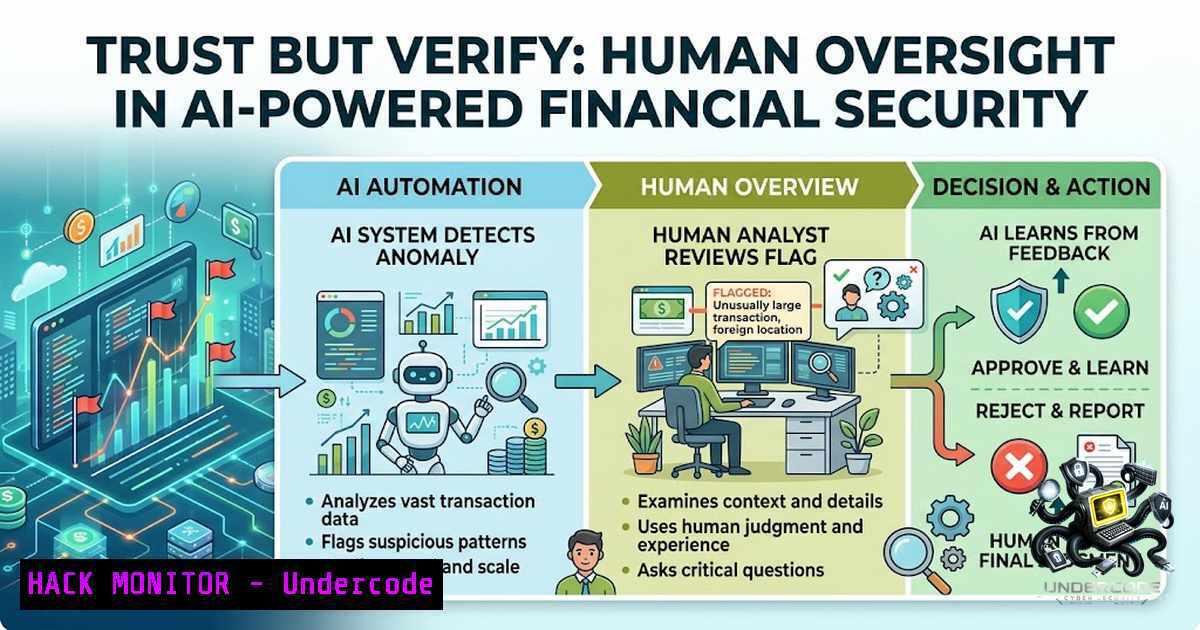
The integration of Artificial Intelligence (AI) into financial security systems promises unprecedented efficiency in fraud detection, compliance monitoring, and threat response. However, as highlighted by a recent EC-Council University CyberTalks webinar, “Trust but Verify: Human Oversight in AI-Powered Financial Security,” this automation introduces critical attack surfaces. The core challenge is no longer just about securing networks and endpoints; it’s about securing the AI models that are increasingly making high-stakes decisions. Attackers are shifting their focus to target these models through adversarial manipulation, data poisoning, and exploiting model drift, making AI security a paramount concern for offensive and defensive security professionals alike.
Learning Objectives & Secrets:
- Objective 1: Understand the Attack Surface of AI in Finance. Learn to identify the specific vulnerabilities in AI-driven financial systems, including concept drift—where an AI model’s accuracy decays over time due to changes in data distributions—and adversarial attacks that aim to fool the model.
- Objective 2: Master AI Red Teaming and Penetration Testing. Discover how to proactively assess AI systems using specialized frameworks. Secret Tip: Leverage tools like MetaLLM, a Metasploit-inspired framework with over 60 modules for testing LLM prompt injections, RAG poisoning, and MLOps infrastructure. Another secret is to use BlackIce, a containerized toolkit that bundles 14 AI security testing tools into a single, reproducible Docker image for streamlined red teaming.
- Objective 3: Implement Effective Human Oversight and Explainability. Learn to build robust governance around AI. Secret Tip: Go beyond simple monitoring by implementing a “human-in-the-loop” (HITL) system. As a practical measure, use SHAP and LIME to explain model decisions, making them auditable and defensible. Ensure that human reviewers have the authority and time to challenge AI outputs, making oversight a true control, not just a formality.
You Should Know:
- Setting Up an AI Red Teaming Environment with BlackIce
Traditional penetration testing is insufficient for AI systems; you need a dedicated environment. BlackIce provides a standardized, containerized toolkit for red teaming both Large Language Models (LLMs) and classical ML models.
- Step 1: Pull the Docker Image. Start by pulling the official BlackIce image from Docker Hub.
docker pull databricksruntime/blackice:latest
What this does: This downloads the pre-configured environment containing 14 essential AI security tools.
-
Step 2: Run the Container. Launch the container with an interactive shell.
docker run -it --rm databricksruntime/blackice:latest /bin/bash
What this does: This starts the container and drops you into a bash shell, where all the tools are pre-installed and ready to use.
-
Step 3: Explore the Toolkit. Within the container, you can list the available tools.
blackice --list-tools
What this does: This command displays all the bundled tools, such as `textattack` for adversarial example generation and `garak` for LLM vulnerability scanning. This creates a reproducible and portable testing environment that simplifies complex assessments.
2. Conducting Adversarial Prompt Injection with MetaLLM
Prompt injection is a critical vulnerability where an attacker manipulates an LLM’s input to override its instructions. MetaLLM is a powerful, Metasploit-style framework for this purpose.
- Step 1: Install and Launch MetaLLM. Clone the repository and run the framework.
git clone https://github.com/perfecXion-ai/MetaLLM.git
cd MetaLLM
python -m venv venv
source venv/bin/activate  On Windows use `venv\Scripts\activate`
pip install -r requirements.txt
python metallm.py
What this does: This installs MetaLLM and launches its interactive command-line interface.
-
Step 2: Select and Configure an Exploit Module. Once in the MetaLLM CLI, select a prompt injection module.
metallm> use exploit/llm/prompt_injection
metallm exploit(prompt_injection)> show options
metallm exploit(prompt_injection)> set TARGET_URL http://your-target-ai.com/api/chat
metallm exploit(prompt_injection)> set PROVIDER openai
metallm exploit(prompt_injection)> set MODEL gpt-4
What this does: This configures the module to target a specific AI API endpoint. The `show options` command reveals all configurable parameters for the attack.
-
Step 3: Execute the Attack and Manage Sessions. Run the exploit and manage the resulting sessions.
metallm exploit(prompt_injection)> run
metallm> sessions -l
metallm> sessions -i 1
metallm> report generate
What this does: The `run` command executes the prompt injection attack. Successful exploitation creates a session that you can interact with (
sessions -i 1). Finally, generate a report mapped to the MITRE ATLAS framework for documentation.
3. Implementing Explainability for AI Fraud Detection
To satisfy compliance and enable human oversight, AI models must be explainable. SHAP (SHapley Additive exPlanations) is a popular framework for this.
- Step 1: Install the SHAP Library.
pip install shap
What this does: Installs the SHAP library for model interpretation.
-
Step 2: Load Your Model and Data. In your Python script, load your trained fraud detection model and a sample of your dataset.
import shap
import xgboost as xgb

Assume 'model' is your trained XGBoost model and 'X_sample' is your data
model = xgb.Booster()
X_sample = ...
explainer = shap.TreeExplainer(model)
shap_values = explainer.shap_values(X_sample)
What this does: This initializes a SHAP explainer for a tree-based model and calculates the SHAP values for each feature in your sample.
-
Step 3: Visualize the Explanation.
shap.summary_plot(shap_values, X_sample)
What this does: This generates a summary plot showing the most important features driving the model’s decisions. This allows security analysts and auditors to understand why an AI flagged a transaction as fraudulent, turning a “black box” into a defensible, auditable process.
4. Understanding and Mitigating Model Drift
Model drift is a silent killer of AI security. An AI model trained on past data will inevitably become less accurate as fraud patterns evolve. To counter this, implement continuous monitoring and retraining.
- Step 1: Monitor Data Drift. Use statistical methods to compare the distribution of incoming data against the training data. A simple approach is to use the Kolmogorov-Smirnov (K-S) test for numerical features.
from scipy import stats
reference_data: data used to train the model
current_data: new data being fed into the model
statistic, p_value = stats.ks_2samp(reference_data['transaction_amount'], current_data['transaction_amount'])
if p_value < 0.05:
print("Significant drift detected in 'transaction_amount'")
What this does: This statistical test detects if the distribution of a key feature has significantly changed, which could indicate the model’s performance is degrading.
-
Step 2: Implement Adaptive Learning. Employ adaptive learning techniques to handle drift. For instance, using the ADWIN (Adaptive Windowing) algorithm can help detect changes in data streams and trigger retraining. The goal is to reduce “drift recovery” time; advanced frameworks can recover from drift within 24 hours.
5. Securing the AI Supply Chain (MLOps)
An AI model is only as secure as the infrastructure that builds and hosts it. Attackers target MLOps platforms like Jupyter, MLflow, and Weights & Biases (W&B) to poison models or steal data.
- Step 1: Assess MLOps Infrastructure. Use tools like MetaLLM to probe these platforms.
metallm> use exploit/mlops/jupyter
metallm exploit(jupyter)> set RHOST target-jupyter-server.com
metallm exploit(jupyter)> run
What this does: This command attempts to exploit common misconfigurations in a Jupyter Notebook server, a critical part of many ML pipelines.
-
Step 2: Implement Hardening Measures. As a defender, follow these best practices:
- Network Segmentation: Isolate your MLOps infrastructure from the public internet and other less sensitive internal networks.
- Strict Access Controls: Implement the principle of least privilege. Not every data scientist needs production access.
- API Security: Secure all APIs used by your AI systems. This includes rate limiting, robust authentication, and input validation to prevent injection attacks.
What Undercode Say:
- Key Takeaway 1: AI is the New Attack Surface. For offensive security professionals, the skillset must now include adversarial machine learning. Understanding how to manipulate AI models is as crucial as exploiting traditional vulnerabilities. Attackers are not just targeting code; they are targeting the decision-making logic of AI.
- Key Takeaway 2: Human Oversight is a Non-1egotiable Control. Automation is a powerful tool, but it cannot replace human judgment, especially in high-stakes financial environments. Human oversight must be meaningful, which means reviewers need the authority, time, and information to effectively challenge AI decisions. This is not a bottleneck but a critical safety mechanism against adversarial inputs and biased outcomes.
Prediction:
- +1 The demand for professionals skilled in AI security, red teaming, and model governance will skyrocket, creating a new and lucrative specialization within cybersecurity.
- +1 Regulatory bodies like the Financial Stability Board (FSB) and central banks (e.g., RBI) will mandate stricter controls, including “kill switches” and mandatory human oversight for critical AI decisions, driving a new wave of compliance-focused security tools.
- -1 Organizations that fail to implement robust human oversight and AI-specific security testing will suffer significant financial and reputational damage from sophisticated adversarial attacks that exploit model drift and vulnerabilities.
- -1 The complexity and cost of securing AI systems will create a security divide, where only large, well-funded enterprises can effectively protect their AI-driven operations, leaving smaller institutions more vulnerable.
- +1 The development of standardized AI security frameworks like MITRE ATLAS and tools like MetaLLM and BlackIce will mature, making comprehensive AI security testing more accessible and standardized.
▶️ Related Video (90% Match):
https://www.youtube.com/watch?v=-Z-A69cGOSU
🎯Let’s Practice For Free:
🎓 Live Courses & Certifications:
Join Undercode Academy for Verified Certifications
🚀 Request a Custom Project:
Secure, high-velocity infrastructure and disruptive technological engineering. Contact our engineering team for high-tier development and proprietary systems:
[email protected]
💎 Smart Architecture | 🛡️ Secure by Design | ⭐ Trusted by Thousands
IT/Security Reporter URL:
Reported By: https://lnkd.in/p/eKEFrBgs – Hackers Feeds
Extra Hub: Undercode MoN
Basic Verification: Pass ✅


