
Listen to this Post
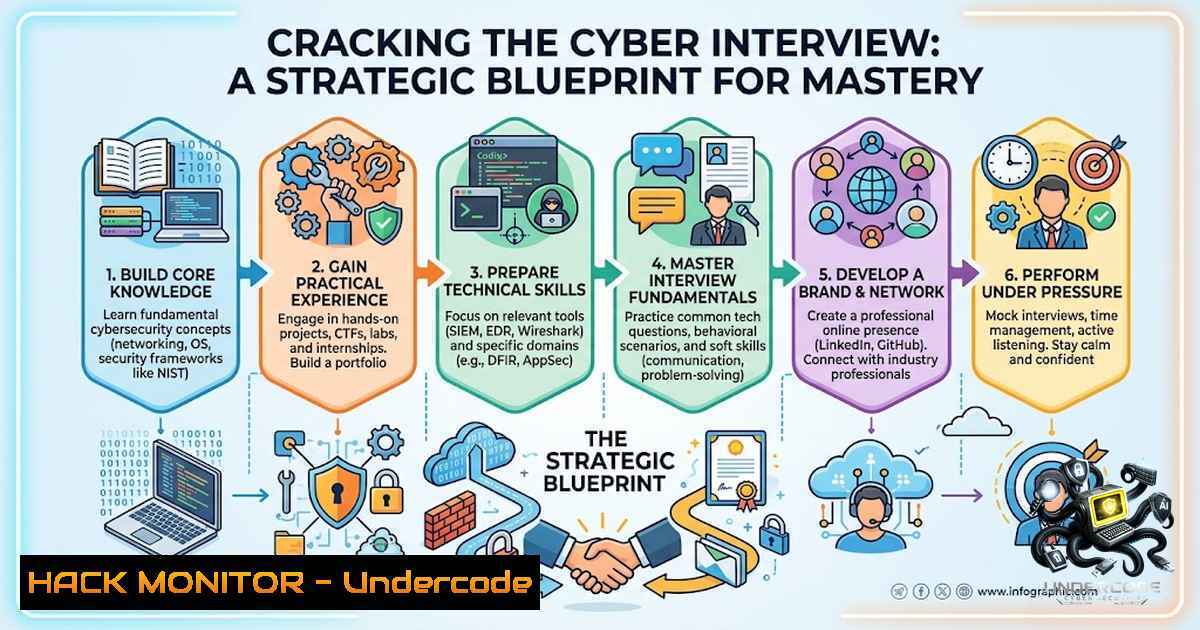
Introduction:
The cybersecurity field is defined by its relentless evolution, making the interview process a rigorous test of both foundational knowledge and adaptive thinking. Candidates are no longer assessed solely on memorized definitions but on their ability to apply concepts like the CIA Triad and cryptographic principles to real-world scenarios. This article provides a technical deep-dive into the core domains of a modern cybersecurity interview, transforming theoretical knowledge into actionable, practical expertise.
Learning Objectives & Secrets:
- Objective 1: Master Foundational Vocabulary. Articulate the differences between threats, vulnerabilities, and risks, and map them to specific controls.
- Objective 2 Secret Tips: When explaining encryption, always mention “Key Rotation” and “Perfect Forward Secrecy” to demonstrate an understanding of operational security, not just theory.
- Objective 3 Secret Tips: For web security questions, be prepared to not only define XSS and SQLi but also demonstrate the OWASP Top 10 mitigation strategies using code snippets and WAF rules.
You Should Know:
1. Core Concepts & Risk Management:
Understanding the CIA Triad is just the starting point; you must know how to implement it. In a technical interview, expect to discuss how to map a specific attack to the CIA pillar it violates (e.g., Ransomware affects Availability and Integrity). Risk management involves calculating Risk = Threat x Vulnerability x Impact.
– Step‑by‑step guide: To assess a risk, first identify the asset (e.g., a customer database). Second, identify the threat actor (e.g., an APT group). Third, identify the vulnerability (e.g., a missing patch MS17-010). Fourth, calculate the potential impact (data loss). Finally, propose a mitigation (patch deployment or IPS rules).
– Linux Command: Use `grep -i “CVE” /var/log/apt/history.log` to check for patched vulnerabilities on Debian-based systems.
– Windows Command: Use `wmic qfe list brief /format:texttable` to list installed Windows updates to verify patch levels.
2. Cryptography, Authentication & Forward Secrecy:
A common trap involves differentiating between hashing, salting, and encryption. Encryption is two-way (requires a key to decrypt), while hashing is one-way. Salting adds random data to the hash to defeat rainbow table attacks. Demonstrating knowledge of Perfect Forward Secrecy (PFS), which ensures that even if a long-term private key is compromised, past session keys remain secure, is a strong differentiator.
– Step‑by‑step guide: To test SSL/TLS configuration for PFS, use a tool to check the cipher suite. Run `nmap –script ssl-enum-ciphers -p 443 example.com` to list supported ciphers. Look for ECDHE or DHE suites which support PFS. Additionally, to generate a hash securely in Linux, use echo -1 "Password123" | sha256sum; to salt it, combine it with a random string.
3. Network Security Protocols & The TCP Handshake:
A senior interviewer will ask about the TCP 3-way handshake (SYN, SYN-ACK, ACK) and how it relates to security attacks like SYN floods. You must differentiate between IDS (Intrusion Detection System) and IPS (Intrusion Prevention System)—where the former monitors and alerts, the latter monitors and actively blocks traffic inline. Understanding the OSI model is critical for troubleshooting, particularly layers 3 (Network) and 4 (Transport).
– Step‑by‑step guide: To spot a potential SYN flood attack in logs, check for a high volume of SYN packets without corresponding ACK packets. On Linux, use `netstat -an | grep SYN_RECV | wc -l` to count pending connections. A high number indicates a potential DoS condition. To harden against this, you can adjust the kernel parameters: sysctl -w net.ipv4.tcp_syncookies=1.
- Web Application Security: XSS, CSRF & SQL Injection:
This is where theory meets code. You must be able to read a code snippet and identify a vulnerability. For SQL Injection, the classic example is a login form where the input is concatenated directly into the query. Mitigation relies strictly on Parameterized Queries (Prepared Statements). For Cross-Site Scripting (XSS), the fix involves context-aware output encoding (e.g., encoding for HTML, JS, or URL context).
– Step‑by‑step guide: To test for SQL injection manually, input a single quote (') into a search bar. If an error appears, it’s likely vulnerable. To secure code (Python/Flask), use cursor.execute("SELECT FROM users WHERE id = %s", (user_id,)). This ensures the input is treated as data, not code. To test for XSS, try injecting `` in input fields. If the alert executes, the website fails to sanitize output. Mitigation in Node.js involves using libraries like `DOMPurify` or the `escape` function.
5. Threat Actors, Botnets & DDoS Mitigation:
Understanding different hacker types (White, Grey, Black Hat) and their motivations is necessary. A botnet is a network of compromised machines used to launch attacks like Distributed Denial of Service (DDoS). Explain the difference between volume-based (UDP floods) and protocol-based (SYN floods) attacks. Mitigation strategies include blackholing, rate limiting, and using CDN/WAF services.
– Step‑by‑step guide: To simulate a basic network stress test (on your own lab environment), tools like `hping3` can be used: hping3 -S -p 80 --flood target_ip. To defend against it, implement rate limiting via `iptables` on Linux: iptables -A INPUT -p tcp --dport 80 -m limit --limit 25/minute --limit-burst 100 -j ACCEPT. This drops connections once the limit is exceeded. For production, configure AWS WAF or Cloudflare to filter malicious traffic at the edge.
- Incident Response, VA vs. PT & Chain of Custody:
Vulnerability Assessment (VA) is a passive process of identifying weaknesses (e.g., using a scanner), while Penetration Testing (PT) is an active process of exploiting those weaknesses to determine risk. Incident Response requires a strict “Chain of Custody” to ensure evidence is admissible in court. This involves logging every touch, transfer, and analysis performed on the data.
– Step‑by‑step guide: In a Windows environment, you can capture memory for forensic analysis using `DumpIt` or WinPMEM. For Linux, use dd if=/dev/mem of=mem_dump.bin bs=1M count=100. To maintain the chain of custody, calculate the hash of the evidence immediately: sha256sum mem_dump.bin > hash.txt. Store the hash and the original file in a secure location. If the hash changes during analysis, the evidence is invalidated.
7. Security Operations & Career Growth:
The dynamic nature of cybersecurity means you must be a continuous learner. Red Team (offensive) and Blue Team (defensive) dynamics are crucial. You should be familiar with SIEM tools (e.g., Splunk, Elastic), and how to query logs to find Indicators of Compromise (IOCs).
– Step‑by‑step guide: To stay current, follow CVE feeds. Use curl -s https://cve.circl.lu/api/last` to fetch the latest CVEs. To integrate threat intelligence, use tools likeMISP. For log analysis, a basic Splunk query to find failed logins isindex=windows_logs EventCode=4625. Using regex in `grep` on Linux, you can parse auth logs:grep “Failed password” /var/log/auth.log`.
What Undercode Say:
- Key Takeaway 1: Do not just memorize definitions; you must contextualize them with a real-world example. The interviewer wants to know if you can connect the dots between a vulnerability and its business impact.
- Key Takeaway 2: The technical value lies in “Operational Knowledge”—knowing the commands, log locations, and mitigation steps. The interview is a bridge between knowing “what” and “how.”
- Analysis: The guide emphasizes a “process-level thinking” approach, which is essential for senior roles. By focusing on the “why” behind security controls, candidates demonstrate they aren’t just ticket-closers but strategic problem solvers. The inclusion of threat modeling and red/blue team dynamics suggests a holistic security posture, moving beyond perimeter defense. This approach is key for modern security roles focused on resilience.
Prediction:
- -1: The talent gap will widen as entry-level candidates fail to grasp the operational aspects of security, relying solely on theoretical knowledge and certifications.
- -1: As automation handles routine patching, manual config checks (like the commands shown) will become a specialized and highly valued skill, often lacking in new graduates.
- +1: The “hybrid analyst” who can script (PowerShell/Bash) and build automation will become the standard requirement, driving a new wave of more efficient security operations centers (SOCs).
- +1: We will see a resurgence in “Manual Penetration Testing” focusing on unique logical flaws rather than automated scanning, making the understanding of core concepts more critical than ever.
- +1: The focus on PFS and modern cryptography will lead to a significant decrease in successful mass-data decryption attacks from passive surveillance.
▶️ Related Video (90% Match):
🎯Let’s Practice For Free:
🎓 Live Courses & Certifications:
Join Undercode Academy for Verified Certifications
🚀 Request a Custom Project:
Secure, high-velocity infrastructure and disruptive technological engineering. Contact our engineering team for high-tier development and proprietary systems:
[email protected]
💎 Smart Architecture | 🛡️ Secure by Design | ⭐ Trusted by Thousands
IT/Security Reporter URL:
Reported By: https://lnkd.in/p/eHhgW2tC – Hackers Feeds
Extra Hub: Undercode MoN
Basic Verification: Pass ✅


