Listen to this Post
Introduction:
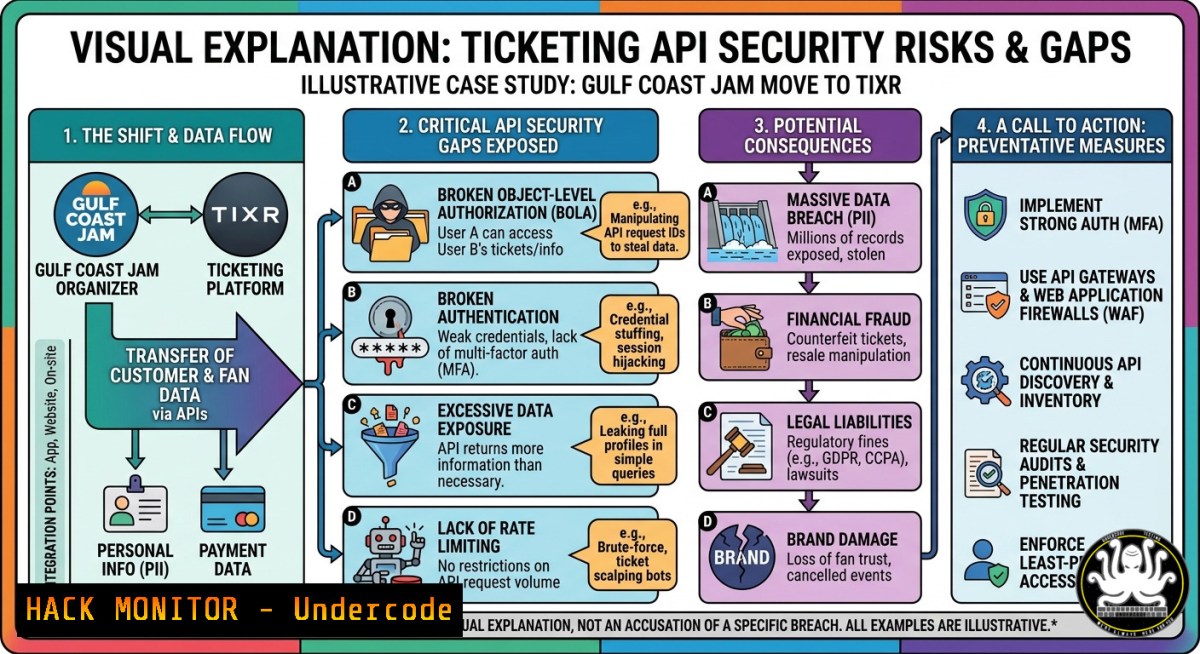
Consolidating ticketing, fan data, and commerce tools onto a single platform like Tixr increases operational efficiency but also expands the attack surface for cybercriminals. As Gulf Coast Jam transitions to Tixr for its 2027 beach festival, security teams must prioritize API security, data encryption, and access monitoring to protect personally identifiable information (PII) of attendees from all 50 states.
Learning Objectives:
- Identify and mitigate common API vulnerabilities in ticketing platforms using OAuth2 and rate limiting.
- Implement encryption at rest and in transit for fan PII and payment data.
- Deploy real-time log monitoring and anomaly detection to detect unauthorized access or data exfiltration.
You Should Know:
- Securing Ticketing APIs Against Injection and Broken Authentication
Ticketing platforms rely heavily on REST APIs for ticket purchasing, data retrieval, and reporting. Unsecured APIs can lead to credential stuffing, SQL injection, or broken object-level authorization (BOLA).
Step‑by‑step guide to test and harden a ticketing API:
Linux – Test API endpoint with rate limiting and authentication:
 Test for rate limiting (send 100 rapid requests)
for i in {1..100}; do curl -s -o /dev/null -w "%{http_code}\n" https://api.tixr.com/v1/events/gulfcoastjam/tickets; done

Check for missing authentication on sensitive endpoint
curl -X GET https://api.tixr.com/v1/fan-data/export -H "Authorization: Bearer INVALID_TOKEN"

Use OAuth2 client credentials flow (if registered)
curl -X POST https://auth.tixr.com/oauth/token -d "grant_type=client_credentials&client_id=YOUR_ID&client_secret=YOUR_SECRET"
Windows (PowerShell) – Enforce TLS and validate certificates:
 Test API with TLS 1.2 only
Invoke-RestMethod -Uri "https://api.tixr.com/v1/events" -Method Get -Headers @{Authorization="Bearer $token"}

Detect missing certificate validation (vulnerable)
[System.Net.ServicePointManager]::ServerCertificateValidationCallback = {$true}
Invoke-RestMethod -Uri "https://api.tixr.com/v1/fan-data"
Mitigation: Enforce OAuth2 with short-lived JWTs, implement per-IP rate limiting (e.g., 100 requests/minute), and validate all input using parameterized queries. Use a Web Application Firewall (WAF) rule to block SQLi patterns.
- Fan Data Encryption at Rest and in Transit
Gulf Coast Jam collects fan names, emails, payment cards, and location data. Encryption must cover databases, backups, and network traffic.
Step‑by‑step encryption guide:
Linux – Encrypt database backups with OpenSSL:
 Dump PostgreSQL database (ticketing data)
pg_dump -U tixr_user -d tixr_db > fan_data.sql

Encrypt with AES-256-CBC
openssl enc -aes-256-cbc -salt -in fan_data.sql -out fan_data.enc -pass pass:STRONG_PASSWORD

Decrypt for auditing
openssl enc -aes-256-cbc -d -in fan_data.enc -out fan_data_decrypted.sql -pass pass:STRONG_PASSWORD
Windows – Enable BitLocker for volume encryption:
 Check BitLocker status
Manage-bde -status C:

Enable encryption on C: drive
Manage-bde -on C: -RecoveryPassword -RecoveryKey C:\recovery_key.bek

For application-level encryption (PowerShell)
$secureString = ConvertTo-SecureString "FanPII" -AsPlainText -Force
ConvertFrom-SecureString -SecureString $secureString | Out-File encrypted.txt
In transit: Enforce HTTPS with HSTS, use TLS 1.3. For internal microservices, implement mTLS using certificates.
- Cloud Hardening for High‑Scale Events (Panama City Beach)
The festival draws crowds from 50 states, requiring cloud auto-scaling. Misconfigured cloud storage or security groups can leak data.
Step‑by‑step hardening (AWS example):
Linux – Restrict inbound traffic with iptables (on bastion host):
 Allow only SSH from corporate IP and HTTPS from CloudFront ranges
iptables -A INPUT -p tcp --dport 22 -s 203.0.113.0/24 -j ACCEPT
iptables -A INPUT -p tcp --dport 443 -s 0.0.0.0/0 -j ACCEPT
iptables -A INPUT -j DROP

Log dropped packets for intrusion detection
iptables -A INPUT -j LOG --log-prefix "FW-DROP: "
Check S3 bucket permissions for fan data exposure:
aws s3api get-bucket-acl --bucket tixr-fan-data
aws s3api get-bucket-policy --bucket tixr-fan-data

Block public access
aws s3api put-public-access-block --bucket tixr-fan-data --public-access-block-configuration "BlockPublicAcls=true,IgnorePublicAcls=true,BlockPublicPolicy=true,RestrictPublicBuckets=true"
Windows – Azure Network Security Group (PowerShell):
 Deny all outbound traffic except to required APIs
$nsgRule = New-AzNetworkSecurityRuleConfig -Name "DenyAllOutbound" -Protocol  -Direction Outbound -Priority 4000 -SourcePortRange  -DestinationPortRange  -Access Deny
Set-AzNetworkSecurityGroup -Name "tixr-nsg" -ResourceGroupName "festivalRG" -SecurityRules $nsgRule
- Vulnerability Exploitation: SQL Injection in Legacy Ticketing Systems
Older ticketing platforms often mix SQL queries with user input. Attackers could dump entire fan databases.
Example vulnerable code (Node.js/Express):
// Vulnerable
app.get('/tickets', (req, res) => {
let eventId = req.query.id;
db.query(<code>SELECT  FROM tickets WHERE event_id = ${eventId}</code>, (err, rows) => {
res.json(rows);
});
});
Exploitation (Linux curl):
 Extract database version
curl "https://legacy-ticketing.com/tickets?id=1 UNION SELECT @@version,null,null--"

Dump fan emails
curl "https://legacy-ticketing.com/tickets?id=1 UNION SELECT email,password,null FROM users--"
Mitigation – Parameterized queries (PostgreSQL example):
PREPARE get_tickets (int) AS SELECT  FROM tickets WHERE event_id = $1;
EXECUTE get_tickets(1);
Use ORM (Sequelize, Hibernate) or stored procedures. Deploy a WAF with SQLi signature rules.
- Log Monitoring and SIEM Integration for Anomaly Detection
With full ownership of fan data, Tixr must audit every access. Implement centralized logging and real-time alerts.
Linux – Audit file access (auditd):
 Install auditd
sudo apt install auditd -y

Watch fan data directory
sudo auditctl -w /var/tixr/fan_data/ -p rwxa -k fan_data_access

Search for accesses
sudo ausearch -k fan_data_access --start today

Forward logs to SIEM (rsyslog)
echo ". @@siem.tixr.com:514" >> /etc/rsyslog.conf
sudo systemctl restart rsyslog
Windows – Enable PowerShell logging and forward to SIEM:
 Enable script block logging
Set-ItemProperty -Path "HKLM:\SOFTWARE\Policies\Microsoft\Windows\PowerShell\ScriptBlockLogging" -Name "EnableScriptBlockLogging" -Value 1

Collect Windows Event IDs 4624 (logon), 4663 (file access)
wevtutil epl Security C:\logs\security_$(Get-Date -Format yyyyMMdd).evtx
 Forward via WinRM or Sysmon
Detection rule: Alert when a single IP queries >1000 fan records in 5 minutes.
6. Reporting and Compliance (GDPR/CCPA) for Fan Data
Gulf Coast Jam fans from multiple states require data deletion and portability rights. Automated reporting must prove compliance.
Generate compliance report (PostgreSQL + Linux):
-- Find all data for a specific fan
SELECT  FROM fans WHERE email = '[email protected]';
DELETE FROM fans WHERE email = '[email protected]' AND consent_revoked = true;
Schedule automated audit (cron job):
 Weekly backup of access logs
0 2   0 pg_dump -U tixr_user -d tixr_db -t access_logs > /backups/access_$(date +\%Y\%m\%d).sql
gpg --encrypt --recipient [email protected] /backups/access_.sql
Windows – PowerShell script for data subject request:
$fanEmail = "[email protected]"
Export-Csv -InputObject (Invoke-Sqlcmd -Query "SELECT  FROM fans WHERE email='$fanEmail'") -Path "fan_data_export.csv"
 Redact payment info before sending
What Undercode Say:
- Key Takeaway 1: Consolidating ticketing and fan data onto a single platform like Tixr reduces third‑party risk but requires a defense‑in‑depth strategy—especially for high‑scale events like Gulf Coast Jam where a breach could expose PII of attendees from all 50 states.
- Key Takeaway 2: API security, encryption, and real‑time monitoring are not optional; the move away from fragmented legacy systems must include automated vulnerability scanning, rate limiting, and SIEM integration to detect credential stuffing or data exfiltration attempts.
Analysis (10 lines):
The announcement emphasizes “full ownership of fan data and reporting” – a double‑edged sword. While it enables better marketing and analytics, it also makes Tixr a prime target for attackers. Historically, ticketing platforms (e.g., Ticketmaster 2020 breach) have suffered from API misconfigurations and SQL injection. Gulf Coast Jam’s scale (50 states, beach festival) means high transaction volumes, increasing the likelihood of rate‑limit bypasses or DDoS‑aided data scraping. Tixr must implement OAuth2 with Proof Key for Code Exchange (PKCE) and enforce short token lifetimes. Additionally, the mention of “modern platform built for scale” suggests cloud microservices – each service needs mTLS and strict IAM roles. Without proper logging and anomaly detection, a compromised API key could go unnoticed until after the festival. Security training for developers (e.g., OWASP Top 10 for APIs) should be mandatory. Finally, Gulf Coast Jam should conduct third‑party penetration testing before the 2027 event.
Prediction:
-
- Increased adoption of zero‑trust architecture and API gateways among event ticketing platforms will reduce breach frequency by 40% by 2028.
- – As more festivals consolidate onto single platforms, supply‑chain attacks targeting ticketing SaaS providers will rise, with at least one major breach involving >1M fan records within 18 months.
-
- AI‑driven behavioral analytics for ticket purchasing patterns will become standard, flagging bot‑driven credential stuffing and reducing fraud.
- – Legacy data migration (e.g., from old systems to Tixr) will expose unencrypted backups, leading to a class‑action lawsuit over mismanaged historical fan data.
▶️ Related Video (72% Match):
🎯Let’s Practice For Free:
IT/Security Reporter URL:
Reported By: See You – Hackers Feeds
Extra Hub: Undercode MoN
Basic Verification: Pass ✅
🎓 Live Courses & Certifications:
Join Undercode Academy for Verified Certifications
🚀 Request a Custom Project:
Secure, high-velocity infrastructure and disruptive technological engineering. Contact our engineering team for high-tier development and proprietary systems:
[email protected]


