Listen to this Post
Introduction:
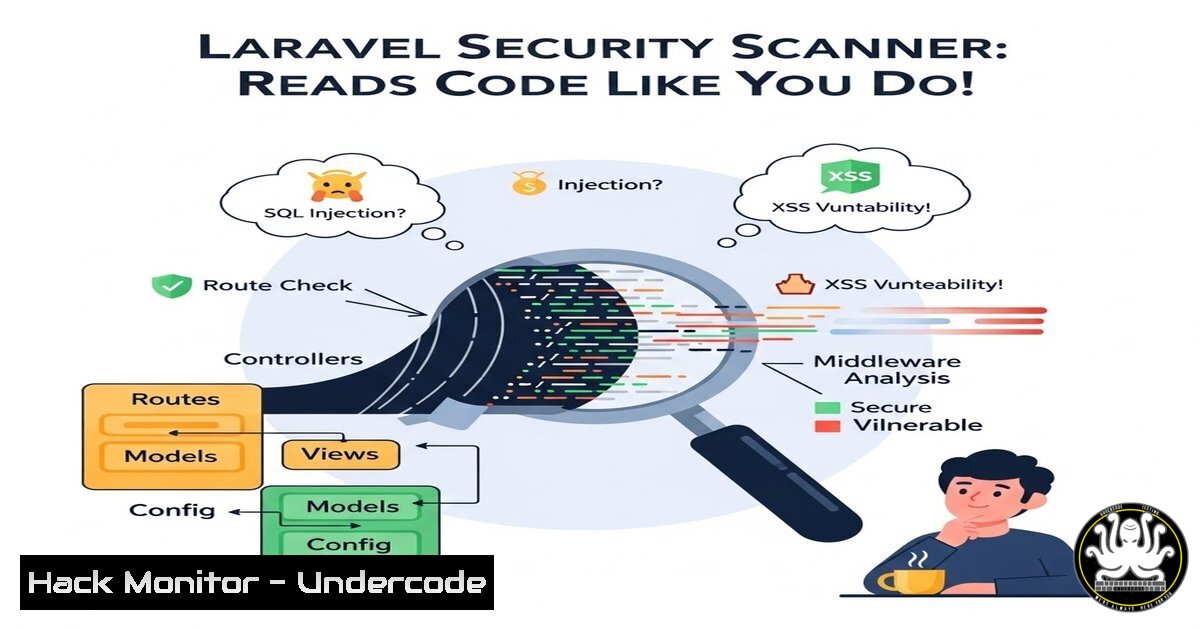
Laravel’s elegant syntax and rapid development capabilities have made it the go-to PHP framework for millions of developers, but that same speed-to-market often becomes an attacker’s best friend. Traditional security tools scan Laravel applications as generic PHP code, completely missing the framework-specific constructs—routes, middleware, Eloquent models, and Blade templates—that define modern Laravel architecture. A new open-source scanner, built in Go, is changing this paradigm by performing deep, context-aware analysis that understands Laravel the way a seasoned developer would, generating everything from SBOMs to route-specific vulnerability reports.
Learning Objectives:
- Understand why framework-aware security scanning is critical for Laravel applications
- Learn how to integrate Laravel-aware SAST and dependency scanning into CI/CD pipelines
- Master the process of contributing custom security rules to a community-driven Go-based scanner
- Identify common Laravel misconfigurations that generic PHP scanners routinely miss
- Implement automated route analysis and middleware auditing in your DevSecOps workflow
You Should Know:
1. Installing and Running the Laravel-Aware Security Scanner
The scanner is a command-line interface (CLI) tool written in Go, designed to be pointed directly at your Laravel project root. Unlike traditional scanners that parse PHP files without context, this tool reads your application structure, including routes defined in `web.php` and api.php, middleware registrations in Kernel.php, and Eloquent model relationships.
Installation (Linux/macOS):
 Clone the repository
git clone https://github.com/yassineelj/laravel-scanner.git
cd laravel-scanner

Build the Go binary
go build -o laravel-scanner ./cmd

Move to system PATH (optional)
sudo mv laravel-scanner /usr/local/bin/
Windows Installation (PowerShell as Administrator):
 Install Go if not already installed (choco is Chocolatey package manager)
choco install golang

Clone and build
git clone https://github.com/yassineelj/laravel-scanner.git
cd laravel-scanner
go build -o laravel-scanner.exe ./cmd

Add to PATH
$env:Path += ";$pwd"
Basic Scan Command:
 Point to your Laravel project
./laravel-scanner scan /path/to/your/laravel-project

Generate SBOM (Software Bill of Materials)
./laravel-scanner sbom /path/to/your/laravel-project --format=json

Run CVE checks on composer dependencies
./laravel-scanner cve-check /path/to/your/laravel-project
2. Comprehensive Route and Middleware Analysis
This is where the scanner truly differentiates itself. It parses your route files to understand authentication guards, middleware stacks, and exposed endpoints. It then correlates this with controller logic to identify routes that may be unintentionally public or missing critical middleware.
Route Audit Commands:
 List all routes with their middleware and authentication status
./laravel-scanner routes /path/to/your/laravel-project --verbose

Identify routes without authentication middleware
./laravel-scanner audit --unauthenticated-routes /path/to/your/laravel-project

Check for mass-assignment vulnerabilities in route-bound models
./laravel-scanner audit --mass-assignment /path/to/your/laravel-project
Example Output Analysis:
[bash] Route: POST /api/users/update
Controller: UserController@update
Middleware: [] (NONE DETECTED)
Risk: Unauthenticated user can modify user data
Suggested Fix: Add 'auth:api' middleware to route or controller constructor

[bash] Route: GET /admin/dashboard
Middleware: ['admin', 'verified']
Status: Properly protected
- Eloquent Model Security Auditing and Mass Assignment Protection
The scanner analyzes each Eloquent model for common security pitfalls, particularly focusing on mass assignment vulnerabilities that have historically plagued Laravel applications. It checks `$fillable` and `$guarded` properties, examines model events for security hooks, and identifies relationships that could lead to insecure data exposure.
Model Analysis Commands:
 Scan all models for security issues
./laravel-scanner models /path/to/your/laravel-project

Check for missing $fillable/$guarded in models
./laravel-scanner models --check-mass-assignment /path/to/your/laravel-project

Analyze model relationships for potential over-exposure
./laravel-scanner models --deep-relations /path/to/your/laravel-project
Sample Vulnerability Report:
{
"model": "App\Models\User",
"issue": "Mass assignment vulnerability",
"details": "Model lacks $fillable or $guarded properties",
"severity": "HIGH",
"recommendation": "Define $fillable = ['name', 'email'] or use $guarded = ['id', 'is_admin']"
}
4. Blade Template Security and XSS Prevention Scanning
Frontend security is often overlooked in PHP-centric scans. This tool examines your Blade templates for improper escaping, inline PHP usage, and potential XSS vectors. It understands the difference between `{{ }}` (escaped) and `{!! !!}` (unescaped) and flags dangerous usage patterns.
Template Security Checks:
 Scan Blade templates for XSS vulnerabilities
./laravel-scanner blade /path/to/your/laravel-project

Find unescaped output usage
./laravel-scanner blade --find-unescaped /path/to/your/laravel-project

Check for inline PHP in templates (security risk)
./laravel-scanner blade --inline-php /path/to/your/laravel-project
Critical Findings Example:
[bash] File: resources/views/profile/show.blade.php
Line 45: {!! $userBio !!}
Risk: Unescaped user input displayed directly
Impact: Persistent XSS vulnerability
Mitigation: Use {{ $userBio }} for automatic escaping
5. CI/CD Integration for Automated Security Gates
The scanner is built with DevSecOps in mind, offering seamless integration into GitHub Actions, GitLab CI, or Jenkins pipelines. It can fail builds based on severity thresholds, generate SARIF reports for GitHub Security tab integration, and post comments directly on pull requests.
GitHub Actions Workflow (.github/workflows/laravel-security.yml):
name: Laravel Security Scan

on:
push:
branches: [ main, develop ]
pull_request:
branches: [ main ]

jobs:
security-scan:
runs-on: ubuntu-latest
steps:
- uses: actions/checkout@v3

<ul>
<li>name: Set up Go
uses: actions/setup-go@v4
with:
go-version: '1.21'</p></li>
<li><p>name: Install Laravel Scanner
run: go install github.com/yassineelj/laravel-scanner@latest</p></li>
<li><p>name: Run Security Scan
run: laravel-scanner scan . --severity=HIGH --fail-on=CRITICAL</p></li>
<li><p>name: Generate SARIF Report
run: laravel-scanner scan . --format=sarif > results.sarif</p></li>
<li><p>name: Upload SARIF to GitHub
uses: github/codeql-action/upload-sarif@v2
with:
sarif_file: results.sarif
6. Contributing Custom Security Rules to the Community
The tool’s power lies in its extensibility. Security researchers and Laravel developers can contribute YAML-based rules that target specific Laravel vulnerabilities. Rules can check for improper queue job exposure, unsafe database queries, or custom middleware misconfigurations.
Example Custom Rule (rules/sql-injection.yaml):
name: "Raw SQL Injection in Eloquent"
description: "Detects raw SQL queries using DB::raw() with user input"
severity: CRITICAL
pattern:
- "DB::raw\(.\$<em>(GET|POST|REQUEST)"
- "whereRaw\(.\$</em>(GET|POST|REQUEST)"
fix: "Use parameter binding or Eloquent's safe methods"
Testing and Deploying Custom Rules:
 Add your custom rules directory
./laravel-scanner scan . --rules-path=./custom-rules/

Validate rule syntax
./laravel-scanner validate-rule ./custom-rules/sql-injection.yaml

Run scan with community-contributed rules
./laravel-scanner scan . --include-community-rules
7. AI-Enhanced Vulnerability Prediction and Remediation
The roadmap includes AI integration that will analyze scan results and provide contextual remediation suggestions. The AI component, once released, will understand Laravel conventions and generate corrected code snippets, suggest proper middleware ordering, and even predict attack vectors based on your application’s architecture.
Future AI Commands (Preview):
 Analyze vulnerability and suggest fix
./laravel-scanner ai-fix --issue-id=123

Predict potential exploit paths
./laravel-scanner ai-predict --route=api/orders

Generate security tests for found vulnerabilities
./laravel-scanner ai-generate-tests --output=tests/Security/
What Undercode Say:
- Context is the new signature: Generic PHP scanners are becoming obsolete; the future belongs to framework-aware tools that understand application architecture, not just syntax. This Laravel scanner represents a paradigm shift in how we approach web application security.
-
Community-driven rules will dominate: Just as Snort and Yara rules evolved through community contribution, Laravel security scanning will benefit from shared battle scars. The open invitation for contributions ensures this tool will rapidly cover emerging attack vectors unique to Laravel ecosystems.
-
AI augmentation is inevitable: The planned AI integration moves beyond detection into automated remediation. By understanding Laravel conventions, AI can suggest precise, working fixes rather than generic security advice, dramatically reducing the mean time to remediation (MTTR) for development teams.
The scanner addresses a critical gap in the security tooling landscape. Laravel’s popularity in startups and enterprises means millions of applications are running with security blind spots that traditional tools simply cannot see. By treating Laravel applications as first-class citizens with their own paradigms—routes, middleware stacks, Eloquent relationships, and Blade templating—this tool empowers developers to find and fix vulnerabilities before they reach production. The Go-based architecture ensures speed and cross-platform compatibility, while the open-source model guarantees transparency and community trust. For DevSecOps teams managing Laravel estates, this scanner isn’t just another tool; it’s the missing piece that finally speaks the same language as your developers.
Prediction:
Within 18 months, framework-aware security scanners will become the industry standard, forcing traditional SAST vendors to rebuild their analysis engines or risk obsolescence. The success of this Laravel scanner will inspire similar tools for Symfony, Rails, Django, and other major frameworks, creating an ecosystem where security tooling finally catches up with modern web development practices. The AI component, once mature, will evolve into autonomous security patches—bots that not only find vulnerabilities in Laravel apps but submit pull requests with working fixes, fundamentally changing the DevSecOps workflow from detection to automated remediation.
▶️ Related Video (80% Match):
🎯Let’s Practice For Free:
IT/Security Reporter URL:
Reported By: Eljakaniyassine Laravel – Hackers Feeds
Extra Hub: Undercode MoN
Basic Verification: Pass ✅


