Listen to this Post
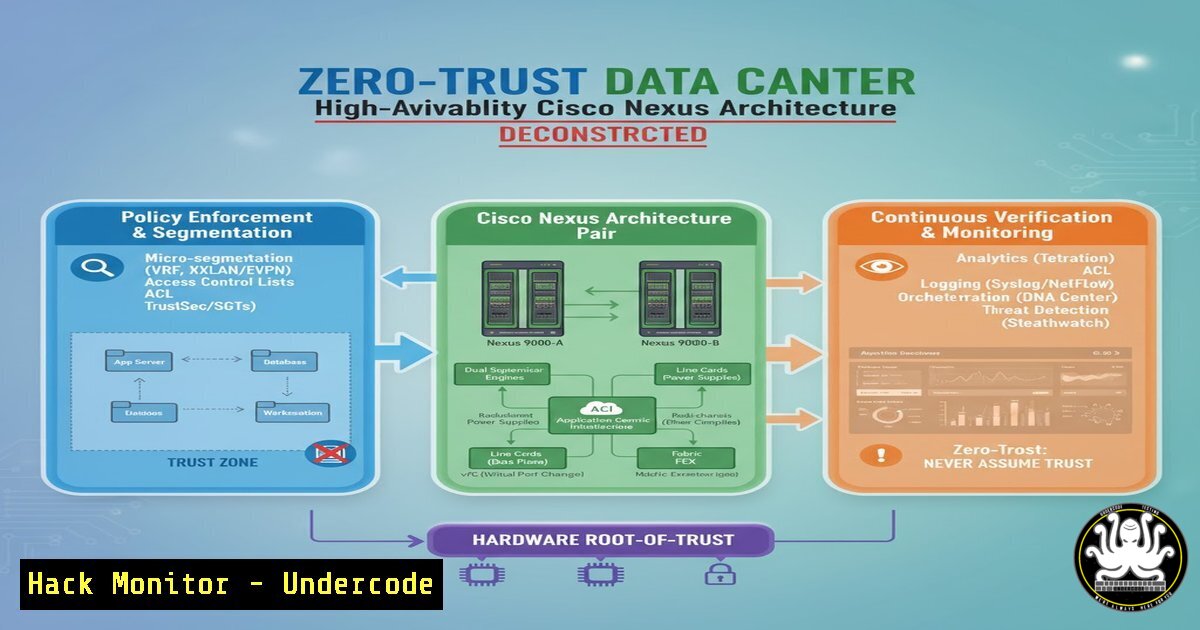
Introduction:
Modern data centers are evolving beyond traditional perimeter-based security, adopting a zero-trust posture where internal network resilience is paramount. This analysis deconstructs a highly resilient Cisco data center design, extracting the core commands and configurations that security and network professionals need to harden, manage, and troubleshoot such critical infrastructure.
Learning Objectives:
- Master key Cisco NX-OS commands for securing and validating FabricPath, vPC, and OTV configurations.
- Implement step-by-step hardening procedures for unified fabric integrating FCoE and Fibre Channel.
- Develop a proactive monitoring and verification strategy for high-availability data center layers.
You Should Know:
1. Validating the FabricPath Core
FabricPath replaces Spanning Tree Protocol (STP) to provide a loop-free, multi-path Layer 2 network. Verifying its health is critical for security and performance.
`show fabricpath isis adjacency`
`show fabricpath route`
`show fabricpath switch-id`
Step-by-step guide:
The `show fabricpath isis adjacency` command confirms that all FabricPath switches have formed neighbor relationships. A stable adjacency table is the foundation of the fabric. Next, `show fabricpath route` displays the learned FabricPath routes, allowing you to verify that all switches are reachable and the routing table is consistent. Finally, `show fabricpath switch-id` lists all the switches in the fabric with their assigned FabricPath IDs. Any inconsistencies here can lead to blackholed traffic or routing loops, directly impacting availability.
2. Hardening the vPC Domain
Virtual PortChannel (vPC) allows a device to form a port-channel with two physical switches. Misconfiguration can cause catastrophic network failures.
`show vpc`
`show vpc consistency-parameters`
`show vpc peer-keepalive`
Step-by-step guide:
Always begin with `show vpc` for a high-level status of the vPC domain, focusing on the peer-link and role. The cornerstone command is show vpc consistency-parameters. This output must be meticulously reviewed; any parameters listed under “Type 1” inconsistencies will cause vPC member ports to be suspended, creating an outage. Ensure parameters like MTU, STP mode, and speed/duplex match exactly. The `show vpc peer-keepalive` command verifies the state of the peer heartbeat, which is essential for split-brain scenarios.
3. Securing Overlay Transport Virtualization (OTV)
OTV extends Layer 2 networks across a Layer 3 underlay, introducing potential security risks if not properly controlled.
`show otv`
`show otv adjacency`
`show otv site vlans`
Step-by-step guide:
Use `show otv` to verify the overall state of the OTV overlay and its control plane status. The `show otv adjacency` command is crucial; it confirms that the remote OTV edge devices are reachable and authenticated. An unauthorized adjacency could lead to a malicious extension of your data center. Finally, `show otv site vlans` explicitly lists which VLANs are being extended. Adhere to the principle of least privilege—only extend the absolute minimum number of VLANs required to mitigate broadcast domain sprawl.
4. Unified Fabric: FCoE and NPV Verification
Fibre Channel over Ethernet (FCoE) converges storage and data networks. N_Port Virtualizer (NPV) mode reduces switch FC domain IDs.
`show fcoe`
`show npv interface status`
`show fcns database`
Step-by-step guide:
The `show fcoe` command provides a summary of FCoE sessions and interfaces, confirming the health of the converged network links. In an NPV setup, `show npv interface status` displays the state of the NPIV links to the core Fibre Channel switches (MDS in the design). To verify end-to-end storage visibility, the `show fcns database` command on the MDS switch lists all logged-in Fibre Channel devices. An unexpected entry here could indicate an unauthorized server accessing the SAN.
5. Infrastructure Hardening with AAA and Role-Based Access
Preventing unauthorized configuration changes is foundational to data center security.
`aaa authentication login default local`
`aaa authorization commands default local`
`role name network-admin`
Step-by-step guide:
Configure `aaa authentication login default local` to enforce local username/password authentication for management access, though using a TACACS+ server is preferred in production. The `aaa authorization commands default local` command ensures that every command entered by a user is checked against their assigned privilege level. Create custom roles using the `role name` command, such as a “network-operator” role with `show` command permissions only, to enforce the principle of least privilege and prevent lateral movement by an attacker.
6. Proactive Monitoring with EEM and Logging
Embedded Event Manager (EEM) can automate responses to specific network events, enhancing resilience.
`event manager applet PORT-BPDUGUARD`
`action 1.0 syslog msg “BPDU Guard violation on $interface”`
`action 2.0 cli command “enable”`
`action 3.0 cli command “config t”`
`action 4.0 cli command “interface $interface”`
`action 5.0 cli command “shutdown”`
Step-by-step guide:
This EEM applet automatically responds to a BPDU Guard violation. When triggered, it first logs the event (action 1.0), then enters enable mode and configuration mode (actions 2.0 and 3.0), identifies the offending interface using the built-in `$interface` variable (action 4.0), and proactively shuts it down (action 5.0). This scripted response contains potential spanning-tree attacks or misconfigurations instantly, protecting the stability of the Layer 2 domain.
7. FCIP Tunnel Configuration and Encryption
FCIP tunnels extend the SAN over IP networks, which requires encryption to protect data in transit.
`fcip profile 1`
`ip address 203.0.113.1`
`crypto auth-mode xrcv`
`crypto key my-secret-key`
`fcip tunnel 1`
`use-profile 1`
`peer-ip-address 203.0.113.2`
Step-by-step guide:
First, define an FCIP profile with fcip profile 1. Under the profile, specify the local IP address and, critically, enter the cryptographic configuration with `crypto auth-mode xrcv` and the shared secret crypto key. This ensures all traffic over the tunnel is authenticated. Finally, create the tunnel interface itself with fcip tunnel 1, associating the profile and the remote peer’s IP address. Without this encryption, sensitive storage data like VM snapshots and database backups would be transmitted in cleartext over the WAN.
What Undercode Say:
- Resilience is Security: A highly available network is a secure network. Outages caused by misconfigured vPC or FabricPath are a primary form of Denial-of-Service. The commands provided are not just operational tools but essential for validating security postures against downtime.
- The Convergence Attack Surface: Unified fabric (FCoE) merges two threat landscapes. An attacker who compromises the Ethernet network is now one misconfiguration away from the storage network. Rigorous segmentation and strict access control, verified by the `show fcns database` and AAA commands, are non-negotiable.
The architectural elegance of this design belies its operational complexity. Each redundancy protocol introduces its own failure domain and potential misconfiguration vector. Security in this context is not a feature but an emergent property of relentless verification, consistent configuration, and automated enforcement. The future of data center defense lies in treating infrastructure-as-code not just for deployment, but for continuous security validation, where the `show` commands listed are scripted and their outputs analyzed autonomously to detect configuration drift or malicious activity.
Prediction:
The increasing complexity of data center fabrics will outpace manual human oversight. We predict the next wave of attacks will target the control planes of these overlay technologies (FabricPath IS-IS, OTV) with sophisticated fuzzing and poisoning attacks, aiming to collapse the network from within. The mitigation will be a shift towards intent-based networking and AI-driven security validation, where machine learning models continuously audit configurations and traffic flows against a declared security policy, automatically quarantining components that deviate from their intended state.
🎯Let’s Practice For Free:
IT/Security Reporter URL:
Reported By: Ah M – Hackers Feeds
Extra Hub: Undercode MoN
Basic Verification: Pass ✅


