Listen to this Post
Introduction:
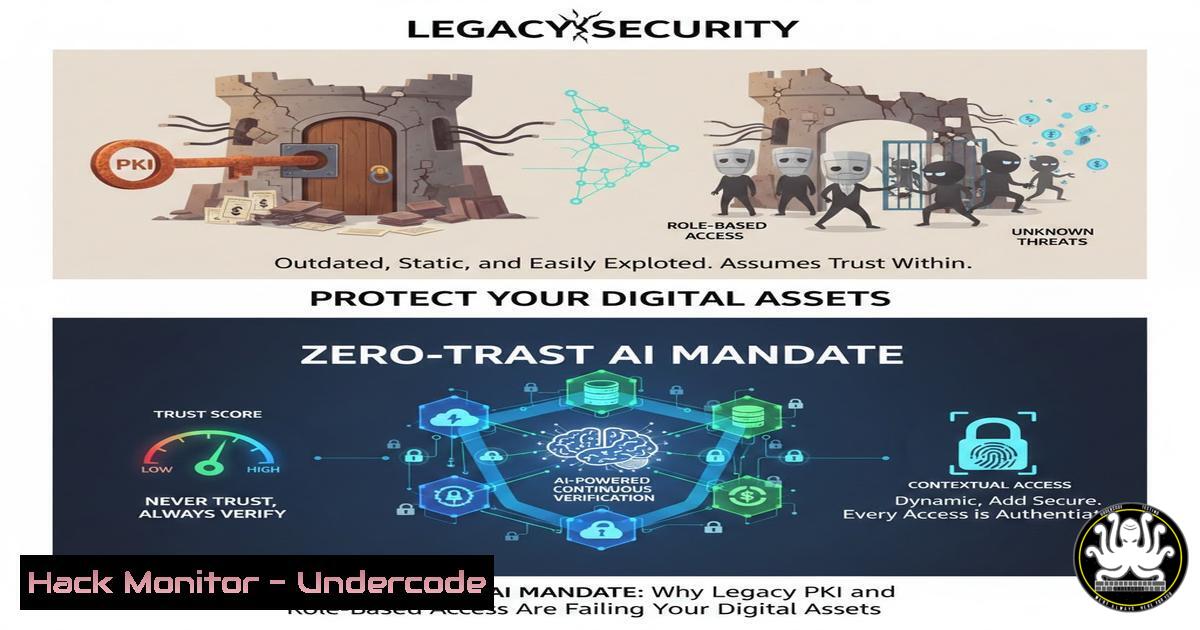
The rapid adoption of AI services is exposing critical flaws in traditional IT governance frameworks. Legacy systems built on B2B protocols, centralized cloud hosting, and simple role-based identity are fundamentally unequipped to handle the dynamic, data-intensive nature of AI. This article explores the emergent need for a meshed, nodal platform architecture that embeds cryptographic trust and mission-based governance directly into the fabric of AI operations.
Learning Objectives:
- Understand the limitations of legacy identity and access management (IAM) in governing AI services.
- Learn how Zero-Trust Architecture (ZTA) and advanced Public Key Infrastructure (PKI) form the bedrock for trustworthy AI systems.
- Explore practical steps for implementing a nodal governance model for digital asset compliance.
You Should Know:
- The Inevitable Collision: AI Services and Legacy IAM
The foundational problem is that most AI services operate in a stateless, context-agnostic manner, while traditional governance relies on static, role-based permissions. A user with “read” access might prompt an AI to generate a comprehensive report synthesizing confidential data, effectively performing a “write” or “synthesize” operation that their role never intended to allow.
Step-by-step guide explaining what this does and how to use it:
Step 1: Identify AI Service Touchpoints. Map every interaction between users, applications, and AI models (e.g., via APIs like OpenAI, Azure Cognitive Services).
Step 2: Audit Permissions. Scrutinize the effective permissions of service accounts and users accessing these AI services. On Linux, for a service account, you might use: `sudo -u sudo -u <service_account> access-rights-check-tool.
Step 3: Enforce Context-Aware Policies. Move beyond roles to attribute-based access control (ABAC). Policies should evaluate the mission context, data sensitivity, and the intended use of the AI-generated output, not just who is making the request.
- PKI: The Non-Negotiable Foundation for Digital Asset Trust
As highlighted in the source post, you cannot have trustworthy digital assets without a robust PKI. PKI provides the cryptographic underpinning for identity, data integrity, and non-repudiation, ensuring that every piece of data and every AI-generated artifact can be traced and verified.
Step-by-step guide explaining what this does and how to use it:
Step 1: Deploy a Root Certificate Authority (CA). This can be an internal CA using open-source tools like OpenSSL.
`openssl genpkey -algorithm RSA -out ca.key -aes256`
`openssl req -new -x509 -days 365 -key ca.key -out ca.crt`
Step 2: Issue Digital Certificates for AI Services. Every AI model and service endpoint should have a unique certificate for authentication.
`openssl req -new -newkey rsa:2048 -nodes -keyout ai_service.key -out ai_service.csr`
`openssl x509 -req -in ai_service.csr -CA ca.crt -CAkey ca.key -CAcreateserial -out ai_service.crt -days 365`
Step 3: Enforce Mutual TLS (mTLS). Configure your API gateways and service meshes to require mTLS, ensuring both the client and the AI service prove their identities before any data is exchanged.
3. Implementing a Zero-Trust Nodal Platform
A “meshed web engine nodal platform,” as described, treats every component (user, AI service, data store) as an untrusted node that must continuously verify itself. This is the operationalization of Zero-Trust.
Step-by-step guide explaining what this does and how to use it:
Step 1: Micro-segment Your Network. Isolate AI training data, model repositories, and inference endpoints into distinct network segments. Use firewall rules to only allow explicit, verified traffic.
Windows Command (PowerShell): `New-NetFirewallRule -DisplayName “Allow_AI_Service_A_to_B” -Direction Inbound -Protocol TCP -LocalPort 443 -RemoteAddress
Step 2: Deploy a Continuous Verification Engine. Use tools like OpenZiti or leverage service mesh capabilities (Istio, Linkerd) to inject cryptographic identity into every service-to-service call, ensuring that only authorized nodes can communicate.
Step 3: Log and Monitor All Interactions. Every API call to an AI service must be logged with its cryptographic proofs. Tools like the Elastic Stack (ELK) or Splunk can be configured to ingest these logs for real-time anomaly detection.
4. Mission-Based AI Governance and Compliance
“Mission-based AI” implies that the AI’s actions are constrained and evaluated against a specific organizational context and set of values. This is crucial for compliance with regulations like GDPR, SFDR, and upcoming AI Acts.
Step-by-step guide explaining what this does and how to use it:
Step 1: Define Your Mission Guardrails. Codify your organization’s ethical guidelines and compliance requirements into a machine-readable policy format, such as Open Policy Agent (OPA) Rego language.
Example OPA Snippet:
package ai_guardrails

default allow = false

allow {
input.action == "generate_report"
input.user.department == "Legal"
not contains_sensitive_data(input.prompt)
}

contains_sensitive_data(s) {
re_match("confidential|proprietary", s)
}
Step 2: Integrate Policy Decision Points. Place these policy engines (e.g., OPA) as intermediaries between user requests and the AI service API. The API call proceeds only if the policy evaluation returns allow = true.
Step 3: Automate Compliance Auditing. Use the immutable logs from your nodal platform to automatically generate compliance reports, proving that all AI interactions adhered to the defined mission and regulatory constraints.
5. Hardening the AI Supply Chain
The software supply chain is a major attack vector, and AI models, with their complex dependencies, are particularly vulnerable. An attacker can poison a training dataset or compromise a model repository.
Step-by-step guide explaining what this does and how to use it:
Step 1: Sign and Verify AI Artifacts. Treat AI models and datasets as code. Sign them with Sigstore or similar tools upon creation.
`cosign sign –key cosign.key my-company/ai-model:v1.2`
Step 2: Scan for Vulnerabilities. Integrate static application security testing (SAST) and software composition analysis (SCA) tools like Snyk or GitHub Advanced Security into your AI model CI/CD pipeline to scan for vulnerabilities in the code and libraries.
Step 3: Enforce Immutable Provenance. Use a system like in-toto to create a verifiable chain of evidence from data collection and model training to deployment, ensuring the integrity of the entire AI lifecycle.
What Undercode Say:
- Cryptographic Identity is the New Perimeter. The future of secure AI is not building higher walls but giving every entity a verifiable digital identity that is checked on every transaction. PKI is not legacy; it is more critical than ever.
- Governance Must Be Baked-In, Not Bolted-On. Attempting to retrofit AI governance onto legacy IAM and network architectures is a losing battle. A purpose-built, nodal, Zero-Trust platform is not an option but a necessity for any organization serious about using AI to create and manage valuable digital assets.
The analysis suggests a fundamental shift from centralized, perimeter-based security to a decentralized, cryptographically verifiable trust model. This approach directly addresses the “gaps legacy architectures can’t bridge” by making trust and compliance inherent properties of the system, not afterthoughts. It moves security from a static, human-defined role to a dynamic, context-aware, and machine-enforceable policy, which is the only way to keep pace with AI.
Prediction:
Within the next 2-3 years, regulatory frameworks for AI will mature to the point where demonstrable, technically-enforced governance—of the kind described by the CuMesh approach—will be a legal requirement for operating AI in sensitive sectors like finance and healthcare. We will see the rise of “AI Security Posture Management” tools that automatically audit and enforce these nodal, Zero-Trust principles, and CISOs will be judged on their ability to cryptographically prove the integrity and compliance of their organization’s AI-generated digital assets.
🎯Let’s Practice For Free:
IT/Security Reporter URL:
Reported By: Alan Lloyd – Hackers Feeds
Extra Hub: Undercode MoN
Basic Verification: Pass ✅


