Listen to this Post
Introduction:
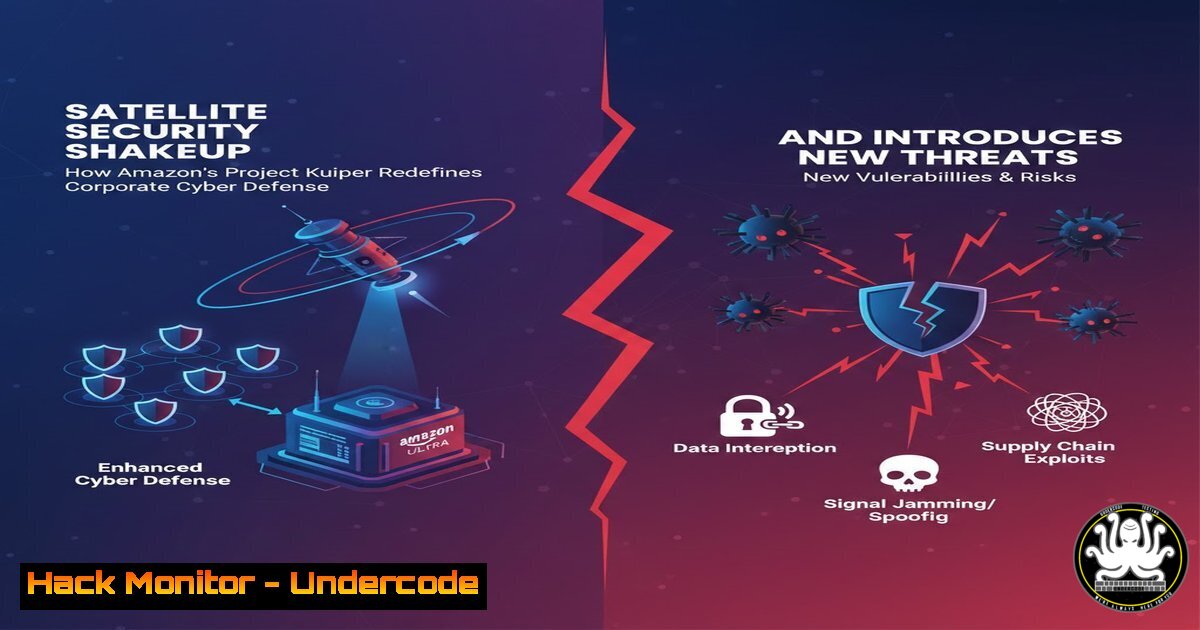
The race for space-based internet supremacy is accelerating, with Amazon’s Project Kuiper entering the arena with its Leo Ultra terminal. Promising gigabit speeds and direct cloud integration, this technology isn’t just a connectivity game-changer; it’s a paradigm shift for corporate network perimeters. For cybersecurity professionals, the emergence of another satellite attack vector demands immediate scrutiny and strategic planning.
Learning Objectives:
- Understand the unique security implications of integrating high-throughput satellite terminals into enterprise network architectures.
- Learn how to harden a satellite internet connection against eavesdropping, signal interception, and unauthorized access.
- Develop a strategy for securely leveraging direct cloud connectivity (AWS) via satellite links while minimizing the attack surface.
You Should Know:
1. The Expanded Corporate Attack Surface
The installation of a Leo Ultra terminal effectively places a new, publicly accessible network gateway on your corporate roof. Unlike fiber, which has physical path obscurity, satellite signals are broadcast through the air, making them inherently more susceptible to interception than a buried cable.
Step-by-step guide explaining what this does and how to use it:
Step 1: Physical Security Assessment. Treat the terminal like critical infrastructure. Conduct a site survey to ensure it is mounted in a location that is difficult to access physically. Fencing, camera surveillance, and tamper-evident seals should be considered.
Step 2: Signal Encryption Verification. Do not assume the link is encrypted end-to-end by default. Contact the service provider (Amazon) to confirm the encryption protocols used for the signal between the terminal, the satellite, and the ground station. Look for documentation specifying AES-256 or equivalent for data in transit.
Step 3: Network Segmentation. The terminal should not plug directly into your core corporate network.
On your firewall, create a dedicated zone for the satellite link.
Use strict Access Control Lists (ACLs) to only allow traffic from this zone to specific, necessary destinations (e.g., your AWS VPC).
Example Firewall Rule (Conceptual): `ALLOW source: SATELITE_ZONE destination: AWS_VPC_CIDR protocol: TCP port: 443,22 DENY source: SATELITE_ZONE destination: CORPORATE_LAN_ZONE`
2. Leveraging and Securing Direct-to-Cloud Links
Amazon highlights direct connectivity to AWS. This bypasses the public internet, reducing latency and exposure to common internet-based attacks. However, it creates a direct pipeline from a potentially vulnerable terminal into your cloud crown jewels.
Step-by-step guide explaining what this does and how to use it:
Step 1: Implement AWS Network Firewall. Before routing traffic from the satellite link to your Amazon VPC, deploy an AWS Network Firewall. This acts as a stateful, managed firewall for your VPC.
AWS CLI Command to create a firewall (simplified):
aws network-firewall create-firewall --firewall-name KuiperFirewall --vpc-id vpc-abcdefg123456 --subnet-mappings SubnetId=subnet-12345,subnet-67890
Step 2: Harden VPC Security Groups and NACLs. The security groups for your EC2 instances and the Network ACLs for your subnets must be meticulously configured.
Example Security Group Inbound Rule: Only allow SSH (port 22) and RDP (port 3389) from your corporate IP space, not from the satellite link’s IP range. Web services (port 443) might be allowed from the satellite zone if a specific application requires it.
Step 3: Mandate Multi-Factor Authentication (MFA). Any administrative access to AWS services (Console, CLI) traversing this link must be protected with MFA. Enforce this using AWS IAM policies.
3. Mitigating Signal Jamming and Spoofing Threats
Satellite signals, especially in the Ka/Ku bands used for these services, can be vulnerable to targeted jamming (Denial-of-Service) or spoofing (redirecting traffic).
Step-by-step guide explaining what this does and how to use it:
Step 1: Establish Redundancy. The primary mitigation for jamming is a redundant internet connection via a different medium (e.g., terrestrial fiber, 5G). Configure your edge router to fail over automatically if the satellite link goes down.
Cisco IOS Example (HSRP for redundancy):
interface GigabitEthernet0/0/0
description Primary-Fiber-Link
ip address 192.168.1.1 255.255.255.0
standby 1 ip 192.168.1.254
standby 1 priority 110
standby 1 preempt
interface GigabitEthernet0/0/1
description Secondary-Satellite-Link
ip address 10.0.0.1 255.255.255.0
standby 2 ip 10.0.0.254
standby 2 priority 90
Step 2: Monitor Link Integrity. Use network monitoring tools (e.g., Zabbix, PRTG) to track satellite link latency, jitter, and packet loss. A sudden, sustained degradation could indicate jamming and should trigger a security alert.
4. Ensuring Endpoint Security for Remote Sites
Leo Ultra will be deployed at remote offices, industrial sites (OT), and mobile platforms. These endpoints are often less defended than a central HQ.
Step-by-step guide explaining what this does and how to use it:
Step 1: Enforce Zero-Trust Network Access (ZTNA). Instead of traditional VPNs that grant broad network access, implement a ZTNA solution. This mandates that every connection to any application must be authenticated, authorized, and encrypted, regardless of the user’s location.
Step 2: Deploy EDR/XDR. Install a robust Endpoint Detection and Response (EDR) or Extended Detection and Response (XDR) platform on all assets behind the satellite terminal. Ensure it is configured to block ransomware, fileless attacks, and beaconing C2 communication.
Step 3: Hardening Script (Linux Example for a remote server):
 Harden SSH configuration
sudo sed -i 's/PermitRootLogin yes/PermitRootLogin no/' /etc/ssh/sshd_config
sudo sed -i 's/PasswordAuthentication yes/PasswordAuthentication no/' /etc/ssh/sshd_config
sudo systemctl restart sshd

Configure UFW (Uncomplicated Firewall)
sudo ufw default deny incoming
sudo ufw default allow outgoing
sudo ufw allow from YOUR_TRUSTED_IP to any port 22
sudo ufw enable
5. Vulnerability Management for the Terminal Itself
The terminal runs a proprietary OS and software. Like any IoT device, it will have vulnerabilities that require patching.
Step-by-step guide explaining what this does and how to use it:
Step 1: Proactive Patching Policy. Establish a process to monitor for and apply firmware updates for the Leo Ultra terminal as soon as they are released by Amazon. Subscribe to their security advisories.
Step 2: Network Behavior Analysis. Use an Intrusion Detection System (IDS) like Suricata or Zeek to monitor traffic to and from the terminal’s management IP address. Look for anomalous outbound connections that could indicate a compromised device.
Example Suricata Rule to Alert on Suspicious Outbound Traffic:
`alert ip any any -> !$HOME_NET any (msg:”Suspicious Outbound Connection from Satellite Terminal”; sid:1000001; rev:1;)`
What Undercode Say:
- The corporate perimeter is officially in orbit. Security teams can no longer focus solely on terrestrial connections; the attack surface now includes the radio frequency spectrum above their facilities.
- The convergence of satellite and cloud technologies creates a powerful capability but also a high-risk, high-reward target for advanced threat actors. A breach here could mean direct, unfettered access from a physical terminal to a core cloud environment.
The launch of Leo Ultra signifies a maturation of LEO satellite internet, moving it from a consumer/soho product to a critical business enabler. This transition is what should grab the attention of every CISO. The direct-to-cloud feature is a double-edged sword, offering performance and security benefits while simultaneously creating a potential shortcut for attackers if the terminal or its local network is compromised. The security community must now develop new frameworks and best practices specifically for space-based access points, treating them not as novelty items but as critical infrastructure requiring defense-in-depth, from the physical dish to the cloud API.
Prediction:
Within the next 18-24 months, we will witness the first major cybersecurity incident attributed to a compromised corporate satellite terminal. This will likely involve a sophisticated cybercriminal or state-sponsored group exploiting an unpatched vulnerability in the terminal’s firmware or its supporting network infrastructure. The incident will lead to data exfiltration or ransomware deployment directly through the satellite link, forcing a rapid industry-wide shift towards stricter security standards and regulatory scrutiny for business-grade satellite internet services. This will simultaneously accelerate the development of “Secure Access Service Edge” (SASE) architectures that are agnostic to the underlying network connectivity type.
🎯Let’s Practice For Free:
IT/Security Reporter URL:
Reported By: Bobcarver Technology – Hackers Feeds
Extra Hub: Undercode MoN
Basic Verification: Pass ✅


