
Listen to this Post
Introduction:
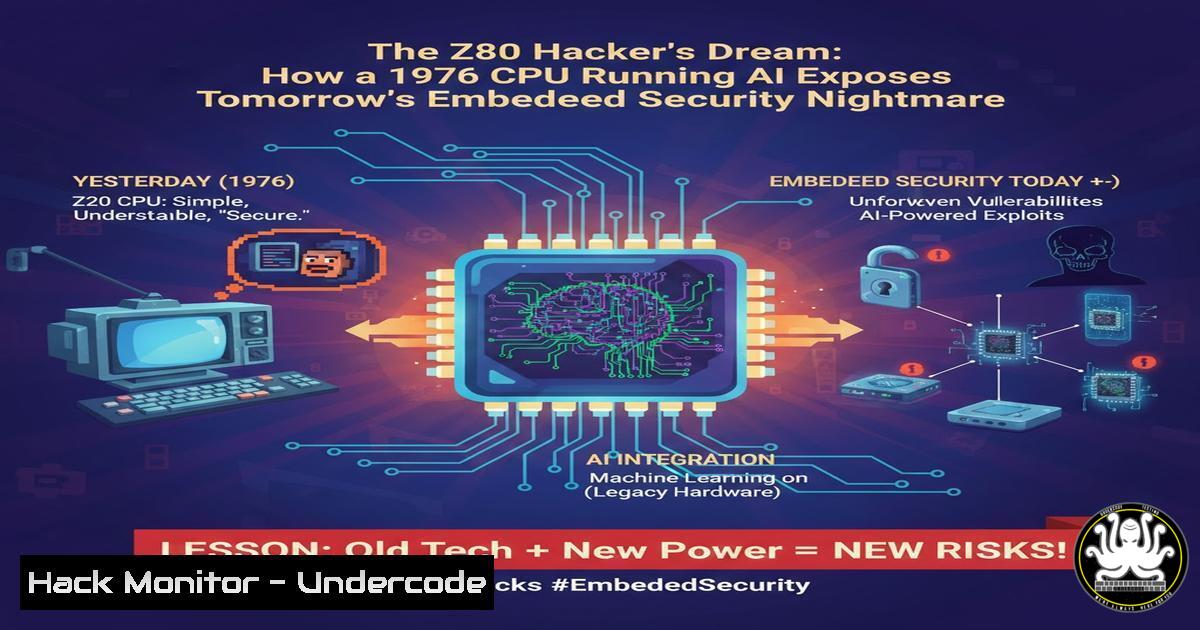
A developer’s breakthrough demonstration of running a conversational AI on a 1976-era Zilog Z80 CPU with only 64KB of RAM is not just a technical curiosity; it’s a stark warning for cybersecurity professionals. This feat proves that highly efficient, malicious AI agents can operate on the most constrained legacy hardware, turning forgotten industrial control systems, medical devices, and network appliances into potent, intelligent attack vectors. The paradigm of assuming limited computational power as a security control is now irrevocably shattered.
Learning Objectives:
- Understand the security implications of ultra-efficient machine learning models deployed on legacy and embedded systems.
- Learn methods to emulate, analyze, and test software on vintage architectures like the Z80 from a modern pentesting platform.
- Develop strategies for hardening embedded and legacy systems against the future threat of micro-AI payloads.
You Should Know:
- Deconstructing the Z80-μLM: When “Impossible” AI Becomes a Pentesting Tool
The core of this project is the Z80-μLM—a meticulously crafted machine learning model small enough to reside in 64KB. This is achieved through extreme quantization, model pruning, and custom tokenizers. For security testing, this means proof-of-concept malware with local “intelligent” decision-making can bypass defenses that rely on detecting cloud-based AI API calls.
Step‑by‑step guide explaining what this does and how to use it:
1. Acquire the Toolchain: To analyze such software, you need a cross-compilation and emulation environment. On a Linux pentesting box, install the `z80asm` assembler and the `z88dk` compiler suite.
sudo apt-get update
sudo apt-get install z80asm z88dk
2. Emulate the Target: Use an emulator like `z80sim` to create a safe, isolated environment to run and dissect Z80 binaries.
git clone https://github.com/z80sim/z80sim
cd z80sim
make
./z80sim -f path/to/z80-ulm.rom
3. Static Analysis: Use a disassembler like `z80dasm` to convert the binary into assembly for review.
z80dasm -l -g 0 -t path/to/z80-ulm.bin > disassembly.asm
4. Conceptualize the Payload: Imagine repurposing the model’s “decision” logic. Instead of guessing an animal in 20 questions, it could iteratively guess a 4-digit PIN on a serial console or make micro-adjustments to a PLC’s timing registers.
- Hardware Emulation & Firmware Extraction: The First Step to Compromise
Before attacking a legacy system, you must understand its firmware. Many Z80-based systems use EPROMs or flash chips.
Step‑by‑step guide explaining what this does and how to use it:
1. Identify Storage: Physically locate the firmware chip (often a 28-pin DIP IC) on the target device’s board.
2. Extract Firmware: Use a hardware tool like a CH341A EEPROM programmer connected to your Kali Linux machine.
 Identify the connected programmer
lsusb | grep CH341
 Use flashrom to read the chip (chip model may vary)
sudo flashrom -p ch341a_spi -r extracted_firmware.bin
3. Load for Analysis: Load the extracted binary into the emulator (z80sim) or a more advanced analysis framework like Ghidra (with a Z80 processor module installed) to search for vulnerabilities like hardcoded credentials or buffer overflow points in serial input handlers.
3. Crafting a Micro-AI Payload for Serial-Based Exploitation
Legacy systems often communicate via serial ports (UART). A malicious micro-AI could use this channel for intelligent fuzzing.
Step‑by‑step guide explaining what this does and how to use it:
1. Set Up a Serial Bridge: Connect to the target’s UART pins (TX, RX, GND) using a USB-to-TTL adapter.
2. Interact and Map: Use a script to map the CLI and identify input vectors.
 Connect to the serial console
sudo screen /dev/ttyUSB0 9600
3. Deploy a Python-Powered “AI Fuzzer”: On your attacking machine, write a script that uses a tiny, rule-based AI (like a decision tree) to intelligently fuzz serial commands based on previous responses, rather than sending random data.
import serial
from sklearn.tree import DecisionTreeClassifier  Example for conceptual design
ser = serial.Serial('/dev/ttyUSB0', 9600, timeout=1)
 ... Logic to send prompts, parse responses, and adapt inputs
 This model would be trained on expected vs error responses to guess valid commands.
This conceptual script highlights how an AI model, even a simple one, could automate exploitation on constrained interfaces.
- Hardening Vintage Systems in an AI-Capable Threat Landscape
Mitigation requires a layered approach, as traditional endpoint security is not an option.
Step‑by‑step guide explaining what this does and how to use it:
1. Network Segmentation: Isolate all legacy systems in their own VLAN with strict firewall rules denying all outbound internet access and only permitting essential inbound traffic from a jump host.
 Example iptables rule on a gateway protecting the legacy VLAN
sudo iptables -A FORWARD -s 192.168.10.0/24 -d 0.0.0.0/0 -j DROP
2. Serial Port Monitoring: Implement a serial-to-network tap and use an IDS like Snort to monitor for anomalous command sequences.
3. Firmware Integrity Checking: Regularly extract and hash the firmware (as shown in Section 2) to create a baseline. Use a cron job to automate periodic checks and alert on changes.
 Simple hash check script
sha256sum /path/to/baseline_firmware.bin
sha256sum /path/to/newly_extracted_firmware.bin
- The Future: AI Worm Development for Air-Gapped Legacy Networks
The final, most advanced threat is a self-propagating micro-AI worm designed for air-gapped industrial networks, spreading via removable media or stolen credentials.
Step‑by‑step guide explaining what this does and how to use it:
1. Research Propagation Mechanisms: Study how Stuxnet used stolen drivers and zero-days. For Z80 systems, propagation might involve compromising the firmware update process or a connected SCADA workstation.
2. Develop Payload Logic: The AI’s role would be to profile the local environment on each hop (e.g., identify connected PLC models via serial scans) and tailor its next-stage payload from a tiny, internal library of exploits.
3. Mitigation Strategy: Defense relies on extreme application whitelisting on any Windows machines connected to these networks and physical write-protection of firmware chips on legacy devices.
What Undercode Say:
- The Floor Just Dropped: The assumption that advanced threats require modern compute is dead. The most significant risk now lies in the vast, unmonitored sea of legacy embedded hardware that was never designed with AI-powered threats in mind.
- Dual-Use Tools are Multiplying: The tools for emulation, firmware extraction, and cross-compilation used by retro-computing enthusiasts are the same as those used by threat actors targeting operational technology (OT). Defender familiarity with these tools is now mandatory.
This demonstration is a canonical example of a capability expanding the attack surface. Security teams must immediately inventory all legacy and embedded systems, treat them as high-risk assets regardless of their perceived simplicity, and assume they are capable of hosting intelligent, persistent threats. The focus shifts from pure network monitoring to deep firmware integrity and anomalous physical-layer communication analysis.
Prediction:
Within the next 3-5 years, we will see the first documented incident of a micro-machine-learning model deployed as a key component of targeted ICS/SCADA malware. Its purpose will not be grand sabotage, but stealthy, persistent intelligence gathering and environmental mapping—behaving like a digital insect that learns the system’s normal patterns to hide and eventually deliver a precise, destructive payload. This will force a renaissance in hardware-based security for critical infrastructure, moving beyond signatures to physical intrusion detection and runtime firmware attestation for even the oldest components.
▶️ Related Video (78% Match):
🎯Let’s Practice For Free:
IT/Security Reporter URL:
Reported By: Michael Tchuindjang – Hackers Feeds
Extra Hub: Undercode MoN
Basic Verification: Pass ✅


