
Listen to this Post
Introduction:
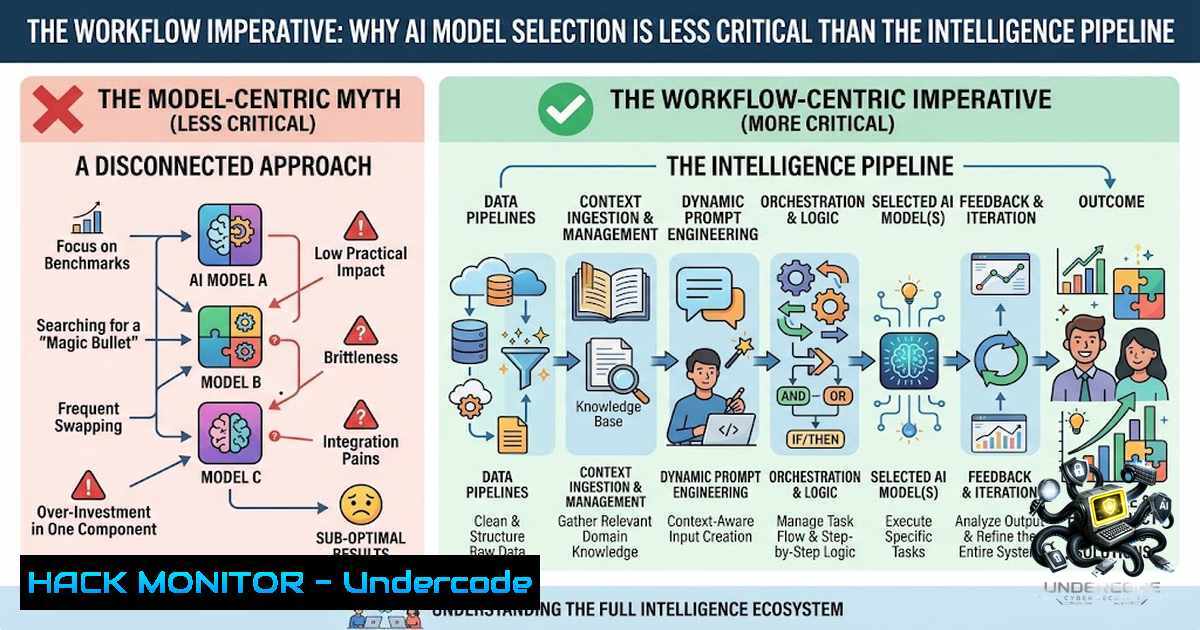
The current discourse surrounding artificial intelligence remains heavily fixated on model-to-model comparisons, benchmark scores, and the raw statistical performance of large language models. However, this focus often obscures a more critical organizational challenge: the transformation of raw AI output into actionable, decision-ready intelligence. While AI models are rapidly becoming a commoditized utility with abundant capability, the institutional value derived from these systems hinges almost entirely on the governance, structure, and rigor of the workflow that frames their use. The central question for enterprises is shifting from “Which model is best?” to “What workflow should govern how intelligence becomes a decision?”
Learning Objectives & Secrets:
- Objective 1: Recognize the Fallacy of Single-Model Superiority. Understand that comparing AI models without a defined operational context is an academic exercise with limited real-world application. The “best” model is the one whose output aligns with the specific constraints, risk tolerances, and data realities of your business problem.
- Objective 2 Secret Tips: Audit for “Resolvedness” Before Action. The secret to effective AI integration lies not in the answer provided, but in the logic that precedes it. Develop a habit of interrogating whether the system has resolved the core variables that could materially change the outcome—such as market definitions, purchasing power, or strategic trade-offs—before it commits to a recommendation.
- Objective 3 Secret Tips: Design for Contextual Resilience. A robust AI workflow must be resilient to changes in context. When shifting from a market analysis question to a human resources or capital allocation query, the underlying data parameters change. Your workflow must adapt its pre-processing and variable resolution logic accordingly, rather than relying on a static prompt.
You Should Know:
- Shifting the Lens from Model Metrics to Workflow Fidelity
The fundamental issue with current AI adoption strategies is the over-reliance on static benchmarks. These benchmarks often test knowledge recall and basic reasoning but fail to assess a system’s ability to handle complex, multi-variable decision-making. The problem is not that models are inaccurate; it is that they are often given a question without the necessary contextual scaffolding. In institutional settings, a decision is rarely a single question and answer. It is a process of iteration, validation, and sensitivity analysis. The workflow must force the system to surface its assumptions and test their stability. For example, when asking about the “best smartphone,” the workflow should first resolve the definition of “most people,” the relevant geographic market, and the budget constraints. Without this structured preamble, the output is merely a statistical guess, not a decision-ready insight.
Step‑by‑Step Guide: Implementing a Pre‑Decision Resolution Protocol
- Define Decision Boundaries: Clearly outline the constraints of the decision (e.g., budget caps, geographic limitations, strategic priorities).
- Prompt for Variable Resolution: Design prompts that force the AI to list and justify its key assumptions before providing a final answer.
- Create a Sensitivity Matrix: Ask the AI to re-evaluate its answer if one of the key variables (e.g., price, availability) were to change by a certain percentage.
- Human Validation Gate: Implement a manual review step where a subject matter expert verifies the resolved variables before accepting the recommendation. This ensures that the workflow, not just the model, is accountable for the outcome.
2. Decomposing the Institutional Decision Structure
The complexity of a decision scales with the context. Market decisions require analysis of external data streams; people decisions involve psychometrics and cultural fit; strategy decisions involve competitive dynamics; and capital decisions involve risk-adjusted return models. A workflow that works flawlessly for market analysis will fail in operations because the data sources and variable dependencies are entirely different. The solution is to build modular workflows that can be reconfigured based on the decision domain. This involves creating a taxonomy of decision types and mapping appropriate data pipelines and resolution protocols to each. The key is to avoid a “one-size-fits-all” approach to AI prompting, recognizing that the workflow surrounding the model is the primary differentiator.
Step‑by‑Step Guide: Building a Domain‑Adaptive Workflow
- Categorize Decision Domains: Classify decisions into categories (e.g., Market, People, Strategy, Capital, Operations).
- Map Data Sources: For each domain, identify the internal and external data sources required for the AI to operate effectively.
- Define Variable Resolution Rules: For each domain, script specific rules to resolve variables (e.g., for Capital: fetch real-time interest rates, for People: access HR policies).
- Implement Orchestration Logic: Use a workflow automation tool to route the question to the correct domain-specific workflow.
- Monitor Performance: Track how often the AI needs to re-query or “fall back” to a human for variable resolution to identify gaps in the workflow design.
3. The Technical Infrastructure for Decision-Ready AI
To operationalize this workflow-driven approach, your technical infrastructure must support dynamic prompting and real-time data integration. This goes beyond the API call to the LLM. It involves setting up a middleware layer that can intercept the user query, enrich it with contextual data, and then parse the AI’s response to check for completeness. For instance, using Python with libraries like `requests` to pull data from internal APIs or `pandas` to analyze structured data before feeding it to the AI is crucial. Additionally, implementing version control for prompts is essential, as prompt engineering becomes a critical part of the workflow lifecycle.
Step‑by‑Step Guide: Scripting a Simple Workflow Enrichment
This script demonstrates how to enrich a simple query with external context before sending it to the AI.
import requests
import json

Define a function to get context from a hypothetical internal API
def fetch_market_context(region):
 Simulated API call to get purchasing power data
 In a real scenario, this would query a database or API endpoint
context_data = {
"US": {"purchasing_power_avg": 45000, "currency": "USD", "preference_trend": "High-end"},
"EU": {"purchasing_power_avg": 30000, "currency": "EUR", "preference_trend": "Value"}
}
return context_data.get(region, {"error": "Region not found"})

User's initial query
query = "What is the best smartphone for most people?"
region = "US"  This would be resolved by another workflow step

Step 1: Resolve variables
context = fetch_market_context(region)

Step 2: Construct a detailed prompt with resolved variables
enriched_prompt = f"""
You are a strategic analyst. The user asks: '{query}'
The context is as follows:
- Region: {region}
- Average Purchasing Power: ${context['purchasing_power_avg']}
- Currency: {context['currency']}
- Preference Trend: {context['preference_trend']}

Task: Before providing a recommendation, list your key assumptions. Then, provide the recommendation.
"""

print("Enriched Prompt Sent to AI:")
print(enriched_prompt)
 In a real script, this would be sent to the OpenAI API or similar
4. Establishing Governance and Version Control for Workflows
Just as software code is versioned, AI workflows must be managed through a rigorous governance process. This includes tracking changes to prompts, data sources, and resolution logic. A failure to govern these elements leads to unreproducible results and makes it impossible to debug why a system failed in a specific instance. Using Git to version control prompt templates and Jupyter Notebooks for experimentation is a recommended starting point. Furthermore, logging all interactions, including the resolved variables and the final decision, creates an audit trail that is critical for compliance and continuous improvement.
Step‑by‑Step Guide: Implementing Workflow Logging
This command helps set up a basic logging structure to track workflow execution.
 Create a log directory for AI interactions
mkdir ai_workflow_logs

Initialize a Git repository to version control your prompt templates
git init
git add prompt_templates/
git commit -m "Initial commit of base prompt templates for Market domain"
- Moving from a Model-Centric to a Data-Centric Architecture
Ultimately, the intelligence derived from an AI is bounded by the quality and structure of the data it has access to. The workflow is the bridge that connects the raw data to the AI’s reasoning engine. As organizations mature in their AI adoption, the focus will inevitably shift from chasing the “best model” to building the “best data pipeline.” This pipeline must ensure that the AI has access to timely, accurate, and contextually relevant information at the exact moment of decision-making.
Step‑by‑Step Guide: Enhancing Data Availability for AI Pipelines
To ensure your AI has the freshest data, automate data refresh cycles. This can be done using cron jobs on Linux or Task Scheduler on Windows.
- Linux/Mac (cron): To update a dataset daily at 2:00 AM:
0 2 /usr/bin/python3 /home/user/data_fetcher.py
- Windows (Task Scheduler via PowerShell): To run a similar script, create a scheduled task.
$Action = New-ScheduledTaskAction -Execute "python.exe" -Argument "C:\Scripts\data_fetcher.py"
$Trigger = New-ScheduledTaskTrigger -Daily -At 2am
Register-ScheduledTask -TaskName "AI_Data_Refresh" -Action $Action -Trigger $Trigger
What Undercode Say:
- Key Takeaway 1: The next competitive advantage in AI will not be the model itself, but the sophistication of the workflow that defines how variables are resolved before a recommendation is made.
- Key Takeaway 2: Institutional decision-making cannot rely on a single “best” model. It requires a dynamic framework that adapts to the context of the decision, forcing the AI to resolve critical uncertainties.
Analysis:
The core insight from this analysis is that we are currently experiencing an “intelligence abyss”—a gap between the raw potential of AI and its practical application in high-stakes environments. By focusing on model benchmarks, we are ignoring the structural requirements that make AI safe and effective. The “Case 01” scenario involving the smartphone recommendation demonstrates that the real value lies in the system’s ability to surface and resolve variables like market definition and affordability. This revelation is critical because it shifts the burden of responsibility from the model developer to the system architect. It suggests that organizations should invest in building robust data ingestion, variable resolution, and orchestration layers rather than merely purchasing the most expensive API. The “workflow” is becoming the new competitive moat, as it embodies the specific institutional knowledge and risk tolerance of the enterprise.
Prediction:
- +1 As organizations shift focus to workflows, we will witness a surge in demand for roles that combine business strategy with workflow orchestration, creating a new category of “Decision Engineers.”
- -1 Companies that fail to move beyond model comparison will find themselves with significant sunk costs in API subscriptions, generating outputs that look impressive but fail to drive reliable business decisions.
- +1 Open-source and commercial tools for AI workflow management will proliferate, leading to a standardized “Maturity Model” for AI-driven decision-making within the next 18 months.
- -1 The gap between AI “hype” and actionable value will widen in the short term, leading to a disillusionment phase where enterprises pause large-scale AI deployments to reassess their workflows.
▶️ Related Video (80% Match):
🎯Let’s Practice For Free:
🎓 Live Courses & Certifications:
Join Undercode Academy for Verified Certifications
🚀 Request a Custom Project:
Secure, high-velocity infrastructure and disruptive technological engineering. Contact our engineering team for high-tier development and proprietary systems:
[email protected]
💎 Smart Architecture | 🛡️ Secure by Design | ⭐ Trusted by Thousands
IT/Security Reporter URL:
Reported By: https://lnkd.in/p/ewyayikF – Hackers Feeds
Extra Hub: Undercode MoN
Basic Verification: Pass ✅


