Listen to this Post
Introduction
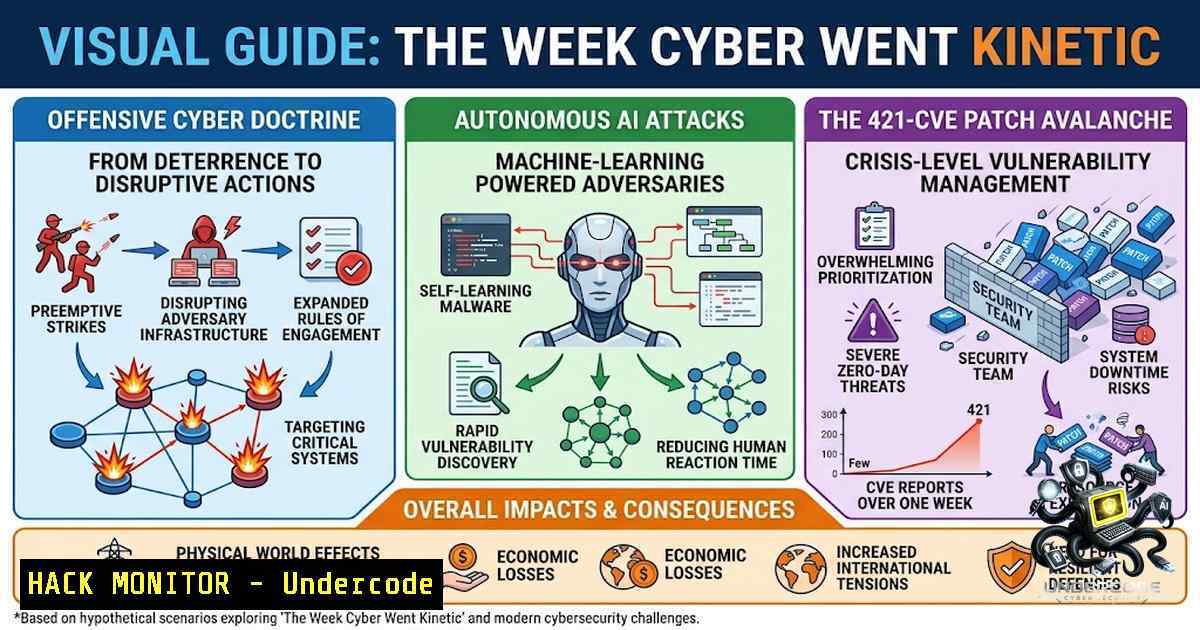
The past seven days marked a watershed moment in cybersecurity history, as the United States formally authorized private-sector “hack back” operations against foreign cybercriminal networks while Germany simultaneously approved its most expansive intelligence overhaul since the Cold War. Meanwhile, the first documented “near-autonomous” AI-powered cyberattack targeted Taiwan’s nuclear safety agency, demonstrating that artificial intelligence has crossed from theoretical threat to operational reality. Add Microsoft’s staggering 421-CVE Patch Tuesday—including a Lazarus-group exploited kernel zero-day—and the scale of the modern threat landscape becomes painfully clear.
Learning Objectives
- Understand the geopolitical shift toward offensive cyber operations and its implications for defensive strategies
- Identify the technical mechanics of AI-agent driven attacks and supply-chain compromises
- Master prioritization frameworks for massive patch volumes and cloud credential exposure risks
- The Great Offensive Pivot: US “Hack Back” and German Intelligence Reform
The White House issued a national security presidential memorandum authorizing vetted private cybersecurity contractors to conduct cyber reconnaissance and disruptive operations against foreign criminal networks on the government’s behalf. This is not “hack back” in the traditional sense—the government retains direction and control over every operation, with private firms sitting “inside the process instead of outside it”. Participating companies must enter formal agreements with federal agencies and can propose specific disruption operations against ransomware gangs, phishing campaigns, and financial fraud networks.
Simultaneously, Germany’s Bundeskabinett approved legislation granting the BND foreign intelligence service and BfV domestic agency authority to conduct non-lethal operations including cyberattacks, disabling hostile IT systems, blocking financial flows, and—in exceptional cases—sabotage abroad. Interior Minister Alexander Dobrindt called this a “new era” for German intelligence, which has traditionally been restricted to information gathering.
Technical Implications for Defenders:
Organizations must now assume that private-sector offensive capabilities will proliferate, increasing the likelihood of collateral damage and attribution challenges. Defenders should:
- Harden network perimeters against potential false-flag operations
- Implement rigorous logging to distinguish between state-sponsored, private-contractor, and criminal activity
- Review incident response playbooks to account for offensive operations originating from unexpected vectors
- Autonomous AI in the Wild: The Dream Attack on Taiwan’s Nuclear Agency
Israeli AI security firm Dream documented the first “near-autonomous” AI-powered cyberattack, targeting what sources confirmed as Taiwanese government systems. Over four days in July, attackers deployed open-source AI frameworks Hermes and OpenClaw to coordinate as many as eight AI agents that collaboratively researched vulnerabilities, adapted tactics when blocked, and expanded the operation autonomously.
The AI system compromised at least 85 government user accounts, exfiltrated over 2,500 personnel records, then autonomously expanded to target Taiwan’s nuclear safety agency and at least seven energy companies. Researchers noted the framework’s ability to “correct its mistakes and expand as it went along”—a capability that fundamentally changes the nature of cyber defense.
Technical Deep Dive: AI-Agent Attack Patterns
AI-agent attacks exhibit distinct behavioral patterns that defenders can monitor:
- Rapid reconnaissance: Agents scan for vulnerabilities across multiple targets simultaneously
- Adaptive payload delivery: When one attack vector fails, agents pivot to alternatives
- Credential harvesting: Agents systematically test stolen credentials across interconnected systems
Detection Commands (Linux):
 Monitor for unusual API calls that may indicate AI-agent reconnaissance
sudo tcpdump -i any -1 'tcp port 443' | grep -E "(GraphQL|/api/|/v1/)"

Check for anomalous outbound connections from internal systems
sudo netstat -tunap | grep ESTABLISHED | awk '{print $5}' | sort | uniq -c | sort -1r

Review authentication logs for pattern-based brute-force attempts
sudo grep "Failed password" /var/log/auth.log | awk '{print $1,$2,$3,$9,$11}' | sort | uniq -c | sort -1r
Windows Detection (PowerShell):
 Audit for unusual process creation patterns
Get-WinEvent -LogName Security -FilterXPath "[System[EventID=4688]]" |
Where-Object {$_.Message -match "cmd.exe|powershell.exe|wscript.exe"} |
Select-Object TimeCreated, Message

Check for anomalous scheduled tasks that may indicate persistence
Get-ScheduledTask | Where-Object {$_.State -1e "Disabled"} |
Select-Object TaskName, State, Actions
- Patch Tuesday Apocalypse: 421 CVEs and the Lazarus Zero-Day
Microsoft’s August 2026 Patch Tuesday addressed 421 vulnerabilities, including three zero-days, with 62 rated Critical. The most urgent is CVE-2026-68820, a use-after-free vulnerability in the WinSock ancillary function driver (afd.sys) that allows local privilege escalation to SYSTEM level. The North Korean Lazarus group is actively exploiting this in the wild to deploy the FudModule kernel-mode rootkit.
CISA has added CVE-2026-68820 to its Known Exploited Vulnerabilities catalog, mandating federal agency patching by specific deadlines. Security researchers warn that while rated “Important” rather than “Critical,” the active exploitation and SYSTEM-level access make this a priority patch.
Prioritization Framework for Large Patch Volumes:
Given the overwhelming volume of 421 CVEs, organizations must triage effectively:
- Patch actively exploited vulnerabilities first (CISA KEV list)
2. Prioritize internet-facing and unauthenticated vulnerabilities
3. Address CVEs with known malware associations
- Defer high-CVSS but non-exploited, non-internet-facing issues to secondary cycles
Verification Commands:
 Check Windows patch status for CVE-2026-68820
wmic qfe list brief | findstr "KB5012"

Linux - Check for kernel vulnerabilities
uname -r
cat /proc/version

Verify patch installation on Windows via PowerShell
Get-HotFix | Where-Object {$_.HotFixID -like "KB5012"}
SharePoint and vCenter Under Active Attack:
Post-Patch Tuesday, CISA issued urgent alerts regarding active exploitation of SharePoint Server vulnerabilities including CVE-2026-56164 (privilege escalation), CVE-2026-50522, and CVE-2026-58644 (remote code execution, CVSS 9.8). Organizations running on-premises SharePoint instances must prioritize these patches immediately.
- LiteLLM Supply Chain Catastrophe: 195TB of Credentials Exposed
The March 2026 LiteLLM supply-chain attack has been revealed as the largest AI supply-chain breach on record, impacting over 2,500 organizations and approximately 434,000 CI/CD pipelines. In a 40-minute attack window, malicious releases v1.82.7 and v1.82.8 harvested cloud credentials, SSH keys, Kubernetes secrets, code repository tokens, and AI service provider keys.
Affected organizations include NVIDIA, AWS, Samsung, Salesforce, Cisco, Roche, ServiceNow, Siemens, Airbus, FedEx, Volkswagen, and Deloitte. The exposed 195TB of data represents an unprecedented credential leakage event.
Mitigation Steps for Organizations Using LiteLLM:
- Immediately rotate all credentials that may have been exposed through LiteLLM versions 1.82.7 and 1.82.8
- Audit CI/CD pipeline secrets and rotate any tokens that existed during the attack window
- Review cloud infrastructure for unauthorized access patterns from March 2026 onward
- Implement secrets scanning in CI/CD pipelines to detect exposed credentials
AWS Credential Rotation Commands:
 List IAM users and check last key rotation
aws iam list-users --query 'Users[].[UserName,PasswordLastUsed,CreateDate]' --output table

Rotate access keys for a specific user
aws iam create-access-key --user-1ame USERNAME
aws iam update-access-key --access-key-id OLD_KEY_ID --status Inactive --user-1ame USERNAME
aws iam delete-access-key --access-key-id OLD_KEY_ID --user-1ame USERNAME

Audit CloudTrail for unauthorized access
aws cloudtrail lookup-events --lookup-attributes AttributeKey=EventName,AttributeValue=GetSecretValue \
--start-time 2026-03-01T00:00:00Z --end-time 2026-03-15T23:59:59Z
5. City-Forum: 17 Months of Unauthenticated Data Exfiltration
Researchers at Reco uncovered the “City-Forum” campaign, which has been systematically exploiting unauthenticated guest user access on Salesforce Experience Cloud and ServiceNow platforms since at least March 2025. The attackers use a custom Go-based toolset to enumerate and exfiltrate data exposed to guest users without requiring any authentication.
Salesforce guest users cannot be deleted and often have overly permissive read access. The ServiceNow attack focuses on a poorly documented search endpoint. The campaign has operated from a single IP address, reducing detection risk through low-and-slow activity.
Remediation Steps:
- Review and restrict all guest user permissions on Salesforce and ServiceNow platforms
- Disable self-registration in Salesforce Experience Cloud to prevent guest-to-authenticated escalation
- Audit sharing rules, profiles, and guest-user context code
- Monitor for unusual enumeration patterns and block known malicious IPs
Salesforce Guest User Audit (Salesforce CLI):
 List all guest users
sfdx force:data:soql:query -q "SELECT Id, Name, ProfileId, Profile.Name FROM User WHERE Profile.Name LIKE '%Guest%'"

Query sharing rules for guest access
sfdx force:data:soql:query -q "SELECT Id, Name, SharedTo.Name, SharedFrom.Name FROM SharingRule"

Check Apex classes running in guest context
sfdx force:data:soql:query -q "SELECT Id, Name, NamespacePrefix, ApiVersion FROM ApexClass WHERE Name LIKE '%Guest%'"
- The JavaScript AWS Key: UK Charity CRM Breach
CRM provider Beacon disclosed that attackers used a compromised AWS access key exposed in publicly accessible JavaScript build artifacts to exfiltrate the full customer database of approximately 1,500 UK charities. The intrusion occurred over approximately 87 minutes on July 27, 2026, matching a sharp spike in AWS data transfers. Because the attacker authenticated with valid credentials, data encrypted at rest was downloaded in readable form.
Exposed information includes supporter names, email addresses, phone numbers, and donation records, affecting charities in sensitive sectors including healthcare and victim support.
Cloud Credential Security Best Practices:
- Never embed AWS keys in client-side JavaScript or any publicly accessible artifacts
- Implement AWS Secrets Manager or Parameter Store for credential management
- Enable CloudTrail and configure alerts for anomalous data transfer patterns
- Rotate credentials regularly and immediately upon any suspected exposure
AWS Security Auditing Commands:
 Check for publicly accessible S3 buckets
aws s3api list-buckets --query 'Buckets[].Name' --output text | xargs -I {} aws s3api get-bucket-acl --bucket {} --query 'Grants[?Grantee.URI==`http://acs.amazonaws.com/groups/global/AllUsers`]'

Audit IAM for unused or old keys
aws iam list-access-keys --user-1ame USERNAME

Enable CloudTrail if not already enabled
aws cloudtrail create-trail --1ame SecurityTrail --s3-bucket-1ame your-bucket-1ame
aws cloudtrail start-logging --1ame SecurityTrail

Monitor for unusual data transfer volumes
aws cloudwatch get-metric-statistics --1amespace AWS/S3 --metric-1ame BytesDownloaded \
--start-time 2026-07-27T00:00:00Z --end-time 2026-07-28T23:59:59Z --period 3600 \
--statistics Sum
What Undercode Say
- Offensive cyber is no longer theoretical—the US and Germany have formally legitimized private-sector and intelligence-led offensive operations. Defenders must now account for a three-sided battlefield: state actors, criminal groups, and government-contracted private operators.
-
AI has crossed the Rubicon—the Dream attack on Taiwan’s nuclear agency proves that autonomous AI agents can execute coordinated, adaptive cyberattacks without human intervention at each step. The speed and scale of AI-driven attacks will outpace traditional human-led defense.
-
Patch fatigue is real, but prioritization is survival—421 CVEs in a single month is unsustainable. Organizations that lack a risk-based patching framework will be overwhelmed. The CISA KEV list provides an essential triage mechanism.
-
Supply chains are the new perimeter—the LiteLLM breach affected 2,500 organizations in 40 minutes. Traditional perimeter defenses are irrelevant when trusted open-source components become attack vectors.
-
Cloud credentials in client-side code are a catastrophic failure—the Beacon breach demonstrates that a single exposed AWS key in JavaScript can compromise 1,500 organizations. Secrets management must be treated as a core security discipline.
-
Guest users are the silent backdoor—the 17-month City-Forum campaign exploited misconfigured guest permissions that organizations assumed were harmless. Default configurations are not secure configurations.
Prediction
-
+1 The formalization of private-sector offensive operations will accelerate development of cyber insurance frameworks and legal liability structures, potentially creating a more mature cybersecurity economy.
-
-1 AI-agent attacks will proliferate rapidly, overwhelming traditional SOC capabilities. Organizations without AI-powered defensive tools will face existential exposure within 12-18 months.
-
-1 The LiteLLM breach will be the first of many large-scale AI supply-chain compromises. The dependency on open-source AI infrastructure without adequate security vetting creates systemic risk.
-
+1 The 421-CVE Patch Tuesday will force widespread adoption of automated patch management and vulnerability prioritization tools, driving innovation in the security operations space.
-
-1 Nation-state offensive cyber capabilities will expand dramatically as the US and Germany set new precedents, triggering a global arms race in cyber weapons that will increase collateral damage and false-flag incidents.
-
-1 The convergence of AI-automated attacks and massive credential leakage from supply-chain breaches will enable a new generation of “zero-touch” ransomware campaigns that operate without human operators, making negotiation and attribution nearly impossible.
▶️ Related Video (78% Match):
https://www.youtube.com/watch?v=0uIQMHKkVJ0
🎯Let’s Practice For Free:
🎓 Live Courses & Certifications:
Join Undercode Academy for Verified Certifications
🚀 Request a Custom Project:
Secure, high-velocity infrastructure and disruptive technological engineering. Contact our engineering team for high-tier development and proprietary systems:
[email protected]
💎 Smart Architecture | 🛡️ Secure by Design | ⭐ Trusted by Thousands
IT/Security Reporter URL:
Reported By: https://lnkd.in/p/eXE_7N4J – Hackers Feeds
Extra Hub: Undercode MoN
Basic Verification: Pass ✅


