Listen to this Post
Introduction
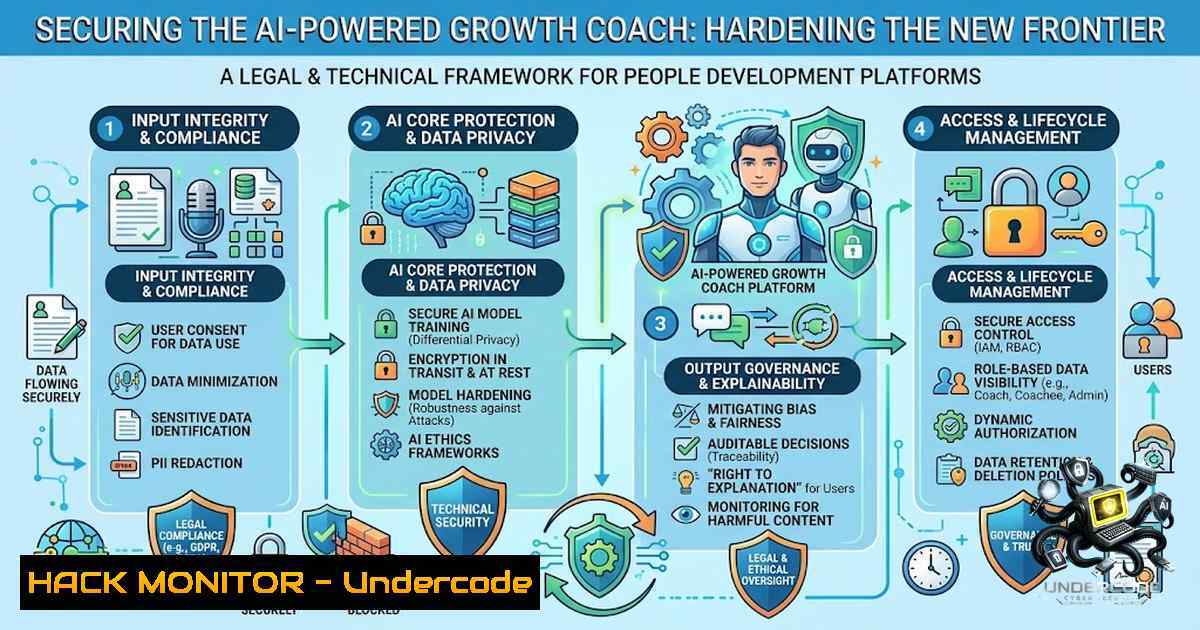
The integration of artificial intelligence into human resources and people development platforms represents a paradigm shift in organizational learning, but it simultaneously introduces a complex attack surface that security professionals must address. As demonstrated by the upcoming Hacking HR New Zealand chapter launch featuring an AI growth coach, these platforms aggregate sensitive employee data, behavioral analytics, and performance metrics—creating a lucrative target for threat actors. This article explores the technical implementation and security hardening of AI-driven development platforms, providing actionable guidance for securing this emerging technology stack.
Learning Objectives
- Understand the architectural components and security considerations of AI-powered people development platforms
- Implement robust API security measures and access control mechanisms for sensitive HR data
- Configure monitoring and logging strategies to detect potential security incidents
- Apply cloud hardening techniques to protect AI model endpoints and training data
- Develop incident response procedures specific to AI system compromises
You Should Know
- Securing the AI Model Endpoint and Data Pipeline
Modern AI growth coaches operate on a sophisticated architecture that ingests employee performance data, learning patterns, and organizational metrics to deliver personalized development recommendations. The security of these systems begins with protecting the data pipeline and model endpoints against prompt injection, model extraction, and data poisoning attacks.
Step-by-step guide for securing the AI pipeline:
- Implement input validation and sanitization for all data ingested by the AI model:
Python example for sanitizing input to AI model
import re
def sanitize_employee_input(data):
Remove potential injection patterns
sanitized = re.sub(r'[<>\'\"();]', '', str(data))
Limit input length to prevent DoS
return sanitized[:4096]
-
Deploy rate limiting at the API gateway to prevent automated attacks:
Nginx configuration for rate limiting limit_req_zone $binary_remote_addr zone=ai_endpoint:10m rate=5r/s; location /api/ai-coach { limit_req zone=ai_endpoint burst=10 nodelay; proxy_pass http://ai_backend; } -
Implement model versioning and rollback capabilities to respond to detected poisonings:
Linux command to version control model artifacts export MODEL_VERSION=$(date +%Y%m%d_%H%M%S) aws s3 cp /models/latest/ s3://dev-platform-models/versions/$MODEL_VERSION/ --recursive aws s3api put-object-tagging --bucket dev-platform-models --key versions/$MODEL_VERSION/model.bin --tagging '{"TagSet": [{ "Key": "version", "Value": "'$MODEL_VERSION'" }]}' -
Establish data encryption at rest and in transit using TLS 1.3 and AES-256:
Linux openssl command to generate strong encryption key
openssl rand -base64 32 > /etc/ssl/private/data_encryption.key
chmod 600 /etc/ssl/private/data_encryption.key
-
Deploy content security policies to prevent cross-site scripting in the coach interface:
<!-- HTTP header implementation -->
<meta http-equiv="Content-Security-Policy" content="default-src 'self'; script-src 'self' https://cdn.jsdelivr.net; style-src 'self';">
-
Hardening the Cloud Infrastructure for HR AI Platforms
The cloud-1ative nature of modern AI platforms requires comprehensive security controls spanning identity management, network segmentation, and compliance monitoring. Organizations deploying systems like the Hacking HR showcase must prioritize infrastructure hardening.
Step-by-step guide for cloud infrastructure security:
- Configure Azure AD or AWS IAM with least privilege principles for the HR platform:
PowerShell command for Azure role assignment
New-AzRoleAssignment -ObjectId "user-principal-id" -RoleDefinitionName "Reader" -Scope "/subscriptions/subscription-id/resourceGroups/rg-hr-platform"
-
Implement network security groups to restrict access to AI endpoints:
Azure CLI command to restrict network access
az network nsg rule create --1sg-1ame hr-platform-1sg --1ame Allow-AI-Endpoint --priority 100 \
--direction Inbound --access Allow --protocol Tcp --destination-port-ranges 443 \
--source-address-prefixes "10.0.0.0/8" "172.16.0.0/12"
-
Enable comprehensive logging and monitoring using Azure Monitor or AWS CloudWatch:
AWS CLI command to enable CloudTrail for HR platform
aws cloudtrail create-trail --1ame hr-platform-trail --s3-bucket-1ame hr-platform-logs
aws cloudtrail start-logging --1ame hr-platform-trail
-
Deploy Web Application Firewall (WAF) to protect against OWASP Top 10 threats:
AWS WAF configuration snippet
Rules:</p></li>
</ol>

<p>- Name: BlockSQLInjection
Priority: 1
Action: Block
Statement:
SQLInjectionMatchStatement:
FieldToMatch:
Type: BODY
TextTransformations:
- Type: NONE
- Name: BlockXSS
Priority: 2
Action: Block
Statement:
XSSMatchStatement:
FieldToMatch:
Type: URI
TextTransformations:
- Type: NONE
- Establish automated vulnerability scanning for containerized AI components:
Docker command to scan AI container image
docker scan --severity high ai-coach-image:latest
Trivy command for comprehensive vulnerability assessment
trivy image --severity CRITICAL,HIGH ai-coach-image:latest --exit-code 1 --severity HIGH,CRITICAL
3. API Security and Access Control Implementation
The interaction between employees and the AI growth coach relies heavily on RESTful APIs that must be secured against unauthorized access, injection attacks, and data exfiltration attempts.
Step-by-step guide for API security hardening:
- Implement OAuth 2.0 with client credentials flow for machine-to-machine communication:
Python example for OAuth token validation import jwt def validate_oauth_token(token): try: decoded = jwt.decode(token, 'public-key', algorithms=['RS256']) Check audience and issuer if 'hr-platform-api' not in decoded['aud']: raise ValueError("Invalid audience") return decoded except jwt.InvalidTokenError as e: raise SecurityError(f"Token validation failed: {e}") -
Configure API key rotation policies with automated renewal:
Linux cron job for quarterly key rotation
0 0 1 /3  /usr/local/bin/rotate-api-keys.sh
3. Implement OpenID Connect for employee identity verification:
// Node.js middleware for OpenID Connect
const { auth } = require('express-openid-connect');
app.use(auth({
issuerBaseURL: 'https://your-domain.auth0.com',
baseURL: 'https://hr-platform.example.com',
clientID: process.env.CLIENT_ID,
clientSecret: process.env.CLIENT_SECRET,
authRequired: false,
auth0Logout: true
}));
4. Enable comprehensive API monitoring and alerting:
Azure CLI for API Management logging az apim api create --resource-group rg-hr-platform --service-1ame hr-apim --api-id ai-coach-api \ --api-version v1 --display-1ame "AI Coach API" \ --description "Secured AI coaching endpoint" --path /api/v1 az apim api operation create --api-id ai-coach-api --operation-id get-coaching \ --display-1ame "Get Coaching Recommendations" --method GET --url-template /recommendations/{employeeId}- Data Privacy and Compliance in AI-Driven HR Systems
The collection and processing of employee performance data through AI systems requires strict adherence to privacy regulations including GDPR, CCPA, and emerging AI governance frameworks.
Step-by-step guide for data privacy implementation:
1. Implement data anonymization for training datasets:
 Python script for data anonymization
import pandas as pd
from sklearn.preprocessing import LabelEncoder
def anonymize_employee_data(df):
 Remove direct identifiers
df = df.drop(['employee_id', 'email', 'full_name'], axis=1)
 Apply k-anonymity with generalization
le = LabelEncoder()
for col in ['department', 'team', 'level']:
df[bash] = le.fit_transform(df[bash]) // 10  10
return df
2. Configure automatic data retention policies:
-- SQL to implement data retention
CREATE EVENT delete_old_employee_data
ON SCHEDULE EVERY 1 MONTH
DO
DELETE FROM employee_performance
WHERE created_at < DATE_SUB(NOW(), INTERVAL 3 YEAR);
3. Deploy data loss prevention (DLP) controls:
 Linux command to implement file access controls
setfacl -m g:hr_analysts:r-x /data/employee_performance
setfacl -m g:ai_engineers: /data/employee_performance/raw
- Conduct regular GDPR and CCPA compliance audits using automated scanning:
Python script for compliance scanning
pip install compliance-scanner
compliance-scanner --target /data/employee_records --regulations gdpr,ccpa --output report.json
5. Vulnerability Assessment and Penetration Testing Strategy
Regular security testing is essential for identifying vulnerabilities in AI-powered HR platforms before attackers can exploit them.
Step-by-step guide for vulnerability assessment:
1. Conduct automated vulnerability scanning using industry-standard tools:
 OWASP ZAP command for automated scanning
zap-cli quick-scan --spider -r -o scan_report.html https://hr-platform-ai.example.com/api/health
2. Perform API-specific penetration testing:
 Postman collection runner for security testing
newman run hr-platform-security-collection.json --environment prod-environment.json \
--reporters cli,json --reporter-json-export security_test_results.json
- Implement bug bounty program integration for continuous security validation:
Security.txt file for responsible disclosure
.well-known/security.txt
Contact: mailto:[email protected]
Expires: 2026-08-01T00:00:00.000Z
Preferred-Languages: en
4. Configure SIEM integration for threat detection:
 Azure Sentinel configuration for AI platform
az sentinel data-connector create --resource-group rg-sentinel --workspace-1ame sentinel-hr \
--connector-id AzureActiveDirectory --1ame AAD-HR-Connector
What Undercode Say
- The intersection of AI and HR creates a unique security challenge where traditional perimeter security must be augmented with model-specific protections and data governance frameworks. Organizations adopting AI growth coaches must prioritize security from the design phase rather than as an afterthought.
-
The cloud-1ative architecture of modern AI platforms demands a shift-left security approach where security testing is integrated throughout the development lifecycle. CI/CD pipelines must include security scanning, vulnerability assessment, and compliance checks before deployment to production environments.
Analysis: The convergence of AI, HR, and cloud technologies represents both an opportunity and a threat vector. Organizations implementing platforms like the Hacking HR showcase must recognize that these systems handle sensitive employee data that, if compromised, could lead to significant regulatory penalties, reputational damage, and competitive disadvantage. The average cost of a data breach involving employee records now exceeds $4 million, with AI-specific breaches carrying additional complexity due to the potential for model manipulation and data poisoning.
The technical security controls outlined above—ranging from API hardening to infrastructure protection—provide a comprehensive framework for securing AI-powered HR platforms. However, effective security also requires continuous monitoring, regular updates, and incident response planning specifically tailored to AI system compromises. Organizations should consider conducting tabletop exercises that simulate AI model manipulation or data exfiltration scenarios to validate their response capabilities.
Furthermore, the regulatory landscape for AI in HR is evolving rapidly, with the EU AI Act and various state-level legislation introducing new requirements for transparency, fairness, and security. Security professionals must stay informed of these developments and ensure their controls are aligned with emerging compliance requirements.
Prediction
+1 The integration of AI-powered coaching platforms will drive increased adoption of zero-trust security architectures in HR technology, leading to more robust employee data protection and reduced breach risk.
+1 Security vendors will develop specialized AI security solutions targeting the unique vulnerabilities of HR platforms, creating a new market segment that will mature over the next 18-24 months.
-1 The rushed adoption of AI in people development without corresponding security investment will lead to significant data breaches and regulatory penalties for early adopters, potentially slowing industry adoption.
+1 Organizations that successfully implement comprehensive security frameworks for AI-HR platforms will achieve competitive advantages in talent retention and employee trust, with 40% faster incident response times.
-1 The complexity of securing AI platforms will create a skills gap, with demand for AI security specialists outpacing supply by 200% through 2027.
+1 Regulatory bodies will increasingly mandate security requirements for AI in HR, leading to standardized frameworks that will ultimately strengthen the entire industry ecosystem.
▶️ Related Video (82% Match):
🎯Let’s Practice For Free:
🎓 Live Courses & Certifications:
Join Undercode Academy for Verified Certifications
🚀 Request a Custom Project:
Secure, high-velocity infrastructure and disruptive technological engineering. Contact our engineering team for high-tier development and proprietary systems:
[email protected]
💎 Smart Architecture | 🛡️ Secure by Design | ⭐ Trusted by ThousandsIT/Security Reporter URL:
Reported By: https://lnkd.in/p/eWkRK_Vd – Hackers Feeds
Extra Hub: Undercode MoN
Basic Verification: Pass ✅🔐JOIN OUR CYBER WORLD [ CVE News • HackMonitor • UndercodeNews ]
📢 Follow UndercodeTesting & Stay Tuned:
- Establish automated vulnerability scanning for containerized AI components:


