Listen to this Post
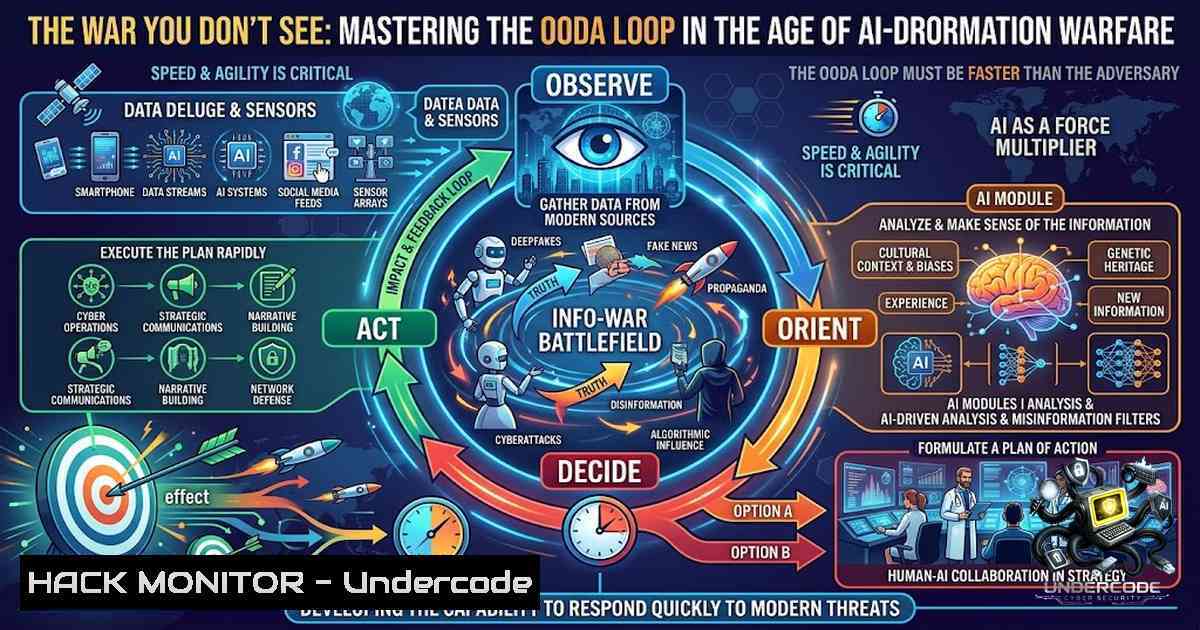
Introduction:
The modern battlespace has transcended physical trenches, evolving into a complex, omnipresent domain where information itself is the primary weapon and the human mind is the ultimate target. As Lt. Colonel Suraj Abraham highlights, the most dangerous conflicts are those we do not recognize have begun, fought for perception and narratives through cyber, electronic warfare, AI, and psychological operations. This article provides a technical and strategic framework for security professionals to understand, identify, and mitigate threats in this invisible war, leveraging the OODA Loop (Observe-Orient-Decide-Act) as a critical lens for information environment analysis and operational security.
Learning Objectives:
- Understand the core principles of information warfare and its convergence with AI, cyber, and psychological operations.
- Master the application of the OODA Loop for threat analysis and decision-making in complex information environments.
- Acquire practical commands and techniques for system hardening, threat hunting, and vulnerability mitigation across Linux and Windows environments.
- Develop strategies for cognitive resilience and defending against AI-enabled influence operations.
You Should Know:
- Operationalizing the OODA Loop in the Cyber Battlespace
The OODA Loop, developed by U.S. Air Force Colonel John Boyd, is a decision-making framework that is exceptionally relevant to cybersecurity and information warfare. It consists of four phases: Observe (gather data from the environment), Orient (analyze and synthesize information based on cultural, genetic, and previous experience), Decide (formulate a hypothesis or course of action), and Act (execute the decision). In the context of information warfare, the “Orient” phase is critical, as it represents a bottleneck where adversaries can manipulate perception through disinformation and cognitive attacks.
Step-by-step guide to applying the OODA Loop for threat intelligence:
1. Observe: Continuously monitor network traffic, system logs, and open-source intelligence (OSINT). Use tools like Wireshark for packet analysis and Security Information and Event Management (SIEM) solutions to aggregate logs.
2. Orient: Contextualize the observed data. This involves understanding the threat actor’s tactics, techniques, and procedures (TTPs) using frameworks like MITRE ATT&CK. Ask: What is the adversary’s narrative? Are they attempting to create fear, confusion, or doubt?
3. Decide: Based on your orientation, choose a response. This could be deploying a firewall rule, issuing a public counter-1arrative, or patching a vulnerability.
4. Act: Execute the decision and then rapidly return to the “Observe” phase to assess the effectiveness of your action and detect any changes in the adversary’s behavior.
2. Hardening Systems Against Information Warfare Tactics
Adversaries in information warfare often exploit technical vulnerabilities to gain a foothold, which they then use for psychological operations or data manipulation. System hardening is a fundamental defense.
Linux Hardening Commands:
- Process Enumeration: Adversaries often use `ps` to list running processes. Regularly audit running processes:
ps auxfww
- Network Connections: Use `netstat` or `ss` to monitor active connections and identify suspicious outbound traffic:
netstat -tulpn
ss -tulwn
- File Integrity Monitoring: Use `aide` or `tripwire` to detect unauthorized changes to critical system files.
- User Audit: Regularly check for unauthorized users with `cat /etc/passwd` and `sudo` privileges with
cat /etc/sudoers.
Windows Hardening Commands:
- Process Enumeration: Use `tasklist` or the PowerShell cmdlet `Get-Process` to see running processes:
tasklist /v
Get-Process
- Network Configuration: Use `ipconfig` and `netstat` to review network settings and connections:
ipconfig /all
netstat -an
- User and Group Management: Audit local users and groups with `net user` and
net localgroup.
3. Securing the API and Cloud Attack Surface
APIs are a critical component of modern infrastructure and a prime target for adversaries seeking to exfiltrate data or disrupt services. Cloud Instance Metadata APIs are a particularly high-value target, as they can be exploited to steal credentials.
Step-by-step guide for API and cloud security:
- Implement Robust Authentication: Enforce multi-factor authentication (MFA) and the principle of least privilege for all API access.
- Automate Configuration Checks: Utilize tools to continuously assess your security posture, detecting misconfigured APIs or exposed storage buckets.
- Rate Limiting: Implement rate limiting on all public API endpoints to prevent brute-force and denial-of-service attacks.
- Regular Auditing: Conduct regular audits of IAM roles, API endpoints, and container isolation, including red-team exercises within your cloud infrastructure.
4. Vulnerability Exploitation and Mitigation Strategies
In information warfare, the exploitation of vulnerabilities is often a precursor to a larger influence campaign. Research indicates that N-day vulnerabilities are exploited more frequently than zero-days, emphasizing the critical importance of patch management. A constructive system engineering approach is vital to mitigate the threat of subversion, which often exploits fundamental trust relationships within systems.
Step-by-step guide for vulnerability management:
- Asset Discovery: Maintain an up-to-date inventory of all systems and software.
- Vulnerability Scanning: Regularly scan your environment using tools like Nessus, OpenVAS, or Qualys.
- Risk Assessment: Prioritize vulnerabilities based on their Common Vulnerability Scoring System (CVSS) score and the potential impact on your organization.
- Patch Management: Implement a rigorous patch management process, prioritizing patches for vulnerabilities that are being actively exploited in the wild.
- Deception Technology: Consider deploying deception technologies, such as honeypots, to detect and deflect attackers.
5. Combating AI-Enabled Cognitive Warfare
The integration of AI has enabled psychological operations to operate at an industrial scale. AI-powered botnets can manipulate social media algorithms and public discourse. Defending against these threats requires a multi-layered approach.
Step-by-step guide for building cognitive resilience:
- Digital Literacy Training: Educate employees and stakeholders on how to identify disinformation, deepfakes, and other forms of manipulated content.
- Ambient Information Monitoring: Monitor the information environment for narratives that could target your organization or personnel.
- Rapid Response Plan: Develop a plan to quickly counter disinformation campaigns with factual, transparent communication.
- Technical Defenses: Deploy AI-powered tools that can detect and flag potentially malicious or misleading content.
What Undercode Say:
- The OODA Loop is not just a military concept but a powerful analytical tool for understanding and winning in the information environment.
- Technical system hardening and proactive vulnerability management are non-1egotiable foundations for any information warfare defense strategy.
- The future of conflict will be defined by the ability to out-think, out-maneuver, and out-resilience adversaries in the cognitive domain.
Expected Output:
The provided text from Lt. Colonel Abraham serves as a critical reminder that the battlefield has fundamentally changed. The convergence of cyber, AI, and psychological operations necessitates a holistic defense strategy that integrates technical rigor with a deep understanding of human cognition and decision-making. By operationalizing frameworks like the OODA Loop and implementing robust technical controls, security professionals can begin to see and fight the war that is already being waged around them.
Prediction:
- -1 The increasing sophistication and automation of AI-driven disinformation campaigns will outpace the ability of traditional defenses to counter them, leading to a period of heightened societal and political instability.
- +1 The development of AI-powered defensive tools and a greater emphasis on cognitive resilience training will empower organizations and individuals to better detect and neutralize influence operations, creating a more resilient information ecosystem.
- -1 The exploitation of cloud infrastructure and APIs will become the primary vector for nation-state information warfare attacks, leading to more frequent and devastating data breaches and operational disruptions.
- +1 The adoption of proactive security measures, such as automated configuration checks and deception technologies, will significantly raise the cost and complexity of successful attacks, forcing adversaries to invest in more resource-intensive methods.
- -1 The gap between vulnerability discovery and patch deployment will continue to be a critical weakness, with adversaries increasingly exploiting N-day vulnerabilities to devastating effect.
▶️ Related Video (76% Match):
🎯Let’s Practice For Free:
🎓 Live Courses & Certifications:
Join Undercode Academy for Verified Certifications
🚀 Request a Custom Project:
Secure, high-velocity infrastructure and disruptive technological engineering. Contact our engineering team for high-tier development and proprietary systems:
[email protected]
💎 Smart Architecture | 🛡️ Secure by Design | ⭐ Trusted by Thousands
IT/Security Reporter URL:
Reported By: Lt Colonel – Hackers Feeds
Extra Hub: Undercode MoN
Basic Verification: Pass ✅


