Listen to this Post
Introduction
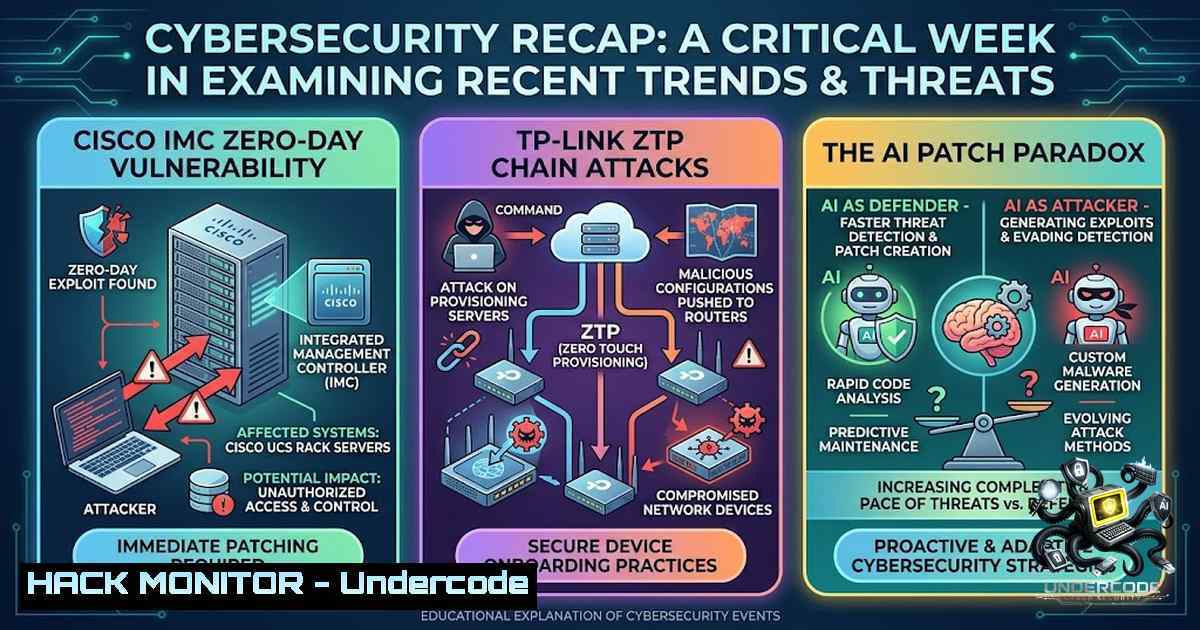
The week of August 5, 2026, delivered a cascade of high-impact cybersecurity developments that underscore the escalating sophistication of modern threats and the expanding attack surface across enterprise infrastructure. From a critical argument injection vulnerability in Cisco’s Integrated Management Controller (CVE-2026-20200) that grants root access to authenticated attackers, to 15 newly discovered flaws in TP-Link Omada’s zero-touch provisioning (ZTP) ecosystem that can be chained for full network takeover, the threat landscape is evolving at an unprecedented pace. Simultaneously, the security community grapples with the “patch apocalypse”—Microsoft’s July 2026 Patch Tuesday delivered over 600 CVEs, the highest monthly security update in corporate history—while AI-driven security tools promise both enhanced detection capabilities and new vulnerabilities, as research reveals that three out of four AI-generated patches fail to fully address the issues they target.
Learning Objectives
- Understand the technical mechanics of CVE-2026-20200 and implement effective mitigation strategies for Cisco IMC deployments
- Master the detection and response techniques for BYOVD (Bring Your Own Vulnerable Driver) attacks using Elastic Defend’s expanded 800+ driver coverage
- Learn to leverage AI-powered investigation platforms like Stairwell’s Backstory for malware blast radius mapping and campaign attribution
- Implement automated alert triage workflows using Agentic AI to reduce SOC alert fatigue by up to 70%
- Identify and remediate TP-Link Omada ZTP vulnerabilities through proper network segmentation and firmware management
- Evaluate the risks and limitations of AI-generated security patches in enterprise environments
- Cisco IMC Argument Injection (CVE-2026-20200) – Root Access Through the Web Interface
Cisco addressed a high-severity argument injection vulnerability in its Integrated Management Controller (IMC) on August 5, 2026. Tracked as CVE-2026-20200 with a CVSS score of 8.8, this flaw allows an authenticated, remote attacker with low privileges to execute arbitrary commands on the underlying operating system and elevate privileges to root. The vulnerability affects Cisco UCS C-Series M7 and M8 Rack Servers in standalone mode, and proof-of-concept exploit code is already publicly available.
What this means: An attacker with minimal credentials—perhaps obtained through credential stuffing or phishing—can gain complete administrative control over the server’s management controller, effectively owning the physical host. From there, they can install persistent backdoors, exfiltrate sensitive data, or pivot to other systems on the network.
Step-by-step mitigation guide:
- Identify affected systems: Run the following command on Cisco IMC devices to check the firmware version:
SSH into IMC and check version
show version
Affected versions include Cisco IMC prior to 6.0(2.260044) and prior to 4.3(6.260033).
-
Apply the patch immediately: Upgrade to Cisco IMC 6.0(2.260044) or later, or 4.3(6.260033) or later. The patch is available through Cisco’s Software Download portal.
-
Restrict network access: If immediate patching is not possible, restrict access to the IMC web interface to trusted management networks only:
On Cisco IMC, configure access control lists
scope acl
create ip-filter <name>
set ip-address <trusted_subnet>
commit
-
Enable comprehensive logging: Monitor for suspicious activities on IMC interfaces:
Enable audit logging
scope logging
set audit-log-state enabled
commit
-
Deploy intrusion detection rules: Monitor for exploitation attempts targeting the IMC web interface. Search for anomalous command injection patterns in web request logs.
-
The Patch Tuesday Apocalypse – Managing Over 600 Monthly CVEs
Microsoft’s July 2026 Patch Tuesday was historic, delivering over 600 CVEs—three times the previous record set just one month earlier. This unprecedented volume signals a systemic vulnerability saturation across Microsoft’s entire product portfolio. The August 2026 Patch Tuesday is expected to continue this trend, with Microsoft confirming that the large volume of CVE disclosures will persist as AI-driven vulnerability discovery tools identify more security flaws.
Operational impact: Security teams face a resource-exhaustion crisis. With over 600 patches to test, deploy, and validate monthly, traditional manual patch management processes are no longer sustainable.
Step-by-step patch management strategy:
- Prioritize using CVSS and exploitability: Not all CVEs are equal. Use the following PowerShell script to query the CVE database and prioritize patches:
Query Microsoft Update Catalog for critical updates Get-WindowsUpdate -Category "Security Updates" | Where-Object { $_.MsrcSeverity -eq "Critical" } -
Implement phased deployment: Deploy patches to test environments first (Day 1-3), then pilot groups (Day 4-7), followed by production rollouts (Day 8-14).
-
Automate with Windows Update for Business: Configure Group Policy for automatic deployment:
Set up Windows Update for Business via GPO
Computer Configuration > Administrative Templates > Windows Components > Windows Update >
Configure Automatic Updates > Enabled
-
Monitor for patch-related issues: Use Event Viewer to track installation failures:
Get-WinEvent -LogName System | Where-Object { $_.ProviderName -eq "Microsoft-Windows-WindowsUpdateClient" } -
Maintain rollback procedures: Document and test rollback procedures for each critical update.
3. AI-Powered Malware Investigation – Stairwell’s Backstory
Stairwell launched Backstory, an agentic investigation platform designed to trace related malware variants, identify affected systems, and map an incident’s full blast radius. Backstory is an AI agent that takes a single alert and works outward to map how far a malware campaign has spread, functioning like an elite human analyst but operating at machine speed and scale.
Key capability: Stairwell discovered an average of 2.4 additional malicious variants connected to each published malware hash. Backstory is powered by AI trained on more than 110,000 detection rules and intelligence from over 20 public threat sources.
Step-by-step implementation for security teams:
- Integrate Backstory into your SOC workflow: Backstory ingests alerts from existing SIEM and EDR platforms via API. Configure the webhook integration:
Example Python integration with Backstory API import requests url = "https://api.stairwell.com/v1/backstory/investigate" headers = {"Authorization": "Bearer <API_KEY>"} payload = {"alert_hash": "<malware_hash>"} response = requests.post(url, json=payload, headers=headers) -
Configure alert thresholds: Set up automated triggers for Backstory investigations on high-severity alerts.
-
Correlate findings: Use Backstory’s output to identify previously unknown infected systems within your environment.
-
Automated response: Implement playbooks that trigger containment actions when Backstory identifies a widespread campaign.
-
Elastic Defend – Combating BYOVD Attacks at Scale
Elastic Security expanded Elastic Defend’s coverage to over 800 known vulnerable Windows drivers used in Bring Your Own Vulnerable Driver (BYOVD) attacks. The platform now automatically generates and deploys YARA rules to block vulnerable drivers as soon as they are disclosed. Additionally, Elastic Defend has expanded its coverage to include Windows on ARM, supporting Snapdragon and Copilot+ PCs.
What is BYOVD? Attackers exploit legitimate but vulnerable kernel-mode drivers to execute code with SYSTEM privileges, bypassing traditional security controls. With over 800 vulnerable drivers now tracked, this attack vector represents a significant threat to Windows environments.
Step-by-step implementation:
- Deploy Elastic Defend: Install the Elastic Agent on Windows endpoints:
Download and install Elastic Agent
.\elastic-agent-<version>-windows-x86_64.exe install --url=<fleet_url> --enrollment-token=<token>
-
Enable BYOVD protection: In Elastic Defend policy, ensure “Block Vulnerable Drivers” is enabled:
In Kibana, navigate to:
Security > Manage > Endpoint Policies > Edit Policy > Malware Protection >
Enable "Block vulnerable drivers"
-
Monitor driver loading events: Use the following Elasticsearch query to identify vulnerable driver loads:
{ "query": { "bool": { "must": [ { "term": { "event.type": "driver-load" } }, { "exists": { "field": "driver.vulnerable" } } ] } } } -
Automated troubleshooting: Elastic Defend’s automated troubleshooting feature provides guided remediation steps when vulnerable driver loads are detected.
-
Stellar Cyber Agentic AI – Automated Triage Saving 19 Minutes Per Hour
Stellar Cyber reported that its Agentic AI-powered automatic triage system saves analysts approximately 19 minutes per hour by closing thousands of false positive tickets automatically. In customer trials, the Auto-Triage AI agreed with human analysts 99.7% of the time. The system evaluates incoming alerts, enriches them with contextual intelligence, and filters out likely false positives before they reach the analyst, reducing alert noise by up to 70% and cutting triage time by as much as 80%.
Step-by-step implementation:
- Deploy Stellar Cyber platform: Configure data ingestion from your existing security tools (firewalls, EDR, SIEM, email security).
-
Enable Auto-Triage: In the Stellar Cyber console, navigate to Settings > Agentic AI > Auto-Triage and enable the feature.
-
Configure verdict thresholds: Set confidence thresholds for automated decisions:
Example configuration
Auto-Triage Confidence Threshold:</p></li>
</ol>

<p>- Low (< 70%): Route to human analyst
- Medium (70-90%): Auto-close with notification
- High (> 90%): Auto-close with summary
- Phishing email triage: Enable automated analysis of user-reported emails, reducing investigation time from hours to minutes.
-
Monitor and refine: Review auto-triage decisions weekly to refine AI models and improve accuracy.
-
TP-Link Omada ZTP Vulnerabilities – 15 Flaws Enable Network Takeover
Forescout’s Vedere Labs identified 15 new vulnerabilities affecting TP-Link Omada’s zero-touch provisioning (ZTP) systems. These flaws span four categories: client-side code execution through cross-channel scripting, authentication bypass, command injection, and cloud adoption race conditions. When chained together, these vulnerabilities enable attackers to hijack devices, spy on camera traffic, and execute arbitrary code with root privileges. A cloud adoption race condition (CVE-2025-15630) allows attackers to exploit a device’s MAC address during registration and steal configuration data.
Step-by-step mitigation:
- Identify affected devices: Check if your TP-Link Omada devices are running vulnerable firmware. Log into the Omada Controller and navigate to Devices > Firmware.
-
Apply firmware updates: TP-Link has released patches for these vulnerabilities. Update all Omada devices to the latest firmware version:
Via Omada Controller web interface:
Devices > Select Device > Upgrade > Check for Updates
-
Network segmentation: Isolate Omada management interfaces on separate VLANs with strict access controls:
Example VLAN configuration on Cisco switch
interface vlan 100
ip address 192.168.100.1 255.255.255.0
ip access-group MANAGEMENT-ACL in
-
Monitor for exploitation: Search for anomalous ZTP registration attempts in your network logs. Look for:
– Multiple registration attempts from the same MAC address
– Registration requests originating from untrusted networks
– Unexpected configuration changes on Omada devices- Disable ZTP if not required: If zero-touch provisioning is not essential in your environment, consider disabling it temporarily until all devices are patched.
-
The AI Security Patch Paradox – 75% Failure Rate
Recent research revealed a concerning trend: three out of four patches generated by AI for security vulnerabilities fail to fully address the detected issues. This highlights the critical importance of human oversight in AI-assisted security operations. While AI excels at vulnerability discovery and initial triage, the remediation phase requires deep contextual understanding that current AI models often lack.
Step-by-step approach to AI-assisted patching:
- Treat AI patches as starting points, not final solutions: Always review AI-generated patches manually before deployment.
2. Implement a validation pipeline:
 Example validation script for AI-generated patches
def validate_patch(patch_code, original_vulnerability):
 Run static analysis
static_results = run_static_analysis(patch_code)
 Run dynamic analysis in sandbox
dynamic_results = run_dynamic_analysis(patch_code)
 Compare against vulnerability criteria
return validate_fix(static_results, dynamic_results, original_vulnerability)
- Maintain human-in-the-loop: Require senior security engineers to approve all AI-generated patches before deployment.
-
Continuous monitoring: After patch deployment, monitor for regression or incomplete fixes.
What Undercode Say
-
CVE-2026-20200 demands immediate action. With public PoC code already available and root-level access attainable through authenticated low-privilege accounts, attackers are actively scanning for vulnerable Cisco IMC instances. Organizations must prioritize patching over convenience.
-
The patch volume crisis is real. Over 600 monthly CVEs from Microsoft alone represents a fundamental shift in the vulnerability landscape. Security teams must embrace automation and risk-based prioritization to survive the “patch apocalypse.”
Analysis: The convergence of these events paints a picture of an industry struggling to keep pace with the accelerating discovery and exploitation of vulnerabilities. AI is a double-edged sword: it accelerates vulnerability discovery and detection capabilities (Backstory, Elastic Defend, Stellar Cyber) but simultaneously creates new challenges when applied to remediation (the 75% AI patch failure rate). The TP-Link Omada vulnerabilities demonstrate how seemingly isolated flaws can be chained together for catastrophic impact. Organizations must adopt a defense-in-depth strategy that combines automated detection with human-driven remediation and validation.
Prediction
- +1 AI-driven vulnerability discovery will continue to increase the volume of CVEs disclosed monthly, with 2026 projected to surpass 2020’s record of 1,245 CVEs. This will drive widespread adoption of automated patch management systems.
-
+1 Agentic AI platforms like Backstory and Stellar Cyber will become standard components of enterprise SOCs, reducing mean time to detection (MTTD) and mean time to response (MTTR) by 50-70% within the next 18 months.
-
-1 The 75% failure rate of AI-generated patches will lead to significant security incidents as organizations over-rely on automated remediation without proper human validation. Expect at least one major breach attributed to an incomplete AI-generated patch within the next 12 months.
-
-1 IoT and edge device vulnerabilities (like those in TP-Link Omada) will increasingly become entry points for enterprise network breaches as zero-touch provisioning expands. The attack surface of managed devices will grow faster than the security workforce can manage.
-
+1 The expansion of Elastic Defend to cover 800+ vulnerable drivers and ARM-based Windows devices represents a significant step forward in endpoint protection, potentially reducing BYOVD attack success rates by 60% or more.
Stay informed. Stay protected. Cybersecurity is a collective effort that requires our ongoing attention and action.
▶️ Related Video (72% Match):
🎯Let’s Practice For Free:
🎓 Live Courses & Certifications:
Join Undercode Academy for Verified Certifications
🚀 Request a Custom Project:
Secure, high-velocity infrastructure and disruptive technological engineering. Contact our engineering team for high-tier development and proprietary systems:
[email protected]
💎 Smart Architecture | 🛡️ Secure by Design | ⭐ Trusted by ThousandsIT/Security Reporter URL:
Reported By: Luis Oria – Hackers Feeds
Extra Hub: Undercode MoN
Basic Verification: Pass ✅🔐JOIN OUR CYBER WORLD [ CVE News • HackMonitor • UndercodeNews ]
📢 Follow UndercodeTesting & Stay Tuned:


