Listen to this Post
Introduction:
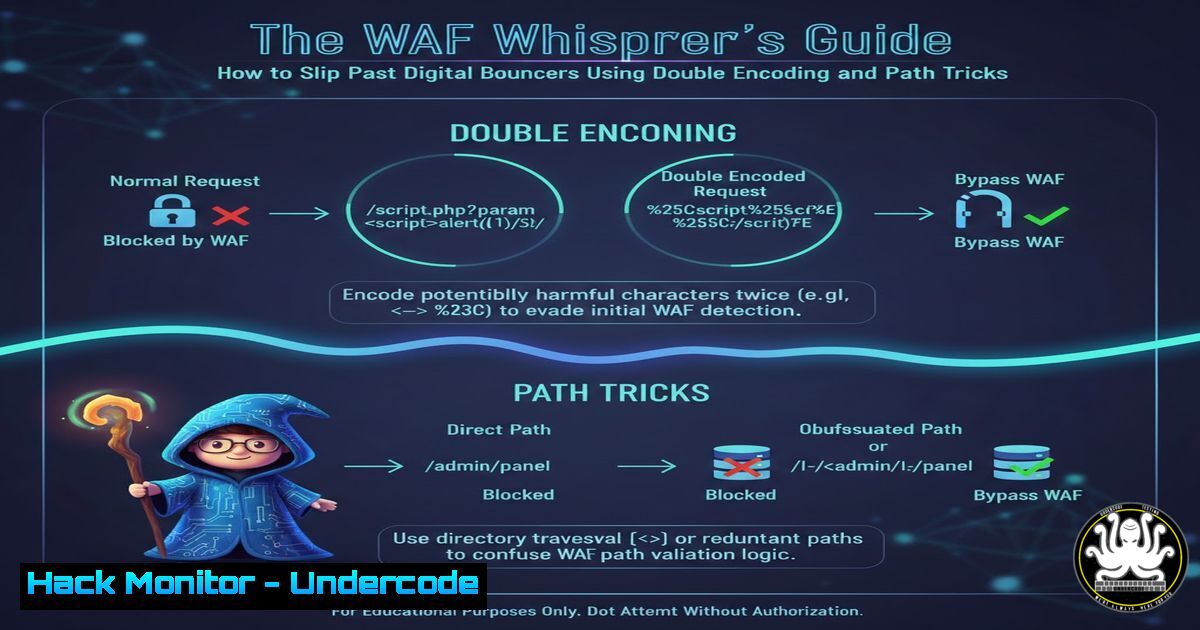
Web Application Firewalls (WAFs) stand as critical gatekeepers, filtering malicious HTTP traffic to protect applications from attacks like SQL Injection (SQLi) and Cross-Site Scripting (XSS). However, a sophisticated attacker can exploit inconsistencies in how these systems process incoming requests, particularly during URL normalization, to sneak harmful payloads through undetected. Techniques such as double encoding and manipulating path structures target the gap between the WAF’s security logic and the backend server’s interpretation, revealing that a firewall is only as strong as its most obscure parsing rule.
Learning Objectives:
- Understand the principle of URL normalization and how discrepancies between WAF and backend processing create bypass opportunities.
- Master practical obfuscation techniques, including double encoding, path traversal variations, and alternative encoding schemes.
- Learn defensive configurations and monitoring practices to harden WAFs against these evasion methods.
You Should Know:
1. The Core Vulnerability: Request Normalization Failures
The fundamental flaw exploited in these attacks is a mismatch in request normalization—the process where a system decodes and standardizes incoming data for inspection. A WAF must correctly decode and analyze a request to identify malicious patterns. If the backend server or application performs an additional or different decoding step, an attacker can craft a payload that appears benign to the WAF but becomes malicious after final processing.
For example, a WAF might block a simple path traversal attempt like /api/v1/../../../config. However, if the WAF’s normalization is flawed, an obfuscated version like `/api/v1/%2e%2e/%2e%2e/config` (where `..` is URL-encoded as %2e%2e) might slip through, only to be correctly decoded by the backend into the dangerous traversal sequence.
Step-by-step guide explaining what this does and how to use it.
Step 1: Identify a Potential Target Parameter. Use a tool like Burp Suite to proxy your traffic and identify user-controlled inputs, such as URL parameters (?id=1), form fields, or HTTP headers.
Step 2: Test with Basic Malicious Payloads. Submit a basic test payload, like a SQL snippet (' OR 1=1--) or a simple path traversal (../). Confirm it is being blocked by the WAF (e.g., you receive a 403 Forbidden response).
Step 3: Apply Obfuscation. Systematically obfuscate the blocked payload. Start with single URL encoding: change `/../` to /%2e%2e%2f. If blocked, try double encoding: encode the percent character itself, turning `%2e` into %252e, resulting in /%252e%252e%252f.
Step 4: Analyze the Response. If the obfuscated request returns a successful application response (e.g., data, a different error page) instead of a WAF block, the bypass may have worked. Further exploitation, such as extracting database information, can then proceed.
2. Mastering Double Encoding and Alternative Syntax
Double encoding is a potent technique that exploits a two-stage decoding process. The attacker encodes a malicious payload twice. The WAF, decoding it only once, sees a still-encoded, seemingly harmless string. The backend server, however, performs a second decode, revealing the active payload.
This isn’t limited to path traversal. In SQL Injection, characters like a single quote (') can be double-encoded from `%27` to %2527. For XSS, angle brackets can be obfuscated as `%253C` and `%253E` (where `<` is %3C, and `%` is then encoded to %25).
Step-by-step guide explaining what this does and how to use it.
Step 1: Craft the Raw Payload. Start with your intended malicious string. Example: a SQL Injection union payload: 1 UNION SELECT username, password FROM users--.
Step 2: Perform First URL Encoding. Encode all special characters. `UNION SELECT` becomes %55%4e%49%4f%4e %53%45%4c%45%43%54. Spaces can be encoded as `%20` or replaced with +.
Step 3: Perform Second Encoding (Double Encoding). Encode the percent signs (%) from the first step into %25. The first character of “UNION” (U encoded as %55) becomes %2555. Apply this to all percent signs in the string.
Step 4: Submit and Bypass. Submit the final double-encoded string as the parameter value. The payload sent might look like: id=1 %2555%254e%2549%254f%254e+%2553%2545%254c%2545%2543%2545.... A vulnerable WAF will see the literal characters `%2555` and not recognize it as the keyword U, while the backend will decode it correctly.
3. Exploiting Path and Parameter Obfuscation
Beyond encoding, attackers manipulate the structure of URLs and parameters to confuse WAF rule sets. This includes using nested paths, extraneous characters, or splitting parameters across multiple instances (HTTP Parameter Pollution – HPP).
The example from the source post, /api/v1/%2e%2e/%2e%2e/config, uses encoded dot-slash sequences. More advanced techniques involve inserting WAF-internal comments or junk data that the WAF strips out, causing it to mis-evaluate the request. For instance, `/?id=1+un//ion+sel//ect+1,2,3–` might be cleaned by an overly aggressive WAF to 1 union select 1,2,3--, which is then passed to the backend.
Step-by-step guide explaining what this does and how to use it.
Step 1: Path Traversal with Variations. When testing for directory traversal, don’t just use ../. Try:
URL-encoded: `%2e%2e%2f`
Double-encoded: `%252e%252e%252f`
With superfluous slashes: `/./.././../`
Unicode variations (if the system supports it).
Step 2: Parameter Fragmentation (HPF). If a WAF blocks a parameter like ?a=1+union+select+1,2, try splitting the payload across multiple parameters with the same name, which the backend might concatenate: ?a=1+union/&a=/select+1,2.
Step 3: Using Alternative HTTP Headers. WAF rules are often focused on the standard GET/POST request line. Try injecting the target path into headers like X-Original-URL, X-Rewrite-URL, or `X-Forwarded-Prefix` to trick the backend routing logic while bypassing frontend rules. Example request:
GET / HTTP/1.1
Host: target.com
X-Original-URL: /admin/deleteUser?id=123
4. Leveraging a Toolkit for WAF Bypass
Manual testing is powerful, but efficiency demands tooling. Security professionals use a suite of tools to fingerprint WAFs, fuzz parameters with payload lists, and automate complex attack sequences.
Step-by-step guide explaining what this does and how to use it.
Step 1: Fingerprinting with WAFW00F. Identify the WAF in place. This informs which evasion techniques are most likely to work. Use the command: `wafw00f https://target.com`
Step 2: Fuzzing with Burp Suite Intruder. Load payload lists (containing various encoded, obfuscated strings) into Intruder. Use it to bombard a parameter with thousands of variants quickly, analyzing responses for differences that indicate a bypass.
Step 3: Automation with Custom Scripts. For complex multi-step bypasses (e.g., those requiring specific header manipulation), write a Python script using the `requests` library to precisely craft and send HTTP requests. Example snippet to test a header bypass:
import requests
url = "http://target.com/somepage"
headers = {"X-Original-URL": "/admin"}
response = requests.get(url, headers=headers)
print(response.status_code, len(response.content))
5. Defensive Countermeasures and WAF Hardening
For defenders, understanding these techniques is the first step to mitigating them. A “set and forget” WAF is a vulnerable WAF. Effective defense requires a multi-layered, proactive approach.
Step-by-step guide explaining what this does and how to use it.
Step 1: Implement Positive Security Models. Where possible, move beyond blocklists (negative model) to allowlists (positive model). Define strict rules for what constitutes legitimate traffic for each endpoint (e.g., allowed HTTP methods, parameter types, value lengths).
Step 2: Ensure Consistent Normalization. Verify that your WAF’s decoding logic (for URL, Unicode, etc.) perfectly mirrors that of your backend application servers. This closes the gap attackers exploit.
Step 3: Adopt Virtual Patching. Use the WAF to deploy immediate, temporary rules that block exploitation of newly disclosed vulnerabilities in your application before the developers can issue a permanent code patch. Example rule for a vulnerable plugin path in a ModSecurity WAF:
SecRule REQUEST_URI "@beginsWith /wp-content/plugins/vulnerable-plugin/" \
"id:1000,phase:1,deny,status:403,msg:'Virtual patch for CVE-XXXX-XXXX'"
Step 4: Rigorous Logging and Monitoring. Integrate WAF logs with a SIEM system. Don’t just look for blocked attacks; actively hunt for successful bypasses by correlating unusual client behavior with application errors or unexpected data access. Regularly review logs for patterns and test your WAF’s effectiveness through controlled red team exercises.
What Undercode Say:
The Illusion of Absolute Security: A WAF is a vital component of defense-in-depth, but it is a filter, not a silver bullet. Over-reliance on any single WAF, especially with default rules, creates a dangerous false sense of security. The core mitigation for injection flaws must always be secure coding practices like parameterized queries and output encoding.
The Asymmetric Advantage of the Attacker: The attacker needs to find only one successful bypass vector, while the defender must secure the entire attack surface. This asymmetry favors the offense, making continuous tuning, threat intelligence integration, and adversarial testing non-negotiable for effective defense.
Prediction:
The evolution of WAF bypass techniques will increasingly intersect with advancements in AI and application architecture. We will see a rise in AI-powered fuzzing tools that automatically generate highly obfuscated payloads tailored to evade specific ML-based WAF models. Furthermore, as applications decompose into complex graphs of microservices and serverless functions, new attack surfaces will emerge. Bypasses will likely exploit inconsistencies in request routing and normalization across multiple API gateways and cloud-native WAFs, making holistic, architecture-aware security configuration more critical than ever. The defenders’ response will pivot towards deeply integrated DevSecOps pipelines where WAF rules are dynamically generated and tested as part of the CI/CD process, shifting security “left” and “right” simultaneously.
▶️ Related Video (76% Match):
🎯Let’s Practice For Free:
IT/Security Reporter URL:
Reported By: Koutora Anicet – Hackers Feeds
Extra Hub: Undercode MoN
Basic Verification: Pass ✅


