Listen to this Post
Introduction:
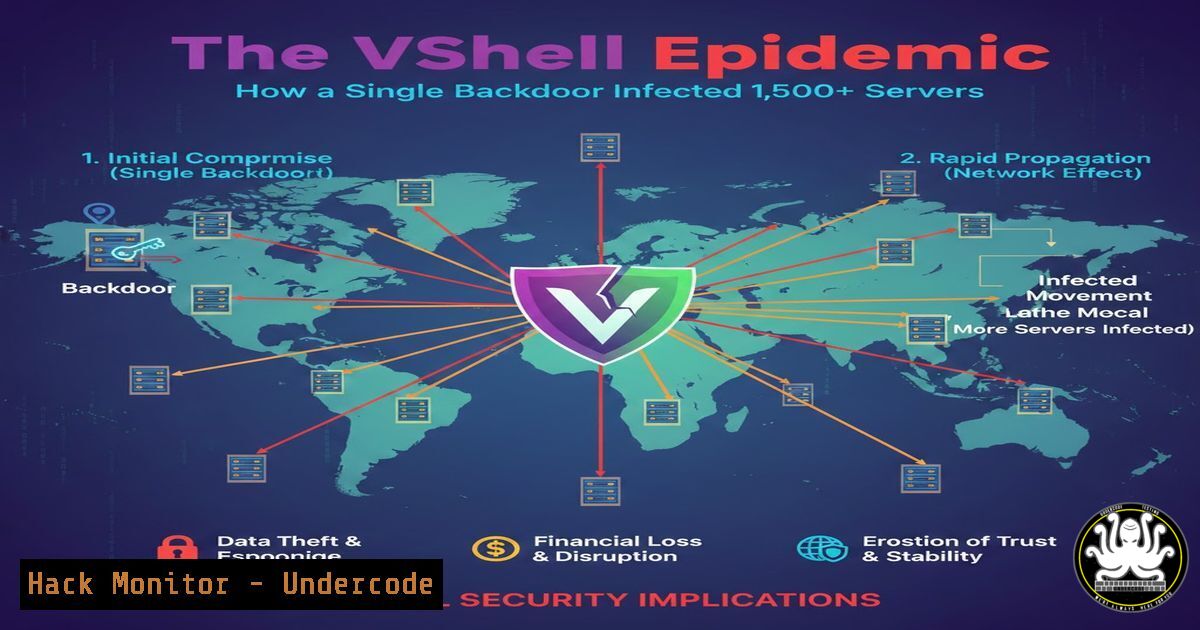
A large-scale cyber espionage campaign leveraging the VShell backdoor has compromised over 1,500 servers worldwide, targeting government, healthcare, military, and research organizations for long-term infiltration. This open-source, cross-platform remote access trojan (RAT) provides attackers with stealthy, persistent control, making it a tool of choice for sophisticated threat actors, particularly those linked to state-sponsored espionage. The campaign underscores a critical shift where advanced attackers increasingly use publicly available tools to mask their activities and complicate attribution.
Learning Objectives:
- Understand the technical mechanisms and cross-platform capabilities of the VShell backdoor.
- Identify the tactics, techniques, and procedures (TTPs) of associated threat actors like UNC5174.
- Implement effective detection, mitigation, and hardening strategies for Windows and Linux systems.
You Should Know:
- Deconstructing VShell: More Than Just a Simple Backdoor
VShell is a potent, cross-platform post-exploitation tool that functions as a Remote Access Trojan (RAT). Written in Go, it provides attackers with a versatile command-and-control (C2) channel on compromised systems running Windows, Linux, and macOS. Its core functionality includes executing arbitrary shell commands, uploading and downloading files, and gathering detailed system intelligence (process lists, network connections). The danger is amplified by its modular design, allowing attackers to customize its capabilities with plugins for specific missions.
The malware is typically deployed after initial compromise, often via phishing or exploitation of public-facing application vulnerabilities. In one documented attack chain, a malicious ZIP archive delivers a legitimate, signed binary that sideloads a malicious DLL (VELETRIX). This loader then uses advanced “IPFuscation”—encoding shellcode as IPv4 address strings—and executes it in memory to finally deploy the VShell payload, leaving minimal forensic evidence on disk.
- The Actors Behind the Curtain: UNC5174 and the Commoditization of Espionage
NVISO’s research has publicly linked several VShell intrusions to a threat actor tracked as UNC5174, a suspected initial access broker with links to China’s Ministry of State Security. This group exemplifies a modern trend: state-aligned actors are increasingly forgoing custom, signatured malware in favor of open-source or commercially available tools like VShell and Cobalt Strike. This “living-off-the-land” approach using common tools helps them blend in with everyday malicious traffic, complicating detection and attribution.
UNC5174 has been observed using VShell in tandem with other sophisticated malware like SNOWLIGHT, which acts as a fileless dropper. Their infrastructure employs sophisticated deception techniques like domain squatting (creating domains that mimic legitimate services like Google or Telegram) to host C2 servers and facilitate phishing. This indicates a high level of operational security and planning. It’s crucial to understand that while UNC5174 is a prominent user, VShell’s public availability means it is used by a wider ecosystem of threat actors, making it a broad indicator of compromise.
3. Network Traffic Analysis: Hunting for VShell Beacons
Detecting VShell communication is critical for identifying infections. The malware’s C2 protocol involves the infected host (stager) beaconing out to a server to request the main payload. NVISO has published detailed Suricata network intrusion detection system (NIDS) rules to catch this activity.
Step-by-Step Guide for Network Monitoring:
- Understand the Signature: The initial beacon from a Windows host contains a plaintext architecture identifier (
w64for 64-bit, `w32` for 32-bit) within the first 45 bytes of a TCP session. - Deploy Detection Rules: Implement the following Suricata rules on your network perimeter to flag potential beaconing activity. The first rule looks for the Windows 64-bit stager request:
alert tcp $HOME_NET any -> $EXTERNAL_NET any (msg:"[bash] Potential VShell beacon payload request (Windows amd64)"; flow:to_server,established; content:"w64 "; fast_pattern; offset:0; depth:6; stream_size:client,<=,45; flowbits:set,NVISO.VShell.Windows; sid:1000000; rev:1;)
- Correlate with the Response: A corresponding rule tracks the C2 server’s response, which contains a specific binary pattern. This rule has a higher confidence level, helping to reduce false positives:
alert tcp $EXTERNAL_NET any -> $HOME_NET any (msg:"[bash] VShell beacon payload response (Windows)"; flow:to_client,established; flowbits:isset,NVISO.VShell.Windows; content:"|d4 c3|"; offset:0; depth:2; content:"|b8 cd f1 f0 ea b9 e9 eb f6 fe eb f8 f4 b9 fa f8 f7 f7 f6 ed b9 fb fc b9 eb ec f7 b9 f0 f7 b9 dd d6 ca b9 f4 f6 fd fc b7|"; offset:77; depth:40; sid:1000002; rev:1;)
- Monitor for Linux Variants: Similar rules exist for Linux stagers, which beacon with identifiers like
l64, `a64` (for ARM64), etc.. Integrating the full rule set from NVISO’s report is essential for cross-platform coverage.
4. Endpoint Hardening: Stopping the Attack Chain
Preventing initial access and execution is paramount. Since VShell is often deployed post-exploit, focus on hardening endpoints.
Step-by-Step Guide for Linux Hardening:
- Restrict File Execution: Use filesystem policies to prevent execution from common temporary directories. For example, with `sudo apt-get install apparmor-utils` and configuring AppArmor profiles for critical services.
- Audit and Restrict Cron Jobs: UNC5174 has been known to use cron jobs for persistence. Regularly audit cron tables: `sudo cat /etc/crontab` and
sudo ls -la /etc/cron./. Implement a centralized logging solution for cron to monitor for unauthorized entries. - Implement Strict File Permissions: Ensure system binaries and configuration files are not writable by standard users. Use commands like `sudo chmod 0755 /usr/bin/` and `sudo chown root:root /usr/bin/` to maintain integrity. Regularly audit for suid/guid files with
find / -type f -perm /6000 -ls.
Step-by-Step Guide for Windows Hardening:
- Enable and Audit PowerShell Logging: Turn on Module, Script Block, and Transcription logging via Group Policy (
Administrative Templates -> Windows Components -> Windows PowerShell). This can catch in-memory execution and payload downloads. - Apply the Principle of Least Privilege: Ensure users and services run with the minimum privileges required. Use Local Security Policy (
secpol.msc) to restrict access and regularly audit local group memberships. - Control DLL Sideloading: Since VShell loaders like VELETRIX abuse DLL sideloading, use tools like Microsoft’s Attack Surface Reduction (ASR) rules to block Office applications from creating child processes or injecting into legitimate processes.
-
Proactive Defense: Threat Intelligence and Security Posture Management
A reactive approach is insufficient against persistent threats. Organizations must adopt proactive measures informed by threat intelligence.
Step-by-Step Guide for Building a Proactive Stance:
- Integrate Threat Intelligence Feeds: Subscribe to feeds that provide Indicators of Compromise (IOCs) like those from NVISO, including hash values for malicious files (e.g., `ba4f9b324809876f906f3cb9b90f8af2f97487167beead549a8cddfd9a7c2fdc` for a VShell DLL) and C2 domain names. Use these to block known-bad entities at your firewall and DNS layers.
- Deploy Endpoint Detection and Response (EDR): EDR solutions are critical for detecting the fileless techniques and in-memory execution used by loaders like SNOWLIGHT and VELETRIX. Ensure your EDR is tuned to alert on suspicious process injection, unusual network connections from legitimate processes, and execution from atypical locations.
- Conduct Regular Vulnerability and Patch Management: As threat actors exploit public-facing vulnerabilities for initial access, a rigorous and fast patch cycle is a primary defense. Prioritize patching for internet-facing systems and software like Ivanti, SAP, and ScreenConnect, which have been targeted in related campaigns.
What Undercode Say:
- The Tool Doesn’t Define the Threat: The focus on VShell itself is a distraction from the more significant trend: the professionalization and commodification of cyber espionage. The real story is how groups like UNC5174 expertly combine open-source tools, legitimate software abuse (DLL sideloading), and sophisticated infrastructure to create highly effective, low-signature attack chains.
- Defense Must Evolve Beyond Signatures: Traditional antivirus is obsolete against these threats. The future of defense lies in behavioral analytics (detecting abnormal process relationships), network traffic analysis (decrypting and inspecting TLS/WebSockets where possible), and comprehensive visibility across endpoints, identity, and cloud workloads. Security teams must assume breach and hunt for anomalies, not just known-bad indicators.
Prediction:
The VShell campaign is a precursor to a new era of hybrid cyber operations. We predict a continued blurring of lines between state-sponsored and criminal activity, with tools and infrastructure being shared, rented, or sold in underground markets. The use of “legitimate” open-source offensive tools will accelerate, forcing a fundamental rethink of supply chain security—not just for software, but for the tools used to defend it. Defenders will increasingly rely on AI and machine learning to analyze behavior at scale, but attackers will concurrently use AI to generate more convincing phishing lures and automate vulnerability discovery. The battleground will shift further towards identity abuse and living-off-the-cloud techniques, making robust visibility and zero-trust architectures non-negotiable for any organization handling sensitive data.
▶️ Related Video (74% Match):
🎯Let’s Practice For Free:
IT/Security Reporter URL:
Reported By: UgcPost 7405151133507473409 – Hackers Feeds
Extra Hub: Undercode MoN
Basic Verification: Pass ✅


