
Listen to this Post
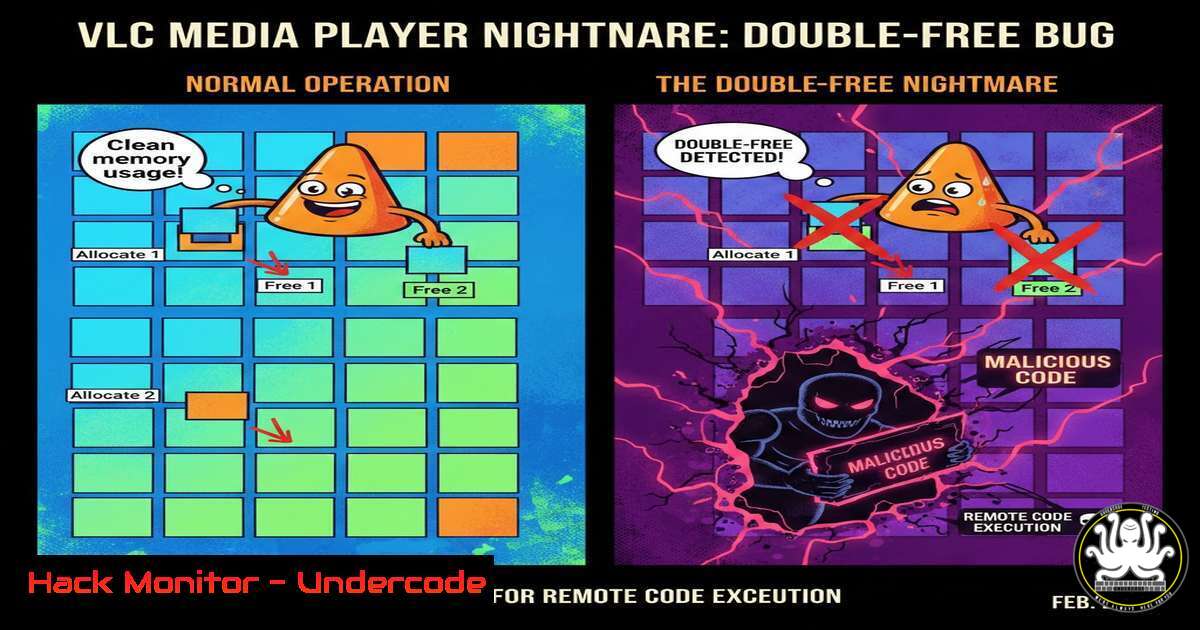
Introduction:
In the interconnected world of digital media, vulnerabilities in ubiquitous software like VLC Media Player pose a significant threat. A recent discovery by security researchers, facilitated by the advanced fuzzing tool Honggfuzz, uncovered a critical double-free Remote Code Execution (RCE) vulnerability within VLC’s parsing mechanisms. This flaw highlights the persistent dangers of memory corruption in widely trusted applications and underscores the necessity of robust fuzzing in the software development lifecycle.
Learning Objectives:
- Understand the mechanics and severe implications of a double-free vulnerability leading to Remote Code Execution.
- Learn how to utilize modern fuzzing tools like Honggfuzz to uncover similar memory corruption flaws.
- Acquire practical steps to mitigate such vulnerabilities, including patching, exploit prevention techniques, and secure coding practices.
You Should Know:
1. Deconstructing the Double-Free RCE Vulnerability
A double-free occurs when a program attempts to free the same allocated memory chunk twice. This corrupts the state of the memory manager (e.g., glibc’s malloc), potentially allowing an attacker to manipulate memory allocation in a way that leads to arbitrary code execution. In the VLC case, specially crafted media file metadata triggered this condition during parsing.
Step-by-step guide explaining what this does and how to use it:
1. The Flaw: The vulnerability likely resided in a code path where, under certain error conditions, a pointer to a dynamically allocated buffer (for metadata like title or artist) was freed but not set to NULL. A subsequent cleanup function then attempted to free the same pointer again.
2. Exploit Primitive: This corruption allows an attacker to shape the heap layout. By carefully timing allocations and frees with malicious input, they can cause the program to allocate new data in a strategic location, eventually overwriting function pointers or return addresses.
3. Weaponization: An exploit would craft a malicious media file (e.g., .mp3, .mp4) where the metadata triggers the double-free. The final payload would be shellcode embedded within the file, which, after the memory corruption, gets executed when the hijacked pointer is dereferenced.
2. Fuzzing with Honggfuzz: Uncovering Hidden Bugs
Honggfuzz is a security-oriented, feedback-driven fuzzer. It mutates input data (like media files) and monitors the target program for crashes, making it ideal for finding memory corruption bugs. Its “persistent mode” allows for incredibly fast in-process fuzzing of libraries like VLC’s parsers.
Step-by-step guide explaining what this does and how to use it:
1. Build Target with Instrumentation: Compile VLC or its specific parser library with sanitizers for optimal bug detection.
 Example compilation with AddressSanitizer (ASAN) to detect memory errors
CC=hfuzz-clang CFLAGS="-fsanitize=address -g" ./configure
make
2. Prepare Seed Corpus: Gather a collection of valid, small media files (seeds) to guide the fuzzer.
3. Launch Honggfuzz: Start fuzzing the target function or binary.
honggfuzz -i ./seed_corpus -o ./findings -n 4 -- ./vlc_parser <strong><em>FILE</em></strong>
4. Triage Crashes: Analyze the crash reports generated in ./findings. A double-free will typically be caught by ASAN, producing a detailed report.
3. Proof-of-Concept Exploitation on a Linux Lab System
Disclaimer: This is for educational purposes in a controlled lab environment (e.g., isolated VM).
Step-by-step guide explaining what this does and how to use it:
1. Setup: Install a vulnerable version of VLC and disable modern exploit mitigations for lab testing.
 Temporarily disable ASLR for deterministic testing
echo 0 | sudo tee /proc/sys/kernel/randomize_va_space
 Compile VLC without stack protection for simpler PoC development
export CFLAGS="-fno-stack-protector -z execstack"
2. Craft Malicious File: Write a Python script that generates a media file with the exact metadata structure that triggers the double-free sequence identified by the fuzzer.
 Simplified structure of a malicious file generator
with open('exploit.m4a', 'wb') as f:
f.write(b'VALID_FILE_HEADER')
 Corrupt metadata atom designed to trigger double-free
f.write(b'ftyp' + struct.pack('>I', 0x100) + b'...')
 ... Additional crafted atoms ...
 Shellcode payload position
f.write(b'\x41'  1024)  Offset to control data
 Pointer manipulation data goes here
3. Debug & Control Execution: Use `gdb` to trace the program’s execution, observe the heap corruption, and verify control over a program counter (e.g., EIP/RIP).
gdb --args vlc --no-audio --no-video exploit.m4a
(gdb) run
(gdb) info registers eip
4. Mitigation Strategies for System Administrators
Immediate action is required to protect endpoints.
Step-by-step guide explaining what this does and how to use it:
1. Patching: The first and most critical step. Update VLC Media Player to the latest version immediately.
– Linux (Debian/Ubuntu): `sudo apt update && sudo apt upgrade vlc`
– Windows: Use the built-in updater or download from the official videolan.org site.
2. Implement Application Whitelisting: Use tools like AppLocker (Windows) or authorized_keys/executable policies (Linux) to prevent unauthorized or outdated versions of VLC from running.
– Windows (PowerShell Admin):
 Create a default deny rule for a specific path
New-AppLockerPolicy -RuleType Path -Action Deny -User Everyone -Path "C:\OldVulnerableVLC\vlc.exe" -XMLEnabled
3. Network Segmentation: Restrict user workstations, where media players run, from accessing sensitive internal networks.
5. Developer Lessons: Hardening Code Against Memory Corruption
Preventing such bugs is more effective than patching them.
Step-by-step guide explaining what this does and how to use it:
1. Adopt Safe Languages/Routines: Use languages like Rust or C++ with smart pointers (std::unique_ptr, std::shared_ptr). In C, use compiler defenses and safe libraries.
2. Enable Exploit Mitigations: Compile with all modern protections.
 Recommended compiler flags for GCC/Clang
CFLAGS="-O2 -fstack-protector-strong -D_FORTIFY_SOURCE=2 -Wformat -Werror=format-security -fPIE"
LDFLAGS="-Wl,-z,now,-z,relro,-pie"
3. Integrate Fuzzing: Make fuzzing with tools like Honggfuzz or libFuzzer a mandatory part of the CI/CD pipeline for all components parsing untrusted data.
- API and Cloud Hardening for Media Processing Services
Backend services that process user-uploaded media are high-value targets.
Step-by-step guide explaining what this does and how to use it:
1. Sandboxing: Run media parsing code in strict, isolated containers or serverless functions with minimal permissions. Use gVisor or Firecracker for strong isolation.
2. Input Validation & Sanitization: Before passing a file to VLC or similar libraries, use a separate, lightweight library to validate basic file structure and impose strict size limits on metadata fields.
3. Web Application Firewall (WAF) Rules: Deploy rules to detect and block attempted exploit payloads in file uploads, looking for anomalous metadata patterns.
What Undercode Say:
- The Shared Library Attack Surface is Vast. This vulnerability isn’t just in the VLC GUI application; it’s in the underlying parsing library (
libvlc). This library can be embedded in countless other applications, web services, and IoT devices, multiplying the attack surface exponentially. Asset management must include tracking the use of such vulnerable libraries deep within the software supply chain. - Fuzzing is Non-Negotiable for Security-Critical Software. The discovery via Honggfuzz is a textbook case of modern defensive security. Any application that handles complex, untrusted file formats must undergo rigorous, continuous fuzzing. This is no longer a “nice-to-have” but a core requirement for secure development, as mandated by frameworks like SLSA and NIST’s SSDF.
Prediction:
The VLC double-free RCE is a precursor to a wave of similar vulnerabilities being discovered in widely deployed media libraries and document parsers. As software composition analysis (SCA) and fuzzing become more automated and accessible, researchers and attackers alike will systematically audit these foundational components. We predict a shift in exploitation focus from end-user applications to the backend microservices and cloud functions that process media at scale (e.g., video transcoding services, content management systems). This will lead to targeted attacks aimed at data exfiltration and lateral movement within corporate networks, rather than broad consumer attacks. The industry response will be a forced acceleration towards memory-safe languages and mandatory, billable-hours-style bug bounty programs for critical open-source dependencies.
▶️ Related Video (76% Match):
🎯Let’s Practice For Free:
IT/Security Reporter URL:
Reported By: Https: – Hackers Feeds
Extra Hub: Undercode MoN
Basic Verification: Pass ✅


