
Listen to this Post
Introduction:
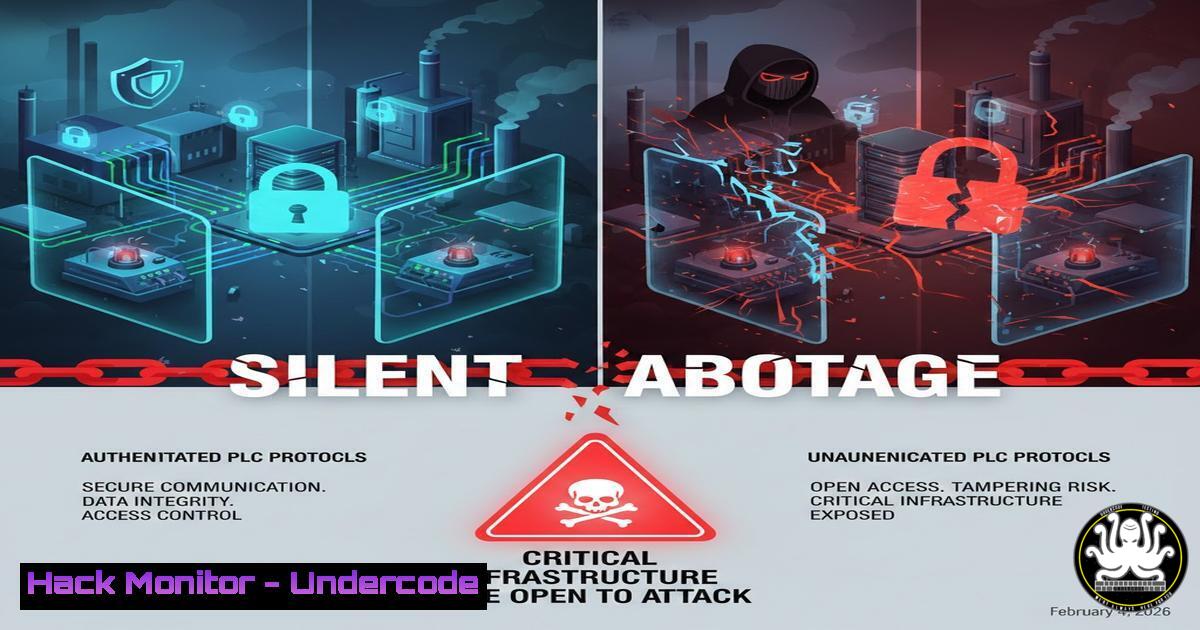
Operational Technology (OT) and Industrial Control Systems (ICS) form the backbone of critical infrastructure, from power grids to water treatment plants. A pervasive and often overlooked vulnerability lies in the very heart of these systems: Programmable Logic Controllers (PLCs). These devices frequently operate using legacy protocols that inherently lack authentication, allowing any attacker on the network to read from or write to controller memory, posing a direct threat to physical processes and public safety.
Learning Objectives:
- Understand the fundamental security flaw in common OT/ICS protocols like Modbus TCP, Ethernet/IP, and PROFINET.
- Learn methods to identify and exploit unauthenticated PLC communications for security testing purposes.
- Implement practical hardening and mitigation strategies to segment and protect OT networks.
You Should Know:
1. The Anatomy of an Unauthenticated Protocol
The core issue is a design philosophy from an era of isolated networks: trust. Protocols like Modbus TCP (port 502) and Ethernet/IP (port 44818) were built for efficiency and reliability, not security. They operate on a simple request-response model where commands to read or write PLC memory registers are executed without any verification of the requester’s identity or authorization.
Step‑by‑step guide explaining what this does and how to use it.
Objective: Identify a Modbus TCP device and query its holding registers.
Tool: `nmap` for discovery, `python` with `pymodbus` library for interaction.
Commands/Tutorial:
1. Network Discovery:
nmap -p 502 --open 192.168.1.0/24 -oG modbus-hosts.txt
This scans the network for hosts with port 502 open.
2. Interrogate PLC Registers:
from pymodbus.client import ModbusTcpClient
client = ModbusTcpClient('192.168.1.10')  PLC IP
client.connect()
 Read 10 holding registers starting at address 0
response = client.read_holding_registers(0, 10)
if not response.isError():
print(f"Register Values: {response.registers}")
 Write to a single register (e.g., address 5, value 100)
write_response = client.write_register(5, 100)
client.close()
This script demonstrates how easily data can be read and potentially manipulated.
2. Sniffing and Decoding OT Network Traffic
Even without direct exploitation, passive reconnaissance reveals critical process information. Attackers can map network topology, identify PLC models, and understand process variables by capturing network traffic.
Step‑by‑step guide explaining what this does and how to use it.
Objective: Capture and analyze Modbus TCP traffic.
Tool: Wireshark with appropriate dissectors.
Commands/Tutorial:
- Start a capture on the relevant network interface.
2. Apply a display filter: `tcp.port == 502`
- Follow a TCP stream to see the plaintext conversation between a Human-Machine Interface (HMI) and the PLC. You will see explicit function codes (e.g., `03` = Read Holding Registers) and data addresses.
- Analyze -> Enabled Protocols -> Ensure “MODBUS” is checked. This allows Wireshark to decode the packets properly, displaying the meaning of function codes and data.
3. Exploiting Write Access for Process Manipulation
The transition from reading data to manipulating it is trivial with write access. Changing a single register value could alter a setpoint (e.g., pressure or temperature), command a valve to open, or stop a motor.
Step‑by‑step guide explaining what this does and how to use it.
Objective: Safely demonstrate a write command in a lab environment.
Tool: `modbus-cli` or a custom Python script.
Commands/Tutorial:
 Using modbus-cli for a direct command-line write
modbus write --uid=1 --type=holding --address=40001 --value=0 192.168.1.10
WARNING: This command, if pointed at a live system, would write the value `0` to holding register 40001 (often corresponding to Modbus address 0). In a real system, this could shut down a process. Always conduct such testing only on isolated, non-production lab PLCs.
4. Implementing Network Segmentation and Access Control
The primary mitigation is architectural. OT networks must be isolated from IT networks and the internet, with strict control over any communications between zones.
Step‑by‑step guide explaining what this does and how to use it.
Objective: Configure a basic firewall rule to restrict access to PLCs.
Tool: Industrial firewall or managed switch with ACLs.
Example Rule (Conceptual):
Action: ALLOW
Source: HMI/Engineering Workstation IP (e.g., `192.168.1.50`)
Destination: PLC Subnet (e.g., `192.168.1.0/24`)
Protocol/Port: TCP/502 (Modbus)
Implicit Deny: All other traffic to the PLC subnet is blocked.
This is a “default deny, explicit permit” policy applied at the network perimeter of the PLC cell.
5. Leveraging Protocol-Aware Deep Packet Inspection (DPI) Firewalls
Modern OT security devices can go beyond IP/port filtering. They can inspect the contents of Modbus or Ethernet/IP packets to enforce positive security models—allowing only specific, pre-configured function codes and register ranges.
Step‑by‑step guide explaining what this does and how to use it.
Objective: Configure a DPI rule to permit only read requests to a specific range of registers.
Tool: Vendor-specific industrial firewall (e.g., Tofino, Cisco Cyber Vision).
Example Policy:
1. Create a whitelist rule for Modbus TCP.
- Permit: Function Code `03` (Read Holding Registers) for register range
30001-31000. - Block: Function Code `06` (Write Single Register) and `16` (Write Multiple Registers) from all sources except the authorized engineering station.
4. Log and alert on any violation attempts.
- Building a Compensating Control: Monitoring and Anomaly Detection
When legacy equipment cannot be upgraded, monitoring becomes essential. Establish a baseline of normal PLC communications and alert on deviations.
Step‑by‑step guide explaining what this does and how to use it.
Objective: Use a network tap and a Security Information and Event Management (SIEM) to detect anomalous Modbus write commands.
Tool: `Zeek (Bro)` IDS with OT protocol logs forwarded to a SIEM like Splunk or Elastic Stack.
Commands/Tutorial:
- Configure Zeek to monitor the OT segment and load the Modbus policy script.
2. Zeek will generate `modbus.log` files.
- Create a SIEM correlation rule that triggers an ALERT if:
A Modbus write command (06,16) is seen outside of a scheduled maintenance window.
A write command originates from an IP address not whitelisted as an HMI or engineering workstation.
What Undercode Say:
- The Vulnerability is Systemic, Not Configurational: The lack of authentication is not a misconfiguration but a fundamental design flaw in the protocols themselves. This shifts the defense burden entirely to network architecture and external controls.
- Passive Discovery is a Critical First Phase for Attackers: Before a single exploit is launched, adversaries can gain a complete blueprint of your industrial process through passive traffic analysis, making network monitoring and encryption (where possible) paramount.
Prediction:
The convergence of IT and OT networks, driven by Industry 4.0 and IoT, will exponentially increase the attack surface. We will see a rise in automated “bot” malware designed to scan for and laterally move through OT networks using these unauthenticated protocols. The future of OT security lies in the widespread adoption of encrypted, authenticated successor protocols (like OPC UA), heavily enforced network segmentation, and the integration of AI-driven anomaly detection capable of identifying subtle manipulations in process data that precede a major disruptive event. The industry will be forced to move from a “perimeter-and-pray” model to a true zero-trust architecture for operational environments.
Relevant Extracted URLs:
- Main Video: https://lnkd.in/eZUWBtZi
- Newsletter: https://lnkd.in/ePTx-Rfw
- Free Learning Videos: https://lnkd.in/eif9fkVg
▶️ Related Video (78% Match):
🎯Let’s Practice For Free:
IT/Security Reporter URL:
Reported By: Mikeholcomb Security – Hackers Feeds
Extra Hub: Undercode MoN
Basic Verification: Pass ✅


