Listen to this Post
Introduction:
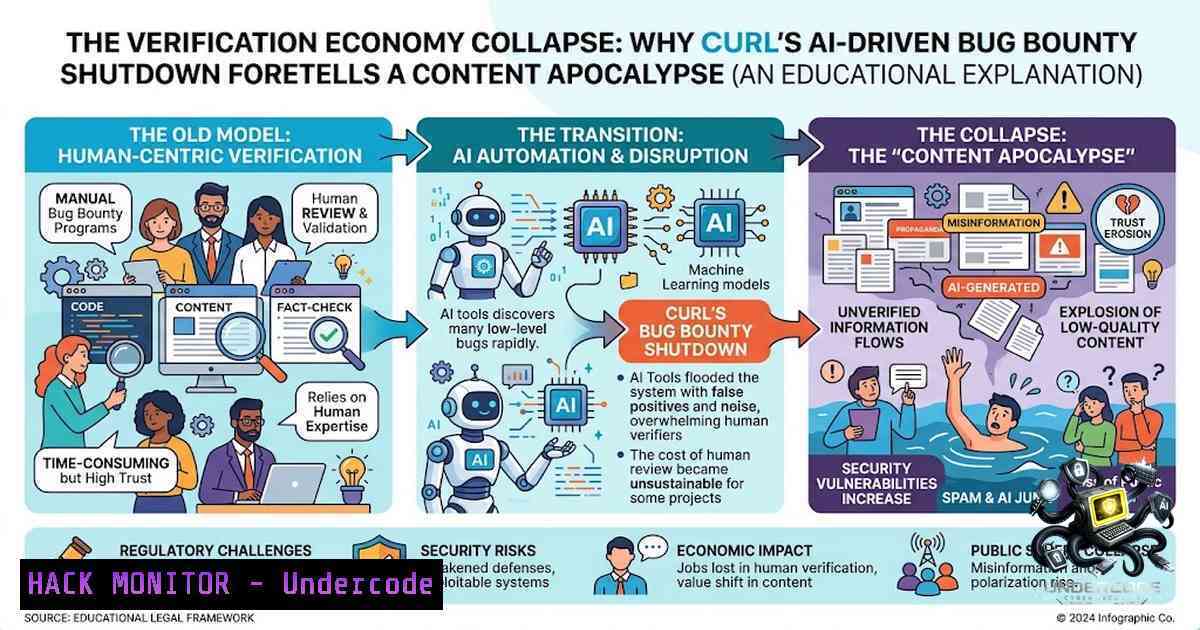
The recent shutdown of the curl bug bounty program in January 2026, precipitated by a staggering influx of AI-generated false positives, has exposed a critical economic asymmetry plaguing modern security and content verification. When the cost of generating a report plummets to near zero while the cost of verifying its authenticity remains static, the verification layer inevitably collapses under its own weight. This event serves as a canary in the coal mine for the broader IT and cybersecurity landscape, highlighting a fundamental failure in resource allocation that is now mirrored in content strategy, cloud security, and AI model training, where trust is becoming an unsustainable liability.
Learning Objectives & Secrets:
- Objective 1: Understand the “Verification Asymmetry” – the economic principle where the cost of generation outpaces the cost of validation, leading to system fragility.
- Objective 1 Secret Tip: To survive this asymmetry, organizations must automate the “first pass” of verification using anomaly detection algorithms rather than human review, reserving human intellect for complex, contextual threats.
- Objective 2: Implement forensic verification workflows that treat every piece of incoming data (bug reports, content updates, AI model outputs) as “hostile” by default.
- Objective 2 Secret Tip: Utilize hash-based integrity checks (SHA-256) on input sources to create a chain of custody before analysis begins.
- Objective 3: Design a “Fail-Fast” verification pipeline that rejects submissions lacking specific metadata (e.g., reproduction steps, environment variables) to offset the cost of processing generated garbage.
- Objective 3 Secret Tip: In Linux, use `grep -E` and `awk` to parse incoming report logs for specific “hallucination markers” (e.g., non-existent CVE numbers) and automatically discard them.
You Should Know:
1. Auditing the “Verification Debt” in Existing Workflows
The curl maintainers were absorbing verification costs on top of engineering work, unpaid and invisible. This scenario is identical to “Technical Debt,” but we must now define “Verification Debt” as the accumulated cost of unverified data entering a system. This debt is rampant in DevSecOps pipelines where security scans generate thousands of alerts, most of which are false positives, yet the team must review every single one.
Step‑by‑step guide to measure your current debt:
- Step 1: Log Aggregation. Collect all security alerts, bug reports, and automated scan outputs over a 30-day period.
- Step 2: Triage Metrics. Measure the time spent verifying the legitimacy of a report vs. the time spent fixing a legitimate one.
- Step 3: The AI Ratio. Use the `file` command in Linux to check for MIME types and metadata patterns that might indicate AI generation (e.g., uniform sentence length, specific token patterns). A command such as `cat reports.txt | awk ‘{print NF}’ | sort | uniq -c` can reveal unnaturally consistent word counts, a hallmark of LLM-generated text.
- Step 4: Cost Analysis. Calculate the man-hours spent on verification. If this exceeds 40% of your engineering time, your pipeline is on a trajectory similar to curl’s. The solution is to implement a “Risk Scoring” system that automatically prioritizes reports based on source reputation and exploitability, effectively ignoring the “noise” until resources are available.
- Simulating the Attack: Generating AI-Generated Reports for Testing
To defend against the “Enshittification” of security inputs, you must understand how easily a bad actor can spam your verification systems. Using open-source LLMs, you can generate dummy reports to test your pipeline’s resilience.
Step‑by‑step guide for simulating a flood:
- Step 1: Setup a Local LLM. Install Ollama (Linux:
curl -fsSL https://ollama.com/install.sh | sh). Pull a model like `mistral` (ollama pull mistral). - Step 2: Create a Prompt Template. Create a file `prompt.txt` containing: “Generate a detailed CVE report for a theoretical use-after-free vulnerability in a web server, including code snippets in C and potential impact.”
- Step 3: Automate Generation. Run a Bash script to loop 100 times:
for i in {1..100}; do ollama run mistral "$(cat prompt.txt)" > generated_report_$i.txt; done. - Step 4: Test Defense. Run your existing verification script against these generated files. Track how long it takes to reject them. To harden, implement regex filters in Python or `grep` to immediately reject reports that do not contain a valid CVE ID pattern (e.g.,
grep -E "CVE-[0-9]{4}-[0-9]{4,7}"). If it fails this check, it goes straight to the trash, saving your engineers from even looking at it.
3. OSINT and Verification: Cross-Referencing External Data
Just as content writers face the “gap” between spec and reality, security analysts must bridge the gap between a bug report and the actual code base. Open Source Intelligence (OSINT) tools can automate the early stages of verification.
Step‑by‑step guide to automating validation:
- Step 1: Setup the Environment. For Windows, use PowerShell to install the OSINT tool “theHarvester” via WSL (Windows Subsystem for Linux). `wsl –install` and then
sudo apt install theharvester. - Step 2: Source Correlation. Before accepting a vulnerability report, query domain information to see if the submitter’s IP/host has a history of abuse. Use Linux: `whois
` and `dig -x ` to verify infrastructure origins. - Step 3: Exploit-DB Verification. Use `searchsploit` (Linux) to see if a similar vulnerability already exists. If the AI-generated report describes a “new” vulnerability but the vector is identical to one in Exploit-DB from 2018, it is likely a hallucination. Command:
searchsploit "Apache" | grep -i "denial". This cross-referencing allows you to kill a report in minutes rather than hours.
4. Cloud Hardening Against Verification Spam
In cloud environments (AWS, Azure), verification spam can lead to auto-scaling events and increased compute costs, as your systems struggle to process bogus requests. This is an economic attack vector.
Step‑by‑step guide for cloud defense:
- Step 1: Implement an API Gateway Circuit Breaker. Configure your AWS API Gateway or Azure API Management to throttle requests per IP address or user.
- Step 2: Serverless Verification. Offload the heavy lifting to serverless functions (AWS Lambda). If a report is sent, trigger a lambda that runs a lightweight validation (regex check, timestamp check, JSON schema validation). If it passes, it moves to the SQS queue for deep inspection. If it fails, it dies in the lambda, costing you a fraction of a cent rather than the man-hour cost.
- Step 3: WAF Rules. Deploy a Web Application Firewall (WAF) rule that checks the `User-Agent` and header structures. AI-generation scripts often have distinct HTTP headers. Blocking these patterns at the edge prevents the spam from even reaching your internal verification systems.
5. The Human Element: Decoupling Verification from Production
The curl issue highlights that “unpaid” verification is unsustainable. In IT security, it is common for junior engineers to be tasked with triage, while senior engineers code. This is a massive failure.
Step‑by‑step guide to restructuring your team:
- Step 1: Dedicated Triage Squad. Create a dedicated “Verification & Reliability” team that does not write production code. Their job is solely to validate inputs.
- Step 2: The SLAs. Implement Service Level Agreements for verification. A report must be acknowledged within 1 hour, but must be fully verified within 24 hours. This sets boundaries.
- Step 3: Generative AI as a Tool. Use GenAI not to write reports, but to parse reports. Create a script that uses the OpenAI API to take a raw report and convert it into a structured JSON format.
- Windows Command:
type raw_report.txt | findstr /i "vulnerability" > structured.txt. - Linux Command: `cat raw_report.txt | jq -R ‘{original: .}’` (This standardizes the input). By turning the noise into structured data, you can use simple `grep` filters to sort the “likely real” from the “likely fake.”
6. Mitigating the Economics of Faking
The core lesson of curl is economic. To mitigate this, we must impose a cost on the submitter. Proof-of-Work (PoW) or “Hashcash” for bug submissions is a path forward.
Step‑by‑step guide for PoW integration:
- Step 1: Add a challenge-response to the submission form. Before the report is uploaded, the client must solve a cryptographic puzzle (similar to web captchas but for API).
- Step 2: Code Snippet (Python). Use the `hashlib` library.
import hashlib, time def solve_challenge(challenge): for i in range(1000000): if hashlib.sha256(f"{challenge}{i}".encode()).hexdigest().startswith("0000"): return i - Step 3: On the server side, verify the nonce. This consumes CPU cycles on the client side but is negligible on the server side. This significantly reduces the viability of mass-report generation, as the cost to submit 10,000 reports becomes prohibitively expensive in terms of compute time.
What Undercode Say:
Key Takeaway 1: The collapse of the curl bounty is a financial warning, not a technical one. We are drowning in data because the infrastructure for verifying it relies on human cognition while the infrastructure for generating it relies on silicon. The only fix is shifting costs back to the generator.
Key Takeaway 2: Reliability must be a funded, independent role. Content verification and bug triage are engineering challenges. Until they are treated with the same budget and headcount as development, organizations are vulnerable to “Verification Bankruptcy.”
Analysis: The core issue is the “Cost of Truth.” In AI and security, truth is expensive because it requires context, testing, and temporal awareness. AI generates content fast, but context is an illusion for it. This creates a “debt trap” where organizations hire more people to verify, but the AI generates faster, eventually breaching the economic ceiling, as seen with curl. We must automate the rejection of the impossible (regex/meta checks) and manually inspect only the plausible. This is a shift from “Trust but Verify” to “Assume Malicious and Prove Innocent.”
Prediction:
+N: The demand for “Verification Engineers” and “AI Forensics Analysts” will skyrocket, creating a new high-paying niche within cybersecurity focused specifically on adversarial AI input validation.
-1: Smaller open-source projects without funding will completely collapse under the weight of AI-generated issues, leading to a consolidation of the open-source ecosystem where only heavily capitalized projects (like Linux) survive.
+N: Techniques like Proof-of-Work and AI-specific watermarking will become standard protocols in API security, effectively creating a “tax” on automation to maintain system integrity.
-1: Organizations will overcompensate by disabling automated reporting entirely, throwing the baby out with the bathwater, and missing the 1 in 20 genuine critical vulnerabilities amidst the noise.
▶️ Related Video (80% Match):
🎯Let’s Practice For Free:
🎓 Live Courses & Certifications:
Join Undercode Academy for Verified Certifications
🚀 Request a Custom Project:
Secure, high-velocity infrastructure and disruptive technological engineering. Contact our engineering team for high-tier development and proprietary systems:
[email protected]
💎 Smart Architecture | 🛡️ Secure by Design | ⭐ Trusted by Thousands
IT/Security Reporter URL:
Reported By: https://lnkd.in/p/eMBm6WUj – Hackers Feeds
Extra Hub: Undercode MoN
Basic Verification: Pass ✅


