Listen to this Post
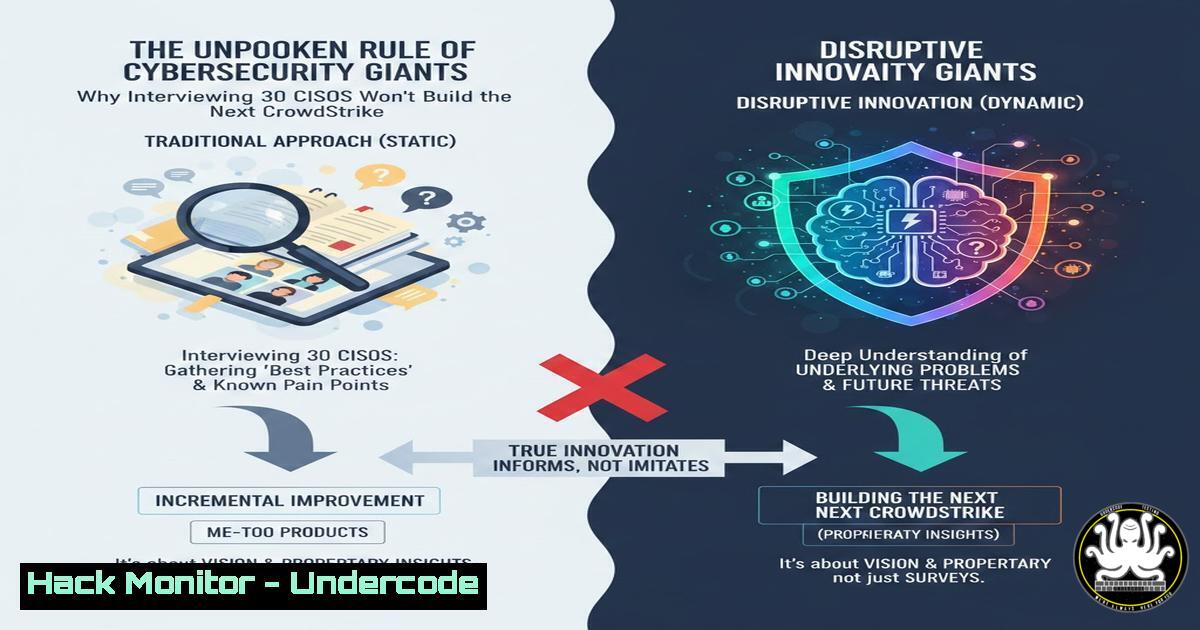
Introduction:
In the high-stakes arena of cybersecurity entrepreneurship, a dangerous myth persists: that identifying a market gap through customer interviews is the primary catalyst for a billion-dollar exit. A recent viral discussion on LinkedIn, sparked by security leader Ross Haleliuk, dismantles this notion, pointing to a more fundamental truth. The architectural DNA of every major security company—from Palo Alto Networks to Wiz—was not coded by survey data, but forged in the crucible of deep, uncompromising domain expertise. This article deconstructs the technical and strategic layers of why raw expertise trumps market research, providing a roadmap for aspiring founders and security professionals on how to cultivate the technical depth required to build the next generation of security tools.
Learning Objectives:
- Analyze the common technical thread behind successful cybersecurity unicorns and how it relates to exploit development and system architecture.
- Understand how to translate deep domain knowledge (e.g., firewall internals, cloud security) into viable product features and defensive strategies.
- Learn practical methods to audit your own technical “right to win” in a specific security niche.
You Should Know:
- The “Right to Win”: A Technical Audit of Founders
The post highlights Nir Zuk, who didn’t just understand firewalls; he built them at Check Point and NetScreen. This isn’t just about having an idea; it’s about possessing the intimate knowledge of a system’s failure points. To build a better firewall, you must understand exactly how a stateful inspection engine can be bypassed or how a fragmented packet can cause a denial of service.
Step‑by‑step guide: How to perform a personal technical audit for a new security concept.
– Step 1: Deconstruct the Legacy. If you want to build an EDR, don’t just read about CrowdStrike. Download and analyze older versions of open-source EDR tools like Wazuh or Osquery. Map their data collection points.
– Linux Command: `sudo bpftrace -l ‘tracepoint:syscalls:sys_enter_’` (Lists all system call tracepoints, the foundational data source for EDR).
– Step 2: Exploit the Problem. Before you can build a product to stop a specific attack, you must be able to execute it. If you want to build a better secret scanner, write a simple Python script that exfiltrates hardcoded AWS keys from a public repo.
– Python Example:
import re
 Simulate scraping a public code dump
code_snippet = "aws_access_key_id=AKIAIOSFODNN7EXAMPLE"
found_keys = re.findall(r"AKIA[0-9A-Z]{16}", code_snippet)
if found_keys:
print(f"Vulnerability found: {found_keys}")
– This simple act shows you understand the exact regex and behavior needed for detection, moving you from a conceptual founder to a technical one.
- From Adallom to Wiz: The Cloud Native Pivot
The Wiz founders didn’t stumble upon cloud security. They spent years at Adallom (acquired by Microsoft) learning the intricacies of Cloud Access Security Brokers (CASB) and the inner workings of Azure. This experience allowed them to identify the shift from SaaS security to the underlying infrastructure (compute, storage, identities). They understood that the new attack surface wasn’t just the application, but the misconfigured cloud shell.
Step‑by‑step guide: Simulating a cloud infrastructure vulnerability (like those Wiz detects).
– Prerequisite: AWS CLI configured with a test account.
– Step 1: Create a Vulnerable Scenario. Expose an internal service unintentionally.
– AWS CLI Command: `aws ec2 create-security-group –group-name ExposedDemo –description “Demo vulnerable group”`
– AWS CLI Command: `aws ec2 authorize-security-group-ingress –group-name ExposedDemo –protocol tcp –port 22 –cidr 0.0.0.0/0` (This opens SSH to the world, a classic Wiz alert).
– Step 2: The “Agentless” Concept. Wiz’s key innovation was agentless scanning. To simulate this, you don’t install software on the VM; you query the cloud provider’s API.
– AWS CLI Command: `aws ec2 describe-instances –query ‘Reservations[].Instances[].[InstanceId, PublicIpAddress]’ –output table`
– This command shows how an external scanner can map your cloud assets and, when combined with the security group data, identify the exposed SSH port without ever touching the instance itself.
- Project Honey Pot: The Data-First Architecture of Cloudflare
Before Cloudflare was a content delivery network, it was a data collection engine. Project Honey Pot was a distributed system for tracking email harvesters and spammers. This wasn’t just a side project; it was a five-year lesson in handling massive-scale, distributed data and analyzing attack patterns in real-time. This domain expertise in large-scale data ingestion and threat intelligence became the backbone of Cloudflare’s DDoS mitigation and web application firewall (WAF).
Step‑by‑step guide: Setting up a basic “honeypot” data collector to understand traffic analysis.
– Concept: Create a simple web server that logs all request headers and IPs, simulating a low-interaction honeypot.
– Step 1: Logging with Netcat (Linux). A rudimentary but effective listener.
– Command: `while true; do nc -l -p 8080 -q 1 >> honeypot.log; done`
– Then, from another terminal: `curl http://localhost:8080/test`
– Check the log: `cat honeypot.log` (You’ll see the raw HTTP request).
– Step 2: Analyzing Attack Patterns. This raw data is the “Project Honey Pot” starting point.
– Linux Command: `cat honeypot.log | grep -oE ‘\b([0-9]{1,3}\.){3}[0-9]{1,3}\b’ | sort | uniq -c | sort -nr`
– This pipeline extracts all IPs, sorts them, and counts unique connections, immediately revealing if a single IP is “scanning” your honeypot.
- Domain Expertise in Application Security: The Foundstone Legacy
George Kurtz and his team at Foundstone wrote the book on hacking (literally, “Hacking Exposed”). Before CrowdStrike, they understood the entire lifecycle of a compromise—from network scanning to web application exploitation to covering tracks. This deep offensive security background informed CrowdStrike’s focus on indicators of attack (IOAs) rather than just indicators of compromise (IOCs). They knew that by the time you have a file hash (IOC), the damage is likely done; you need to detect the behavior (IOA), like `lsass.exe` accessing memory.
Step‑by‑step guide: Simulating an IOA (Credential Dumping) to understand the detection gap.
– Tool: Mimikatz (in a controlled, isolated VM).
– Concept: Foundstone’s expertise taught them that attackers don’t just drop a file; they perform a process.
– Step 1: Simulate the Attack.
– Command (in Windows VM with Admin privileges): `mimikatz privilege::debug sekurlsa::logonpasswords`
– Step 2: The Expert’s View (Understanding the IOA). A file-scanning AV (IOC-based) might miss Mimikatz if it’s obfuscated. But an expert knows that `sekurlsa::logonpasswords` requires opening a handle to the LSASS process. A modern EDR (like CrowdStrike) built by experts would alert on `PROCESS_OPEN` calls targeting `lsass.exe` originating from a non-standard process like `cmd.exe` or powershell.exe.
5. The Architecture of Experience: Zscaler’s Multi-Tenant Design
Jay Chaudhry’s deep history in network security meant he understood the scalability limits of traditional proxy architectures. Building a security cloud required not just a better proxy, but a fundamentally different, multi-tenant architecture that could inspect SSL/TLS traffic at scale without creating a bottleneck. This is a prime example of solving a deep systems engineering problem that only someone with his background would foresee.
Step‑by‑step guide: Understanding the SSL/TLS inspection bottleneck.
- Concept: Inspecting encrypted traffic requires terminating the SSL connection, inspecting the plaintext, and re-encrypting it.
- Step 1: Generate a test certificate.
- OpenSSL Command: `openssl req -x509 -newkey rsa:4096 -keyout key.pem -out cert.pem -days 365 -nodes`
– Step 2: Simulate a simple “man-in-the-middle” proxy withsocat. This shows the compute overhead. - Command: `socat openssl-listen:443,reuseaddr,fork,cert=./cert.pem,verify=0 openssl-connect:google.com:443,verify=0`
– This command forks a process for every connection. An expert architect (like Chaudhry) would know that forking is too slow and would design a multi-threaded, asynchronous event loop from day one, a decision rooted in deep systems knowledge.
What Undercode Say:
- Key Takeaway 1: Expertise is an Unforgeable Moat. In cybersecurity, the product is the defense. You cannot build an effective defense against a sophisticated attack if you have never executed or analyzed that attack yourself. Founders who “live and breathe” the tech can make critical architectural decisions—like agentless scanning or IOA-based detection—that create a 10x product advantage.
- Key Takeaway 2: Compound Knowledge Drives Innovation. The Wiz team’s journey through Adallom and Microsoft wasn’t just a resume filler; it was a period of compounding technical knowledge. They saw the future of cloud security not from a survey, but from the inside of one of the largest cloud providers. This allows founders to pivot ahead of the market, not just react to its current demands.
Analysis: The core argument transcends business strategy; it’s a technical imperative. The security industry is an adversarial system. You cannot build a tool to patch a vulnerability you don’t understand, nor can you create a detection rule for a behavior you’ve never performed. The “interview 30 CISOs” approach yields a list of current pain points, but domain expertise allows a founder to predict the next pain point and have the technical blueprint to solve it before it becomes a widespread problem. It’s the difference between building a better horse and building a car; you need the deep physics knowledge (domain expertise) to realize the horse is obsolete.
Prediction:
We will see a shift in the cybersecurity funding landscape. VCs will move beyond “founder-market fit” slide decks and demand technical validation. “Ghost engineering” work—years spent on open-source tools, detailed vulnerability research, or building internal security infrastructure at scale—will become the most coveted signal for early-stage investment. The era of the “product manager founder” will fade, replaced by a new generation of “principal architect founders” who can whiteboard a zero-day exploit and its mitigation strategy with equal fluency.
▶️ Related Video (78% Match):
🎯Let’s Practice For Free:
IT/Security Reporter URL:
Reported By: Rosshaleliuk Every – Hackers Feeds
Extra Hub: Undercode MoN
Basic Verification: Pass ✅


