
Listen to this Post
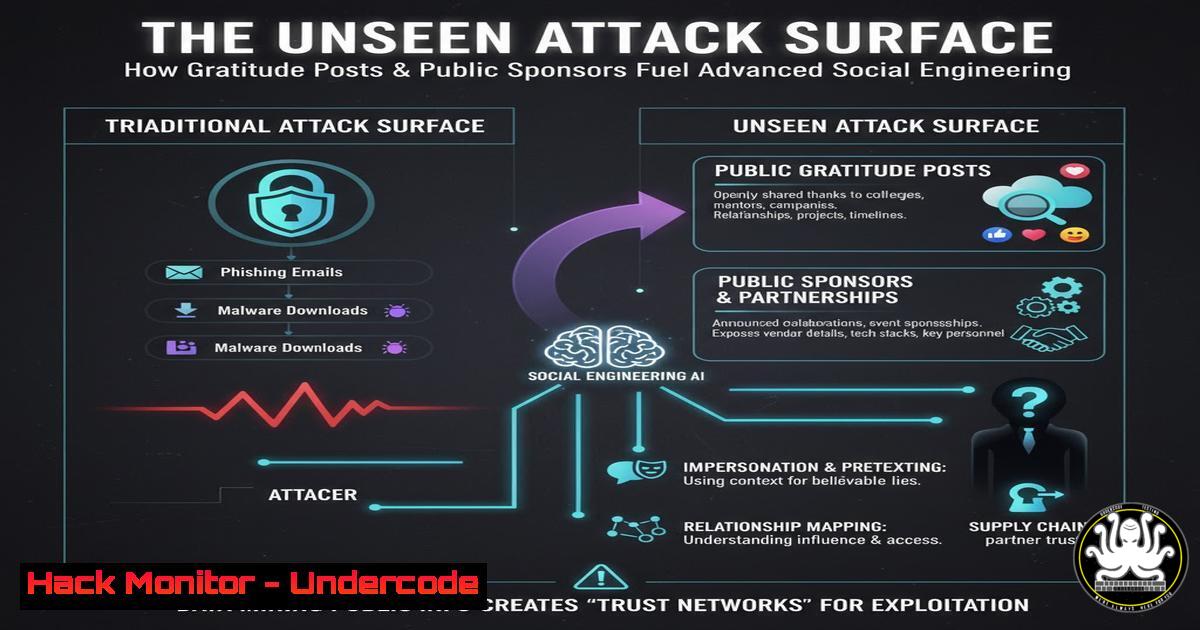
Introduction:
In an era of digital camaraderie, public gratitude posts celebrating partnerships and sponsorships have become commonplace on professional networks. However, these well-intentioned acts can inadvertently arm threat actors with a rich source of intelligence for highly targeted social engineering and supply chain attacks. By mapping an organization’s ecosystem, attackers can craft convincing lures that bypass traditional security controls.
Learning Objectives:
- Understand how public relationship data is weaponized for reconnaissance.
- Learn to identify and mitigate risks associated with public-facing organizational data.
- Implement technical controls to detect and prevent impersonation and pretexting attacks.
You Should Know:
1. OSINT Reconnaissance with LinkedIn APIs
` Example Python script to scrape public post data (for educational purposes)
import requests
from bs4 import BeautifulSoup
Note: Use official APIs with proper authentication in real scenarios.
This simulates data aggregation from a public post.
sponsor_list = [“RiverSafe”, “InfoSec People Ltd”, “Pensta Ltd”, “Pen Test Partners”, “dope.security”, “Damn Good Security”, “Cyber Fusion Distribution”, “Kite”, “Cyber Chain Alliance”, “Torq”, “Inversion6”, “Custodian360”, “TryHackMe”, “Bugcrowd”, “AVAQR TECHNOLOGIES”]
for sponsor in sponsor_list:
print(f”Potential Target Domain: {sponsor.replace(‘ ‘, ”).lower()}.com”)
This script outlines how an attacker can programmatically extract and format target lists from public posts for further reconnaissance.`
Step‑by‑step guide explaining what this does and how to use it.
This script demonstrates the initial phase of an Open-Source Intelligence (OSINT) operation. An attacker can manually or automatically extract the names of all mentioned partners and sponsors from a public post. The script then generates potential domain names by removing spaces and converting to lowercase. This list becomes the target for subsequent phases, such as domain reputation checks, WHOIS lookups, and identifying email address formats for phishing campaigns.
2. Domain Verification and DNS Reconnaissance
` Linux – Perform DNS reconnaissance for a target domain
nslookup tryhackme.com
dig tryhackme.com ANY
dig tryhackme.com MX
theharvester -d tryhackme.com -l 500 -b google
Check for misconfigured DNS records pointing to internal infrastructure.`
Step‑by‑step guide explaining what this does and how to use it.
These commands are used to gather crucial information about a target’s internet footprint. `nslookup` and `dig` query DNS servers to retrieve IP addresses (A records), mail servers (MX records), and all other public records (ANY). `TheHarvester` is a powerful OSINT tool that scours search engines and other sources for emails, subdomains, and hosts associated with the target domain. This data helps an attacker map the target’s external network and identify potential entry points.
3. Constructing Targeted Phishing Lures
` Crafting a believable phishing email pretext based on the gathered intelligence
Subject: Urgent: Invoice for Cyber House Party Sponsorship
Body: “Hi [Target Employee Name], This is Tony from Cyber House Party following up on our recent partnership. Please find the attached invoice for your records. We’re thrilled to have [Sponsor Company Name] on board. Link: http://secure-riversafe-invoice.com”
The link uses a typosquatted domain mimicking a real sponsor.`
Step‑by‑step guide explaining what this does and how to use it.
Using the relationship data, an attacker crafts a highly convincing phishing email. The pretext is built around a shared, real-world event (Cyber House Party) and includes known entities (Tony Moukbel, RiverSafe). The link often leads to a domain that is a slight misspelling of the legitimate sponsor’s domain (typosquatting). Because the context is highly relevant and verified by public information, the target is more likely to lower their guard and click the link or open the attachment.
4. Detecting Impersonation with Email Header Analysis
` Analyze email headers in a suspicious message
Received: from mail.torq.io [185.150.190.210] by mx.google.com
Authentication-Results: mx.google.com;
spf=neutral (google.com: domain of [email protected] does not designate 185.150.190.210 as permitted sender) [email protected];
dkim=fail [email protected];
dmarc=fail (p=REJECT sp=REJECT dis=NONE) header.from=torq.io
Key fields to check: Received, Reply-To, Return-Path, SPF, DKIM, DMARC.Step‑by‑step guide explaining what this does and how to use it.185.150.190.210
This is a critical defensive technique. When a suspicious email is received, its headers must be analyzed. The example shows a failed SPF, DKIM, and DMARC check. The `Received` header shows the email originated from an IP address () not authorized bytorq.io`’s SPF record. This is a clear sign of impersonation. Security teams should train users to report suspicious emails and use email security gateways that automatically perform these checks.
5. PowerShell for User Awareness Training
` Windows PowerShell: Script to extract recent login data and simulate a training alert.
Get-AzureADAuditSignInLogs -Top 1 | Select-Object UserDisplayName, AppDisplayName, IPAddress, Location
Write-Warning -Message “Simulated Alert: A login was detected from a non-corporate IP range. This could be a credential phishing attempt. Please verify the source of any recent authentication prompts.”`
Step‑by‑step guide explaining what this does and how to use it.
This PowerShell command (for environments with the AzureAD module) fetches the most recent sign-in log. It can be used in a security awareness training script to show users the kind of data that is monitored. The subsequent `Write-Warning` simulates an alert that a Security Operations Center (SOC) might generate. Demonstrating this to users makes the threat of credential phishing more tangible and encourages them to be vigilant about where they enter their credentials.
6. Hardening Cloud APIs against Reconnaissance
AWS CLI command to check and enforce S3 bucket privacy.

<h2 style="color: yellow;">aws s3api get-bucket-policy --bucket my-company-sponsor-list</h2>

 A secure policy should explicitly deny public access.

{

<h2 style="color: yellow;">"Version": "2012-10-17",</h2>

<h2 style="color: yellow;">"Statement": [{</h2>

<h2 style="color: yellow;">"Effect": "Deny",</h2>

<h2 style="color: yellow;">"Principal": "",</h2>

<h2 style="color: yellow;">"Action": "s3:",</h2>

<h2 style="color: yellow;">"Resource": "arn:aws:s3:::my-company-sponsor-list/",</h2>

<h2 style="color: yellow;">"Condition": {"Bool": {"aws:SecureTransport": false}}</h2>

<h2 style="color: yellow;">}]</h2>

<h2 style="color: yellow;">}
Step‑by‑step guide explaining what this does and how to use it.
Unsecured cloud storage (like AWS S3 buckets) is a common source of leaked data. This command checks the policy on a hypothetical bucket that might contain sponsor information. The accompanying JSON is an example of a strict bucket policy that denies all public access and also enforces that data is only transferred over a secure (TLS/SSL) connection. Applying such policies prevents accidental exposure of sensitive internal data that could augment an attacker’s OSINT efforts.
7. Network Monitoring for C2 Beaconing
` Suricata IDS rule to detect potential beaconing to a typosquatted domain.
alert http any any -> any any (msg:”SUSPICIOUS – Potential C2 Beacon to Typosquatted Domain”; flow:established,to_server; http.host; content:”riversafe”; distance:0; content:”.com”; distance:0; pcre:”/(river-safe|riversafe|riveresafe)/i”; classtype:trojan-activity; sid:1000001; rev:1;)
This rule triggers on HTTP traffic to domains containing common misspellings of “riversafe”.`
Step‑by‑step guide explaining what this does and how to use it.
After a successful phishing attack, malware often “beacons” back to a command-and-control (C2) server. This Suricata rule is designed to detect such beaconing to a domain that is a common misspelling of a known partner (“riversafe”). It inspects the HTTP host header for the base string and uses a regular expression (pcre) to catch variations. Deploying such threat intelligence-driven rules in a Network Intrusion Detection System (NIDS) can help identify compromised hosts early in the attack chain.
What Undercode Say:
- The Illusion of Benign Public Data: No corporate information shared on social media is truly benign. Every partnership announcement, gratitude post, or employee highlight provides a puzzle piece for attackers, reducing the cost and increasing the success rate of targeted attacks.
- Shifting the Defense Posture: Defense must evolve from merely protecting credentials to actively managing the organization’s digital shadow. This involves continuous monitoring for exposed data, conducting regular OSINT audits on your own brand, and implementing technical controls that assume this data is already in the hands of adversaries.
The core analysis is that the traditional boundary between public relations and cybersecurity has dissolved. The “Cyber House Party” post, while positive, is a canonical example of a high-fidelity data dump for attackers. It provides a verified trust graph. Modern defense requires a proactive approach to digital footprint management, where marketing and infosec teams collaborate to define what should remain in the shadows, even when celebrating success. Training must also advance beyond generic phishing tests to include scenarios based on real, public company data, preparing users for the most convincing attacks they will ever face.
Prediction:
In the next 12-24 months, we will see a significant rise in AI-powered attacks that automate the entire kill chain described above. Machine learning models will continuously scrape social media, news outlets, and public databases to build and maintain dynamic relationship maps of target organizations. These AI “attack managers” will then generate highly personalized, context-aware phishing lures at scale, complete with deepfake audio and video for vishing (voice phishing) attacks. The only viable defense will be an equally sophisticated, AI-driven security posture that can predict these attack vectors by analyzing an organization’s own public data and pre-emptively hardening defenses and educating employees against the most probable imminent threats.
🎯Let’s Practice For Free:
IT/Security Reporter URL:
Reported By: Cyber House – Hackers Feeds
Extra Hub: Undercode MoN
Basic Verification: Pass ✅


