Listen to this Post
Introduction:
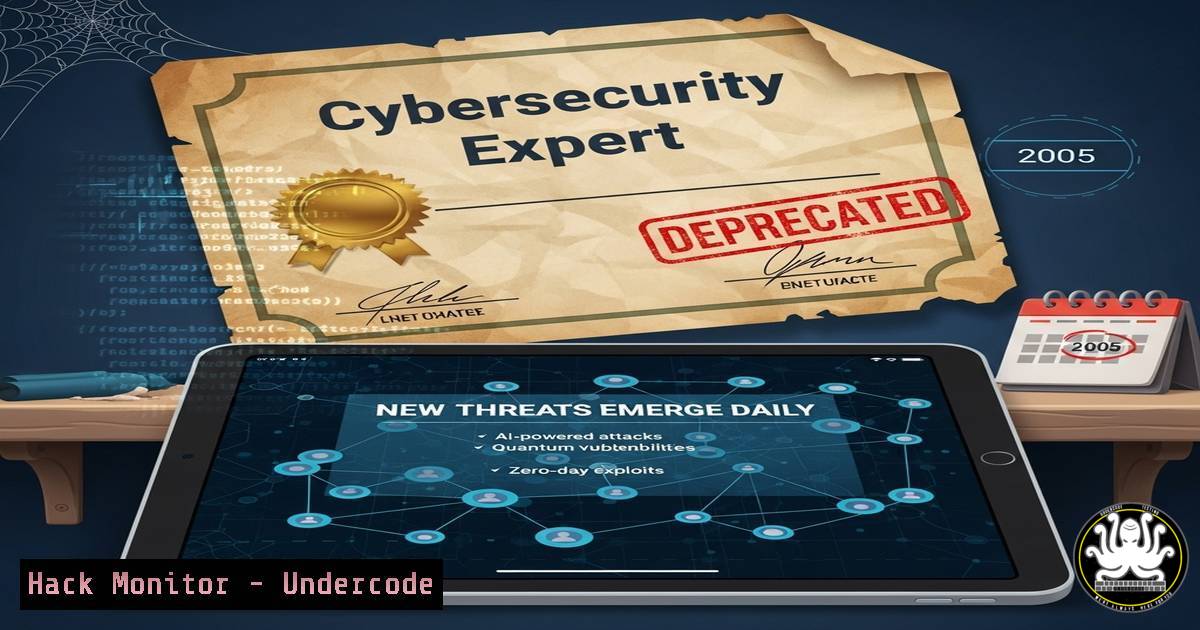
The relentless pace of technological change, particularly in AI, is rendering traditional cybersecurity certifications obsolete at an alarming rate. Relying solely on a CISSP or Security+ learned years ago creates a dangerous skills gap, leaving organizations vulnerable to novel threats that exploit modern tech stacks and AI-driven attacks.
Learning Objectives:
- Understand the critical limitations of traditional, static cybersecurity certifications.
- Identify the key modern skills and command-level proficiencies required to defend today’s environments.
- Learn and apply immediate, actionable commands for cloud, AI, and API security hardening.
You Should Know:
1. Cloud Security Posture Misconfiguration (AWS S3)
`aws s3api get-bucket-policy –bucket my-bucket –query Policy –output text | jq .`
This command retrieves and parses the access policy for an Amazon S3 bucket. Misconfigured S3 buckets are a prime attack vector, often leaking sensitive data.
Step-by-step guide:
- Install and configure the AWS CLI with appropriate credentials (
aws configure). - Run the command, replacing `my-bucket` with your bucket name.
- The `jq` tool formats the JSON policy for readability.
- Analyze the output for overly permissive statements, such as `”Effect”: “Allow”` and
"Principal": "", which grant public access.
2. Container Vulnerability Scanning with Trivy
`trivy image –severity CRITICAL,HIGH your-image:tag`
Trivy is a comprehensive open-source vulnerability scanner for containers and other artifacts. This command scans a container image for critical and high-severity vulnerabilities.
Step-by-step guide:
- Install Trivy via your package manager (e.g., `brew install trivy` on macOS, `sudo apt-get install trivy` on Debian/Ubuntu).
- Build your Docker image: `docker build -t your-image:tag .`
3. Run the Trivy scan command.
- Review the output CVE list and use it to patch or update your base images before deployment.
3. Detecting Lateral Movement with Windows Command Line
`net group “Domain Admins” /domain`
This classic command lists all members of the Domain Admins group in an Active Directory environment. Attackers use this to identify high-value targets after initial compromise.
Step-by-step guide:
- On a Windows machine joined to the domain, open Command Prompt or PowerShell.
- Run the command. It requires no special privileges, meaning any user can execute it.
- This demonstrates why privilege escalation and lateral movement are trivial if an attacker gains a foothold on any domain-joined machine. Mitigation involves implementing Least Privilege and robust logging/monitoring of such commands.
-
Hardening API Security by Testing for SQL Injection
`curl -X GET “https://api.example.com/v1/users?id=1′ OR ‘1’=’1′”`
This cURL command tests a REST API endpoint for a basic SQL injection vulnerability by injecting a malicious payload into the `id` parameter.
Step-by-step guide:
- Identify a target API endpoint that accepts parameters (e.g., user ID, search query).
- Construct the cURL command, appending a common SQLi test string like `’ OR ‘1’=’1` to a parameter.
3. Execute the command.
-
Analyze the response. If it returns more data than expected or a database error message, the endpoint is likely vulnerable. This underscores the need for parameterized queries and input validation.
-
Linux Process and Network Analysis for Threat Hunting
`lsof -i -P -n | grep LISTEN`
This Linux command lists all open files and, with these flags, specifically shows which processes are listening on which network ports. It’s crucial for identifying unauthorized services.
Step-by-step guide:
1. Open a terminal on a Linux system.
- Run the command. `-i` lists Internet network files, `-P` inhibits port-to-name conversion (shows port numbers), `-n` inhibits network number conversion (shows IP addresses).
- Review the output. Investigate any unfamiliar processes listening on ports, especially those bound to 0.0.0.0 (all interfaces).
6. Exploiting and Mitigating XXE in XML Processing
` ]>&xxe; `
This is a classic XML External Entity (XXE) injection payload designed to read the `/etc/passwd` file on a Unix-like system.
Step-by-step guide:
- Identify a web application endpoint that accepts XML input (e.g., SOAP API, document upload).
- Submit the above payload within the XML body of the request.
- If the application is vulnerable, the response will include the contents of the `/etc/passwd` file.
- Mitigation requires disabling external entity processing in your XML parser (e.g., in Python’s
lxml:parser = etree.XMLParser(resolve_entities=False)).
7. Securing AI/ML Pipelines: Model Extraction Attack Simulation
`import requests
model_api = “https://ai.company.com/predict”
response = requests.post(model_api, json={“input”: test_data})`
This Python code snippet simulates a series of queries to a machine learning model’s prediction API. An attacker can use this technique to steal a model by querying it extensively and reconstructing it from the inputs and outputs.
Step-by-step guide:
1. An attacker identifies a public-facing prediction endpoint.
- They use a script like this to send thousands of well-crafted queries, harvesting the outputs.
- Using this data, they can train a substitute model that mimics the proprietary original.
- To protect against this, implement strict rate limiting, API authentication, and monitor for anomalous query patterns.
What Undercode Say:
- Certificates Verify Knowledge, Competency is Proven by Command. A certificate proves you passed a test on a specific day. The daily use of commands like
trivy,lsof, and `aws s3api` proves you can actually defend a system. The latter is infinitely more valuable. - The AI Arms Race Demands a Procedural Shift. Defending against AI-powered threats requires more than theoretical knowledge; it requires the ability to rapidly script, automate, and probe your own defenses using the same tools and techniques attackers use. Static learning cannot keep up.
The core analysis is that the cybersecurity industry is at an inflection point. The “unpopular opinion” that certs are becoming obsolete is a reaction to a market flooded with paper-certified professionals who lack the hands-on, CLI-driven skills to combat modern threats. The value is rapidly shifting from proving you know something to demonstrating you can do something. This doesn’t render foundational knowledge worthless, but it elevates continuous, lab-based practice and the mastery of tool-specific commands from a nice-to-have to the absolute critical differentiator between an effective defender and a target.
Prediction:
The growing reliance on AI and automation will create a two-tiered workforce. Professionals who merely maintain static certifications will be relegated to compliance and governance roles, while those who continuously hone their technical, command-level skills will form a new elite class of hands-on defenders and penetration testers. This skills bifurcation will become the primary factor in an organization’s cyber resilience, directly impacting their ability to prevent, detect, and respond to AI-augmented cyberattacks that operate at machine speed and scale.
🎯Let’s Practice For Free:
IT/Security Reporter URL:
Reported By: Joshuacopeland Unpopularopinion – Hackers Feeds
Extra Hub: Undercode MoN
Basic Verification: Pass ✅


