Listen to this Post
Introduction:
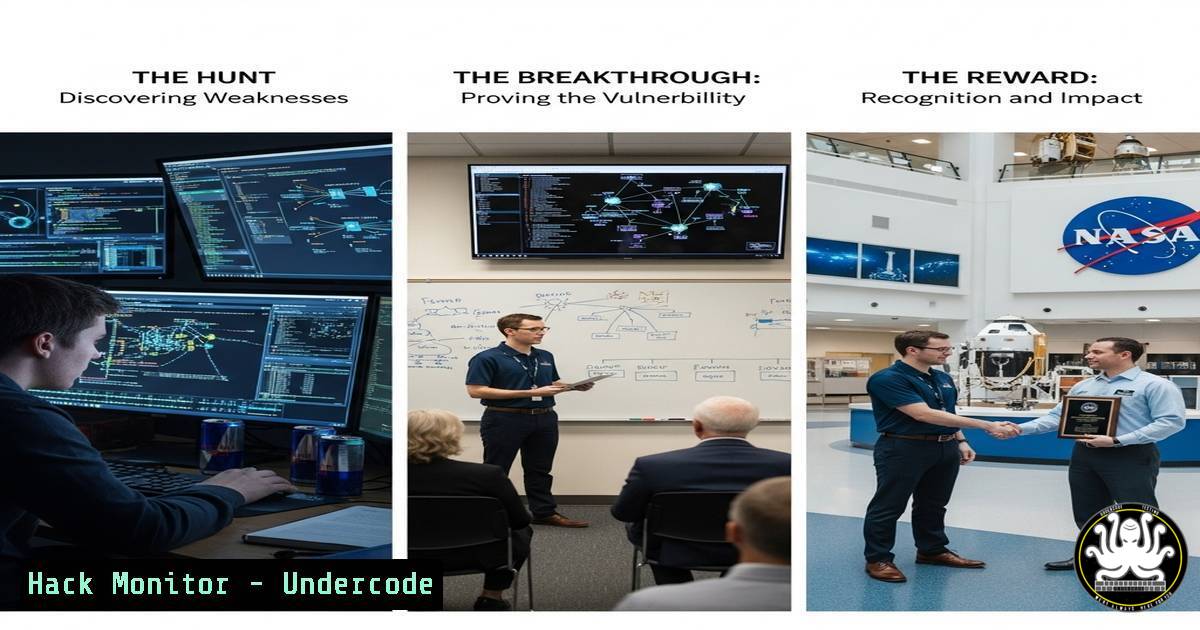
The recent recognition of a security researcher in the NASA Hall of Fame via the Bugcrowd platform underscores the critical role of ethical hacking in protecting national assets. This achievement was not born from luck but from the meticulous application of core cybersecurity methodologies and tool mastery. This article deconstructs the technical prowess required to reach such elite status, providing a roadmap of essential commands and procedures for aspiring bug bounty hunters.
Learning Objectives:
- Master the core reconnaissance and vulnerability scanning tools used by professional security researchers.
- Understand the methodology for identifying and validating common web application and API security flaws.
- Learn the commands for network analysis, exploit proof-of-concept development, and responsible disclosure procedures.
You Should Know:
- The Art of Passive Reconnaissance: Unearthing Hidden Endpoints
Before any attack can be simulated, a hunter must map the target’s digital footprint. This involves passive reconnaissance to discover subdomains, associated IPs, and services without sending a single packet to the target’s main servers.
`command: amass enum -passive -d nasa.gov`
`command: subfinder -d nasa.gov -silent`
`command: assetfinder –subs-only nasa.gov`
Step-by-step guide:
Passive reconnaissance gathers data from third-party sources like search engines and certificate databases. The `amass` command above passively enumerates subdomains for `nasa.gov` without direct interaction. The output is a list of potential targets. Combine these tools for maximum coverage: subfinder -d nasa.gov | sort -u > subdomains.txt. This list becomes the foundation for all further testing.
2. Active Reconnaissance and Service Discovery
With a list of subdomains, the next step is active reconnaissance to identify running services and open ports on live hosts. This pinpoints exactly where to focus your efforts.
`command: nmap -sC -sV -oA nasa_scan target_ip`
`command: naabu -host target.nasa.gov -silent -verify`
`command: sudo masscan -p1-65535 target_ip –rate=1000`
Step-by-step guide:
Nmap is the industry standard for network discovery. The `-sC` flag runs default scripts, `-sV` probes service versions, and `-oA` outputs results in all formats. First, filter your subdomain list for live hosts: cat subdomains.txt | httpx -silent. Then, scan a live host: nmap -sV -oA nasa_scan 123.45.67.89. Analyze the output for unusual open ports (e.g., 8443, 9000) or outdated service versions, which are prime targets.
3. Web Application Fingerprinting and Analysis
Understanding the technology stack (e.g., WordPress, Jenkins, .NET) is crucial for identifying technology-specific vulnerabilities.
`command: whatweb https://target.nasa.gov -v`
`command: wappalyzer https://target.nasa.gov`
`command: nikto -h https://target.nasa.gov -C all`
Step-by-step guide:
Tools like `whatweb` and Wappalyzer browser extensions analyze HTTP headers, cookies, and file structures to identify web technologies. Running `whatweb -v` provides detailed output, including server type, framework, and potential security headers missing. This information directs your testing; finding a Jenkins instance would lead to testing for misconfigured CI/CD pipelines, while an outdated WordPress site would warrant a plugin vulnerability scan.
4. Automated Vulnerability Scanning with Nuclei
The Nuclei framework uses community-powered templates to scan for thousands of known vulnerabilities quickly and efficiently.
`command: nuclei -u https://target.nasa.gov -t cves/ -severity critical,high -silent`
`command: nuclei -l live_subs.txt -t exposures/ -silent`
Step-by-step guide:
Nuclei is a bug bounty hunter’s best friend. The first command scans a single URL for Critical and High severity CVEs. The second command takes a list of live subdomains (live_subs.txt) and checks for common exposures like sensitive file leaks, debug panels, or open S3 buckets. Always review the results manually to eliminate false positives and to understand the context of the finding before reporting it.
- API Security Testing: Uncovering Broken Object Level Authorization (BOLA)
Modern applications are API-driven, making them a primary attack vector. BOLA flaws are among the most common and critical API vulnerabilities.`command: ffuf -w wordlist.txt -u https://api.target.nasa.gov/v1/users/FUZZ/profile -H “Authorization: Bearer
“`
`command: curl -X GET https://api.target.nasa.gov/v1/users/12345/profile -H “Authorization: Bearer“`
Step-by-step guide:
BOLA allows a user to access resources belonging to another user by changing an identifier (e.g., user ID). To test, first authenticate and obtain a valid API token. Use `curl` to access your own resource (e.g., users/123/profile). Then, manually change the ID to `124` and replay the request. If it returns another user’s data, you have a critical BOLA vulnerability. Tools like `ffuf` can automate this fuzzing for IDs.
6. Cross-Site Scripting (XSS) Payload Crafting and Validation
XSS remains a prevalent flaw, allowing attackers to execute scripts in a victim’s browser.
`command: dalfox url “https://target.nasa.gov/search?q=DaTest”`
`command: dalfox pipe < urls.txt`
`payload: `
`payload:  `
`
Step-by-step guide:
Tool-assisted testing is key for XSS. Dalfox is a powerful automated scanner. Provide it with a single URL containing a parameter (?q=) or a list of URLs (urls.txt). It will inject various payloads and detect vulnerabilities. Always validate any automated finding manually by injecting a simple payload like `alert(document.domain)` into the parameter and observing if it executes. This confirms the vulnerability for your report.
7. Proof-of-Concept Development for SQL Injection
Finding a SQL injection is a major win. A clear proof-of-concept (PoC) is required for a valid report.
`command: sqlmap -u “https://target.nasa.gov/user?id=1” –batch –dbs`
`command: sqlmap -u “https://target.nasa.gov/user?id=1” –batch -D database_name –tables`
`manual test: id=1′ SLEEP(5)– -`
Step-by-step guide:
Sqlmap automates the process of detecting and exploiting SQLi. The `–dbs` flag attempts to enumerate databases. However, always test manually first to avoid noisy automated attacks. Append a single quote to a parameter (id=1') and look for errors or odd behavior. A time-based blind injection test like `id=1′ SLEEP(5)– -` will cause a 5-second delay if vulnerable, confirming the flaw before using sqlmap for further exploitation and data extraction.
What Undercode Say:
- Methodology Over Tools: Success is 90% process—comprehensive recon, understanding the application, and manual testing—and 10% the tools themselves.
- The Devil is in the Details: The highest-impact vulnerabilities are often found not by automated scanners but by manually analyzing a request/response cycle for subtle logical flaws.
The induction of researchers into NASA’s Hall of Fame is a powerful indicator of the shifting cybersecurity paradigm. Organizations are increasingly relying on the global ethical hacking community to augment their defenses, moving beyond traditional perimeter security. This crowdsourced approach allows for continuous, real-world testing that internal teams often lack the bandwidth for. For aspiring professionals, this signifies a clear path: deep technical skill, coupled with a rigorous and ethical methodology, is not just valued but celebrated at the highest levels. The tools and commands are the weapons, but the hunter’s mindset—curiosity, persistence, and precision—is what truly leads to discovery.
Prediction:
The public validation of bug bounty hunters by flagship institutions like NASA will catalyze a massive shift in talent acquisition and security budgeting. We predict that within five years, a proven bug bounty track record will become a standardized and highly-valued credential, often outweighing traditional degrees for offensive security roles. Furthermore, as more critical infrastructure and government entities adopt VDPs, we will see a corresponding rise in nation-state actors attempting to infiltrate these same programs, leading to more rigorous researcher vetting processes and the rise of decentralized, anonymous contribution platforms to protect hunter identities.
🎯Let’s Practice For Free:
IT/Security Reporter URL:
Reported By: Harsh Chaudhari – Hackers Feeds
Extra Hub: Undercode MoN
Basic Verification: Pass ✅


