Listen to this Post
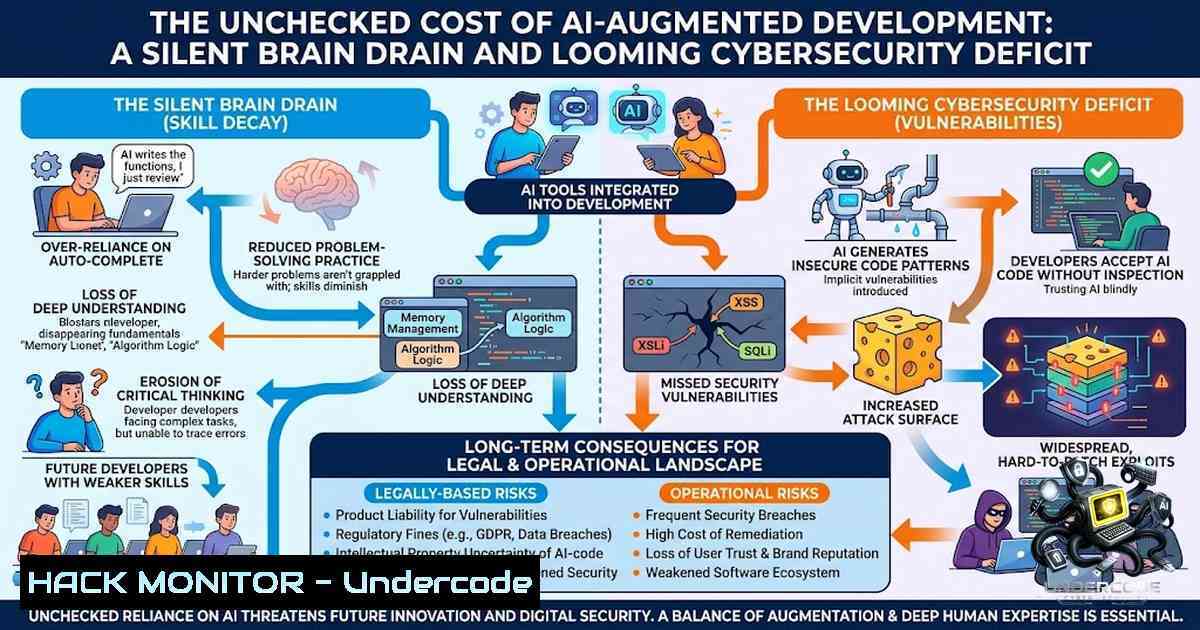
Introduction:
The software engineering community is currently confronting a palpable existential crisis, driven by the rapid integration of generative AI into the development lifecycle. The core concern is that the “craft” of problem-solving and systems-thinking is being replaced by an efficiency-driven, oversight-centric role, potentially leading to a talent exodus of the most passionate engineers. For the cybersecurity sector, this shift poses a critical risk, as the departure of experienced engineers who inherently understand security trade-offs and complex system vulnerabilities could create a massive skills gap, leading to brittle, insecure applications that are optimized for functionality rather than resilience.
Learning Objectives:
- Understand the correlation between the rise of AI-assisted coding and the potential erosion of deep technical security knowledge.
- Identify the hidden attack surfaces created by “AI product managers” who may not fully comprehend the underlying code.
- Implement mitigation strategies, including enhanced CI/CD pipelines, code review methodologies, and command-line forensics.
You Should Know:
- The “Blanding” Effect: The Hidden Security Cost of Abstraction
The post highlights a critical sentiment: “I’m effectively an AI product manager.” This transition from craftsman to manager introduces a layer of abstraction that can obscure the underlying code logic. When engineers are no longer thinking through the stack, edge cases are missed, and security vulnerabilities are inadvertently introduced. The risk is that AI-generated code, while syntactically correct, often lacks the contextual understanding of security boundaries, API throttling, or authorization logic that a human engineer would instinctively apply.
Step-by-Step Security Review for AI-Generated Code:
- Contextual Analysis: Before integrating code, run a static analysis tool like `bandit` (Python) or `Semgrep` to identify known vulnerability patterns.
– Linux Command: `bandit -r ./your_ai_directory -f json -o bandit_report.json`
2. Manual Logic Review: Focus specifically on the authorization functions. Does the AI understand the difference between authentication and authorization? Verify that role-based access controls (RBAC) are enforced, not just assumed.
– Windows Command: `findstr /S /I “is_admin” .` (to locate admin checks in your codebase).
3. API Security Hardening: AI is notorious for generating insecure API endpoints. Enforce strict input validation.
– Code Snippet (Node.js): `app.use(express.json({ limit: ’10kb’ }));` (to mitigate DDoS via large payloads).
2. Mitigating the CI/CD Pipeline Vulnerabilities
With engineers focusing less on the “hacking” and more on “managing,” the CI/CD pipeline becomes a prime target. If the engineers don’t know what they are shipping, they certainly won’t secure the pipeline that ships it. We need to enforce strict supply chain security.
Step-by-Step CI/CD Hardening:
- Secrets Rotation: Ensure secrets are never hardcoded. Use environment variables or a secrets manager. For Linux, ensure you are not leaving traces in bash history.
– Linux Command: `history -c` (clear history) and `set +o history` (to temporarily disable history).
2. Dependency Scanning: AI often pulls in the latest, but not necessarily the safest, libraries.
– Command: `trivy fs . –security-checks vuln –severity CRITICAL` (to scan your local filesystem for critical vulnerabilities).
3. Pipeline Isolation: Ensure your build agents are isolated. If an attacker compromises a test, they shouldn’t have access to production keys. Implement OIDC (OpenID Connect) for cloud access rather than static service accounts.
- The Art of the Manual Code Review (The “Eureka” Moment)
The post laments the loss of the “eureka moments” that come from wrestling with a problem. In cybersecurity, these moments are crucial for spotting “business logic” flaws—vulnerabilities that no SAST (Static Application Security Testing) tool can find because they rely on the specific workflow of the application. With AI, we risk automating the creation of code that is secure at the syntax level but insecure at the business logic level.
Steps for Effective Logic Review:
- Threat Modeling: Sit down with the AI-generated code and draw a data flow diagram (DFD). Identify trust boundaries. Where does the data go from “untrusted” to “trusted”?
- Privilege Escalation Testing: Try to find a path where an attacker can perform an action they shouldn’t. Use tools like `Burp Suite` to intercept and replay requests.
- Review the AI Often, the issue lies in the “prompt.” If you asked the AI to “write a function to upload a file,” it will do so without adding virus scans or file type validation. You must manually add that logic.
4. Addressing the “Bluffing” Engineer and Skill Verification
The text mentions “some good, some bluffing” engineers. With AI, the bluffers can now appear competent. This makes skill verification paramount. We need to move from “Who built it?” to “How do we break it?”.
Step-by-Step Verification:
- Red Team Exercises: Conduct internal red teaming exercises. If the code survives a basic injection attack, verify deeper.
– Linux Command for fuzzing: wfuzz -c -z file,wordlist.txt http://target.com/FUZZ` (to test for directory traversal).OpenSCAP
2. Compliance Audits: Ensure the code meets NIST or ISO standards. Automate this with.oscap xccdf eval –profile xccdf_org.ssgproject.content_profile_cis –report report.html /usr/share/xml/scap/ssg/content/ssg-ubuntu2204-ds.xml`.
- Command:
3. Pair Programming: Have the “AI Manager” explain the code to a junior. If they can’t, the code is a liability.
- The Exodus of Talent and the “Cobalt Strike” Effect
If the “quiet ones” who truly love the craft leave, they aren’t just leaving the company; they are leaving the industry. This creates a vacuum that attackers are all too happy to exploit. The defenders are leaving, and the AI is creating a battlefield where the offense has more innovative tools than the defense.
Mitigation Strategy:
- Capability Building: Use AI to augment the junior engineer, not replace the senior. Treat AI as a “super junior” developer.
- Focus on “Blue Team” Automation: Use AI to generate detections for SIEM (Security Information and Event Management) systems.
– Example: Creating a Sigma rule for suspicious PowerShell usage (often used in AI-generated scripts).
– Windows Command: `Get-WinEvent -LogName Security | Where-Object { $_.Id -eq 4688 -and $_.Message -match “powershell.-e” }` (to hunt for encoded PowerShell commands).
What Undercode Say:
- Key Takeaway 1: The shift from software craft to AI management is increasing technical debt and creating a “blind spot” in application security.
- Key Takeaway 2: The real vulnerability lies in the “abstraction layer”—engineers no longer trust their instincts because they didn’t write the code, leading to a false sense of security.
- Key Takeaway 3: To survive, we must treat AI as a “threat vector” in itself. The prompt injection attacks are just the beginning; the code it produces is the payload.
- Analysis: The sentiment expressed is not just a morale issue; it is a systemic risk. When the “hacking” mindset (curiosity, persistence) is replaced by “bland” management, we lose the proactive defense mindset. Organizations need to invest in “DevSecOps” culture, not just tools. If we rely on AI to save time, we must spend that saved time on red-teaming and threat hunting. If we automate the “making” of software, we must double down on the “breaking” of software. The best defense against the coming AI-generated exploit landscape is a human with a hacker’s mindset.
Prediction:
- +1 The crisis will force the industry to create a new breed of “AI Security Engineer,” who specializes in auditing AI outputs, creating high-paying, specialized jobs.
- -1 We will see a massive wave of data breaches in 2026-2027 as companies realize that code generated by AI for “efficiency” has deep architectural flaws that are only exploitable under specific race conditions.
- -1 The “quiet ones” leaving will result in a significant shortage of capable incident responders, as those who understand the deep internals of operating systems and networking are the hardest to replace.
- -1 The “blanding” effect will lead to homogenized codebases across the industry; if one AI model has a systematic flaw, millions of applications will share the same vulnerability.
- +1 Niche security consultancies that focus on “human-centric penetration testing” will see a surge in demand, as companies realize AI can’t replicate the creativity of a human attacker.
▶️ Related Video (78% Match):
🎯Let’s Practice For Free:
🎓 Live Courses & Certifications:
Join Undercode Academy for Verified Certifications
🚀 Request a Custom Project:
Secure, high-velocity infrastructure and disruptive technological engineering. Contact our engineering team for high-tier development and proprietary systems:
[email protected]
💎 Smart Architecture | 🛡️ Secure by Design | ⭐ Trusted by Thousands
IT/Security Reporter URL:
Reported By: https://lnkd.in/p/eEgTDn4S – Hackers Feeds
Extra Hub: Undercode MoN
Basic Verification: Pass ✅


