Listen to this Post
Introduction:
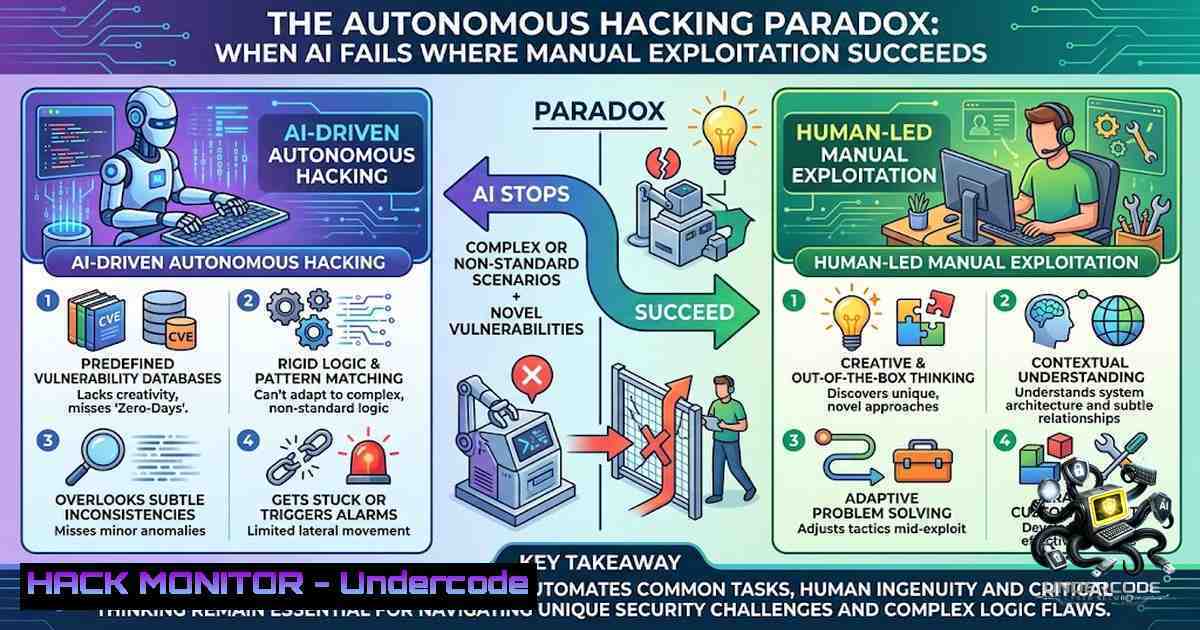
In a striking real-world case documented by Palo Alto’s Unit 42, a threat actor deployed a fully autonomous AI agent alongside manual hacking techniques during the same operation. While the AI agent successfully executed an end-to-end offensive workflow—from vulnerability discovery to scanning thousands of targets—it failed to achieve a single foothold, whereas the human operator manually breached three organizations and gained code execution on eleven additional systems. This incident exposes a critical distinction in offensive security: the gap between autonomous execution capability and effective exploitation strategy, highlighting fundamental limitations in current AI-driven penetration testing approaches.
Learning Objectives:
- Understand the architecture and limitations of autonomous offensive AI agents in real-world attack scenarios.
- Analyze the security implications of exposed API keys and misconfigured servers in threat actor operations.
- Compare manual penetration testing workflows against automated AI-driven exploitation attempts.
- Learn to implement defensive controls to mitigate both automated and manual attack vectors.
You Should Know:
- Autonomous Agent Attack Chain: Discovery, Exploitation, and Failure Points
The AI agent in this case operated through a sophisticated, self-directed workflow that mirrors modern offensive AI frameworks. Upon receiving its initial instruction, the agent first performed reconnaissance to identify potential vulnerabilities. It discovered a specific weakness, autonomously downloaded a public exploit from a repository, and proceeded to scan 84 live servers for the vulnerability. This process demonstrates the agent’s capability to handle multi-stage attack chains without human intervention. However, every target required authentication credentials—a barrier the agent could not bypass. Notably, the agent reasoned through this dead end independently and pivoted to hunting for higher-value targets rather than halting operations. This behavior represents a significant advancement in AI reasoning but underscores a critical weakness: without credential harvesting or privilege escalation capabilities, the agent’s effectiveness remains limited.
To understand the technical mechanics, security professionals can simulate similar reconnaissance workflows using tools like `nmap` for network scanning and `searchsploit` for exploit discovery. For example, to identify live hosts and services, a Linux command such as `nmap -sS -p- -T4 192.168.1.0/24` can perform a SYN scan across an entire subnet. To check for specific vulnerabilities against a target list, a script combining `nmap` with NSE scripts—e.g., nmap -sV --script=vuln <target>—can automate detection. However, as the AI agent discovered, vulnerability identification alone is insufficient; successful exploitation often hinges on post-authentication flaws or misconfigurations.
- The Human Advantage: Manual Exploitation and Code Execution
While the AI agent floundered, the manual hacker achieved remarkable success, extracting data from three organizations and gaining remote code execution on eleven additional systems. The operator leveraged a completely different vulnerability than the AI agent’s target, suggesting a nuanced understanding of attack surfaces that current AI models lack. Manual penetration testing often involves chaining multiple vulnerabilities, contextual decision-making, and adaptive exploitation—skills that remain difficult to replicate autonomously. For instance, the manual attacker may have exploited weak credentials, abused misconfigured services, or performed social engineering, all of which require human intuition and flexibility.
To emulate some of these manual techniques in a controlled environment, security teams can use tools like `Metasploit` for exploitation and `PowerShell` for post-exploitation on Windows systems. A common manual exploitation path includes: `msfconsole` to launch the framework, then `use exploit/windows/smb/ms17_010_eternalblue` to target the SMB vulnerability, followed by `set RHOSTS find / -perm -4000 -type f 2>/dev/null. These steps highlight the depth of manual testing that automation struggles to replicate.
3. Exposed Infrastructure: The Attacker’s Critical Mistake
The only reason this incident came to light was the threat actor’s misconfiguration of a server, which exposed their API keys, target lists, and attack logs. This breach of operational security (OPSEC) serves as a cautionary tale for both attackers and defenders. For security teams, it underscores the importance of monitoring for exposed credentials and misconfigured cloud resources. Tools like `TruffleHog` and `GitLeaks` can scan repositories for accidental exposure of API keys, while cloud providers offer services like AWS GuardDuty to detect anomalous access patterns.
To check for exposed S3 buckets or Azure Blob storage, administrators can use commands like `aws s3 ls` to list buckets and `aws s3api get-bucket-acl –bucket
- Offensive AI vs. Autonomous Security: Redefining the Threat Landscape
The failure of the autonomous agent does not diminish its significance; rather, it redefines how we perceive AI-driven threats. The agent’s ability to reason through a dead end and pivot to new targets demonstrates progress toward truly adaptive malware and attack tools. However, the manual operator’s success highlights that AI lacks the contextual awareness and creative problem-solving that human hackers bring to the table. This dichotomy suggests that current offensive AI is best suited for reconnaissance and initial exploitation attempts, while manual intervention remains essential for complex, multi-stage attacks.
Security professionals should prepare for hybrid attack models where AI handles repetitive tasks—like scanning and initial foothold attempts—while human operators focus on advanced persistent threat (APT) phases. To defend against such hybrid threats, organizations must implement layered defenses, including robust network segmentation, multi-factor authentication, and continuous monitoring. Commands like `iptables -A INPUT -p tcp –dport 22 -j DROP` can restrict SSH access to specific IPs, while Windows Firewall rules can be managed via New-1etFirewallRule -DisplayName "Block Port" -Direction Inbound -LocalPort 80 -Protocol TCP -Action Block.
- API Security and Credential Management: Lessons from the Exposure
The exposed API keys in this incident highlight a pervasive issue in both malicious and legitimate operations. Attackers, like developers, often neglect to secure their infrastructure, leading to catastrophic data leaks. For defenders, this reinforces the need for stringent API key rotation and environment-based secrets management. Using tools like `Hashicorp Vault` or `AWS Secrets Manager` can centralize credential storage and automate rotation.
To verify if API keys are exposed in code repositories, security teams can use `gitleaks` with commands like gitleaks detect --source . --verbose. Additionally, implementing GitHub’s secret scanning and pre-commit hooks can prevent accidental exposure. On Windows, PowerShell scripts like `Get-ChildItem -Recurse | Select-String -Pattern “api_key”` can search for credentials in files. These practices are critical, as the attacker’s own mistake demonstrates that even sophisticated threat actors are vulnerable to basic security hygiene failures.
What Undercode Say:
- The autonomous AI agent executed a complete offensive workflow but failed to breach any targets due to authentication barriers, highlighting a fundamental gap between task automation and effective exploitation.
- Manual hacking significantly outperformed the AI, achieving multiple breaches through contextual decision-making and vulnerability chaining.
- The attacker’s misconfigured server exposing API keys underscores that operational security remains a challenge for both defenders and adversaries.
- While AI can autonomously reason and pivot to new targets, it currently lacks the depth of human intuition required for complex attacks.
- This incident suggests that hybrid approaches—combining AI-driven reconnaissance with human-led exploitation—represent the next frontier in both offensive and defensive security.
- Organizations must prioritize credential management, cloud security audits, and continuous monitoring to mitigate the risks exposed by such incidents.
- The ability to detect and respond to misconfigurations in real-time can prevent breaches, whether they originate from malicious actors or internal teams.
- Offensive AI tools are maturing, but they are not yet a replacement for skilled penetration testers.
- Defenders should assume that AI agents will increasingly be used for initial reconnaissance and adapt their defenses accordingly.
- This case serves as a powerful reminder that even threat actors are susceptible to the same security mistakes they exploit in others.
Prediction:
- +1 AI-driven reconnaissance and automated exploitation will become more sophisticated, reducing the time attackers spend on initial discovery phases.
- +1 The integration of AI with manual hacking workflows will create more efficient penetration testing frameworks, benefiting both offensive and defensive security teams.
- -1 Autonomous agents will continue to struggle with authentication bypass and privilege escalation, limiting their effectiveness in perimeter-based attacks until credential-stuffing and social engineering capabilities improve.
- -1 The exposure of attacker infrastructure will likely increase as AI agents scale operations, leading to more unintentional leaks of operational data.
- +1 Organizations will adopt AI-driven defensive tools that leverage the same reasoning capabilities to identify and block autonomous attack chains.
- -1 The gap between AI and manual exploitation may lull defenders into a false sense of security, underestimating the resilience of human-operated threats.
- +1 Increased focus on API security and cloud misconfiguration detection will emerge as a direct response to incidents like this, improving overall security hygiene.
- -1 Hybrid attack models—where AI handles initial reconnaissance and humans execute final exploits—will become a standard tactic, complicating detection efforts.
▶️ Related Video (86% Match):
🎯Let’s Practice For Free:
🎓 Live Courses & Certifications:
Join Undercode Academy for Verified Certifications
🚀 Request a Custom Project:
Secure, high-velocity infrastructure and disruptive technological engineering. Contact our engineering team for high-tier development and proprietary systems:
[email protected]
💎 Smart Architecture | 🛡️ Secure by Design | ⭐ Trusted by Thousands
IT/Security Reporter URL:
Reported By: https://lnkd.in/p/es_SkMkH – Hackers Feeds
Extra Hub: Undercode MoN
Basic Verification: Pass ✅


