Listen to this Post
Introduction:
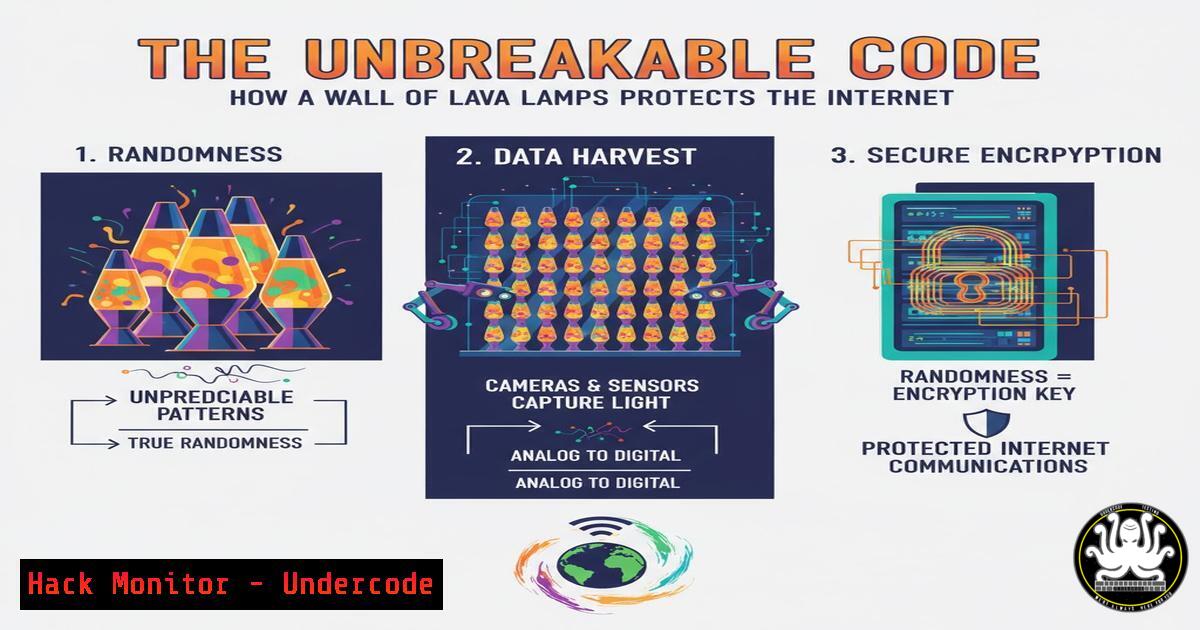
In an era where digital security hinges on mathematical complexity, one of the internet’s largest infrastructure companies, Cloudflare, relies on a surprisingly analog source of strength: a wall of lava lamps. This isn’t a gimmick; it’s a sophisticated implementation of a hardware-based entropy source designed to generate true randomness for cryptographic key generation. As deterministic computers struggle to produce unpredictable data, this physical solution provides a foundational layer of security for a significant portion of the web.
Learning Objectives:
- Understand the critical role of true randomness in cryptography and why computers are inherently bad at producing it.
- Learn how physical entropy sources, like Cloudflare’s LavaRand, are integrated into secure systems to enhance randomness.
- Explore practical commands and methods to check and manage entropy on your own Linux and Windows systems.
You Should Know:
1. The Problem with Pseudo-Randomness
Computers are deterministic machines. When asked to generate a “random” number, they use algorithms called Pseudo-Random Number Generators (PRNGs). These algorithms start with an initial value, known as a seed, and produce a sequence of numbers that appears random. The critical weakness is that if an attacker knows the algorithm and the seed, they can perfectly predict the entire sequence of “random” numbers. This predictability is a catastrophic failure in cryptography, where keys must be impossible to guess.
Step‑by‑step guide explaining what this does and how to use it.
To understand the entropy available on a Linux system, you can check the kernel’s random number generator. The following command checks the amount of entropy (in bits) available in the system’s entropy pool:
`cat /proc/sys/kernel/random/entropy_avail`
A low value (e.g., below 100) indicates the system might be struggling to gather enough environmental noise to fuel secure operations. For critical tasks like generating SSL keys, high entropy is non-negotiable.
2. Harnessing Physical Chaos: How LavaRand Works
Cloudflare’s solution, dubbed LavaRand, uses a physical wall of lava lamps in their San Francisco lobby. The chaotic, unpredictable motion of the wax blobs is captured by a camera. This video feed is digitized and fed into a processing algorithm that hashes the ever-changing pixel data. This hash is then mixed into the system’s entropy pool, providing a continuous stream of high-quality, truly random data that is immune to mathematical reverse-engineering.
Step‑by‑step guide explaining what this does and how to use it.
While you may not have a wall of lava lamps, the principle is to use unpredictable physical events. On Linux, the primary interfaces for randomness are `/dev/random` and /dev/urandom.
– /dev/random: Blocks (pauses) if the entropy pool estimate is low, ensuring high-quality randomness but potentially causing delays.
– /dev/urandom: Does not block. For most cryptographic purposes, including generating SSH keys, it is considered secure and is the preferred choice.
Example: Generating a strong SSH key pair using the non-blocking source.
`ssh-keygen -t ed25519 -a 100 -f ~/.ssh/my_secure_key`
3. Verifying System Entropy and Randomness Quality
It is crucial for system administrators to ensure their servers have sufficient entropy, especially in virtualized or cloud environments where physical hardware sources may be limited. A lack of entropy can cause services to hang while waiting for `/dev/random` to unblock.
Step‑by‑step guide explaining what this does and how to use it.
On a headless server, you can install tools to test and view entropy. The `rng-tools` package includes utilities for this purpose.
Linux:
1. Install rng-tools: `sudo apt-get install rng-tools` (Debian/Ubuntu)
- Check the quality of randomness from `/dev/urandom` using
rngtest:
`cat /dev/urandom | rngtest -c 1000`
This will run a series of FIPS 140-2 tests on the random data stream. Any failures warrant immediate investigation.
Windows:
You can use the `certutil` command to generate a random byte string and save it to a file for analysis.
`certutil -generateRandom 64 random.bin`
- Supplementing Entropy with Hardware Random Number Generators (HRNGs)
For organizations requiring the highest level of security, dedicated Hardware Random Number Generators (HRNGs) are the gold standard. These are PCIe cards or USB devices that use quantum effects or atmospheric noise to generate randomness, functioning as a commercial, scalable version of the LavaRand principle.
Step‑by‑step guide explaining what this does and how to use it.
If a system has an HRNG like `OneRNG` or TrueRNG, it can be configured to feed the Linux kernel’s entropy pool.
1. Install the `rng-tools` package.
2. Edit the `/etc/default/rng-tools` configuration file.
- Set the `HRNGDEVICE` parameter to point to your hardware device, e.g.,
HRNGDEVICE=/dev/ttyACM0.
4. Restart the service: `sudo systemctl restart rng-tools`.
The kernel will now use the HRNG as a primary source of entropy, dramatically improving the quality and quantity of available random data.
5. The Quantum Computing Threat and Future-Proofing Randomness
The rise of quantum computing presents a new threat. A powerful enough quantum computer could potentially find patterns in the output of some PRNGs much faster than classical computers. While true randomness, by definition, has no pattern, the algorithms that consume entropy must also be quantum-resistant. This makes robust, physical entropy sources even more critical for long-term security.
Step‑by‑step guide explaining what this does and how to use it.
Post-quantum cryptography is an active field. System administrators should begin preparing by:
1. Auditing: Identifying systems that rely on classical cryptographic algorithms (e.g., RSA, ECDSA).
2. Testing: Experimenting with post-quantum algorithms. OpenSSL 3.0+ supports some post-quantum key exchange mechanisms.
3. Generating Hybrid Keys: While not yet standard practice, the concept involves generating keys that combine classical and post-quantum algorithms.
Example (using OpenSSL to generate a classic elliptic curve key):
`openssl genpkey -algorithm EC -pkeyopt ec_paramgen_curve:P-256 -out ec_private.key`
What Undercode Say:
- Physical Beats Digital for Foundational Security. In the core layers of trust, like entropy generation, incorporating physically unpredictable elements provides a defense against purely mathematical attacks that can compromise deterministic systems.
- Explainability is a Security Feature. Cloudflare’s lava lamps are a masterclass in “security explainability.” A complex concept becomes a memorable story, building public trust and demystifying a critical, yet often invisible, component of internet safety.
The LavaRand system is far more than a marketing stunt; it is a pragmatic and robust solution to a fundamental computer science problem. It highlights a critical vulnerability in purely digital systems—their inherent predictability—and offers a blueprint for mitigating it. As attacks become more sophisticated, leveraging physics-based chaos provides a layer of security that is computationally irreducible. This approach will become increasingly vital not just for content delivery networks, but for the core of critical infrastructure, financial systems, and the next generation of AI, all of which depend on the integrity of their cryptographic foundations.
Prediction:
The Cloudflare outage mentioned in the post, while likely unrelated to the lava lamps, underscores the internet’s fragility and its dependence on a few key players. The “CrowdStrike moment” comparison is apt. We will see a growing trend of integrating diverse, physical entropy sources directly into critical cloud infrastructure and hardware security modules (HSMs) to create a more resilient and attack-resistant foundation. Furthermore, as quantum computing advances, the race will intensify to pair these robust entropy sources with quantum-resistant algorithms, making hybrid physical-digital security models the new standard for the next decade.
🎯Let’s Practice For Free:
IT/Security Reporter URL:
Reported By: Peleg4711 Cloudflare – Hackers Feeds
Extra Hub: Undercode MoN
Basic Verification: Pass ✅


