Listen to this Post
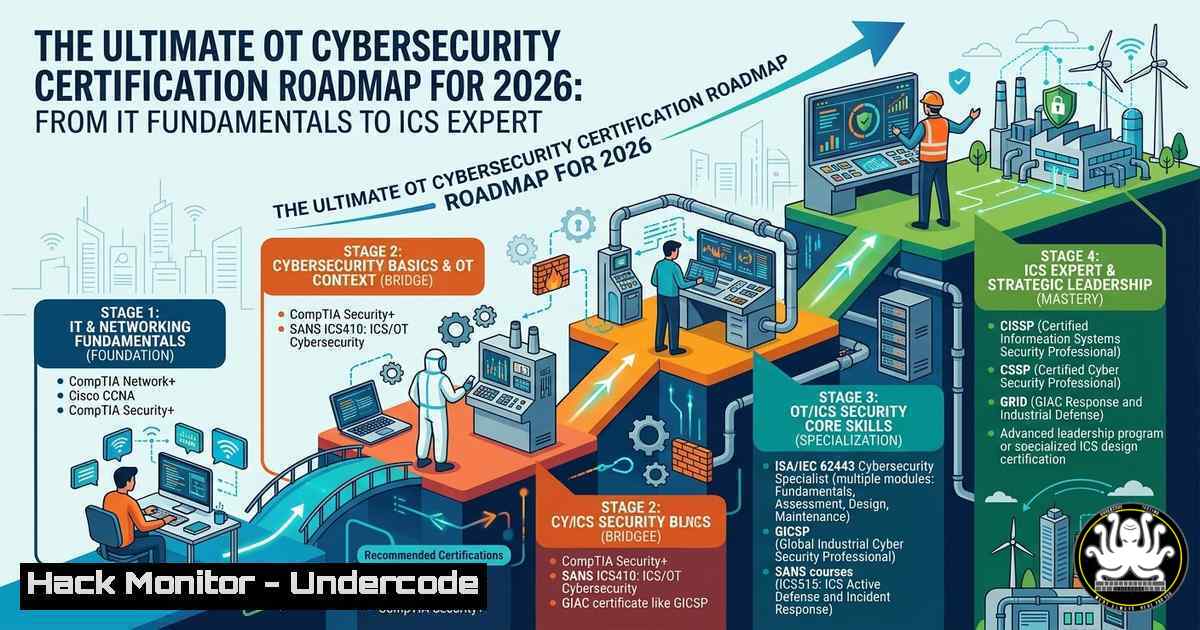
Introduction:
Operational Technology (OT) cybersecurity is no longer a niche specialization; it is a critical frontier as industrial control systems (ICS) become increasingly interconnected with enterprise IT networks. Unlike traditional IT security, where confidentiality is often the primary goal, OT security prioritizes safety, availability, and integrity to keep physical processes running. Building a career in this field requires a structured approach, blending foundational IT knowledge with specialized training in legacy systems, real-time monitoring, and industrial protocols.
Learning Objectives:
- Differentiate between IT and OT cybersecurity priorities, architectures, and incident response strategies.
- Identify the essential certifications for each career stage, from CompTIA Network+ to SANS ICS and ISA/IEC 62443.
- Develop a practical roadmap for acquiring hands-on skills in OT asset management, vulnerability assessment, and secure architecture design.
You Should Know:
- Building the IT Foundation: Networking and Security Essentials
Before diving into OT-specific concepts, a strong grasp of IT networking and security fundamentals is non-negotiable. The post highlights CompTIA’s Network+ and Security+ as the starting blocks. Network+ provides the bedrock of understanding how data moves across networks—crucial for grasping how OT data traverses segmented environments. Security+ introduces the principles of defense-in-depth, identity management, and incident response, which are adapted for OT contexts.
Step-by-step guide to reinforcing these fundamentals:
- Network Mapping (Nmap): Use Nmap to discover live hosts and open ports on a subnet. This simulates the asset discovery phase in OT environments.
Linux command to scan a local subnet for active devices
sudo nmap -sn 192.168.1.0/24
- Analyzing Network Traffic (Wireshark): Capture and filter for specific protocols like HTTP or DNS to understand normal vs. malicious traffic patterns.
Capture traffic on interface eth0 and filter for HTTP
tshark -i eth0 -Y "http.request"
- Windows Firewall Configuration: Implement network segmentation by creating advanced firewall rules to restrict communication between specific VLANs.
PowerShell command to block inbound traffic from a specific IP
New-NetFirewallRule -DisplayName "Block_OT_Device" -Direction Inbound -RemoteAddress 192.168.10.50 -Action Block
2. Transitioning to OT/ICS Cybersecurity Fundamentals
Once IT basics are mastered, the focus shifts to understanding the unique constraints of OT. The post emphasizes that while IT and OT share concepts, the execution differs dramatically. OT environments involve legacy systems (often running Windows XP or proprietary RTOS), specialized protocols (Modbus, DNP3, Profinet), and a critical need for uptime, which often prohibits patching. The CompTIA SecOT+ certification (entering beta in 2026) is positioned as the ideal entry point for IT professionals.
Step-by-step guide to exploring OT fundamentals:
- Simulating OT Protocols: Use tools like `Modbus-cli` or `pymodbus` to interact with a simulated PLC (Programmable Logic Controller) to understand how commands are sent.
Python script to read a holding register from a Modbus device from pymodbus.client import ModbusTcpClient client = ModbusTcpClient('192.168.1.100') client.connect() result = client.read_holding_registers(0, 1, unit=1) print(result.registers) client.close() - OT Asset Visibility: Deploy a lightweight network monitoring tool like `Zeek` (formerly Bro) to parse OT traffic and generate logs for anomaly detection.
Install Zeek on Ubuntu and start monitoring an interface
sudo apt-get install zeek
sudo zeekctl deploy
- Risk Assessment: Create a risk matrix comparing IT assets (servers) vs. OT assets (PLCs). Note that OT risk metrics often prioritize “impact on human safety” over “data loss.”
- Specialized OT/ICS Certification Paths: ISA/IEC 62443 vs. SANS ICS
The post outlines the two primary advanced paths: the ISA/IEC 62443 Cybersecurity Expert path for those with limited resources and the SANS ICS path for those with significant budgets. The ISA/IEC 62443 series is standards-focused, teaching how to apply a lifecycle approach to industrial security, from risk assessment to maintenance. The SANS ICS courses (like ICS410, ICS515) are hands-on, focusing on active defense, threat hunting, and in-depth protocol analysis.
Step-by-step guide to preparing for these paths:
- For ISA/IEC 62443: Download the ISA 62443 standards overview and map the “zones and conduits” model to a sample network diagram. Use a tool like `draw.io` to segment an OT network into safety zones and define conduits for communication.
- For SANS ICS: Practice with open-source ICS honeypots like `Conpot` to understand how attackers interact with industrial systems.
Deploy Conpot honeypot via Docker
docker run -d -p 80:80 -p 102:102 -p 502:502 honeynet/conpot
- Linux Command for Log Analysis: Use `grep` and `awk` to analyze ICS-specific logs for anomalies, such as unauthorized writes to Modbus registers.
Search for specific Modbus function codes in a log file
cat /var/log/ics_traffic.log | grep "Modbus" | awk '/write/ {print $0}'
4. Practical Mitigation and Hardening Techniques
Certifications validate knowledge, but practical experience is essential. The post reminds that certs do not replace hands-on experience. Real-world OT security involves hardening edge devices, implementing secure remote access, and developing cyber-physical incident response plans.
Step-by-step guide for hardening OT environments:
- Disabling Unnecessary Services (Windows): For OT workstations, reduce the attack surface by disabling services like Print Spooler and SMBv1 using PowerShell.
Disable SMBv1 (often a vulnerability in legacy OT systems)
Disable-WindowsOptionalFeature -Online -FeatureName SMB1Protocol
- Linux Firewall for OT Gateways: Configure `iptables` on a Linux-based OT gateway to allow only specific industrial protocol traffic.
Allow only Modbus TCP (port 502) from a specific management host
sudo iptables -A INPUT -p tcp --dport 502 -s 192.168.50.10 -j ACCEPT
sudo iptables -A INPUT -p tcp --dport 502 -j DROP
- Secure Remote Access: Implement a jump box with multi-factor authentication. For OT, use a hardened Linux server as a jump host with SSH key-only authentication.
Configure SSH to disable password authentication
sudo nano /etc/ssh/sshd_config
Set: PasswordAuthentication no
sudo systemctl restart sshd
5. Continuous Learning and Threat Intelligence
The field of OT cybersecurity evolves rapidly. The post recommends subscribing to newsletters and following experts like Mike Holcomb. Staying current requires engaging with threat intelligence specific to industrial sectors, such as energy, water, and manufacturing.
Step-by-step guide to building a threat intelligence feed:
- Automate OSINT Gathering: Create a simple bash script to scrape threat feeds related to ICS malware like TRITON or Industroyer.
Bash snippet to fetch and filter a threat feed
curl -s https://otx.alienvault.com/api/v1/pulses/subscribed | grep -i "ics"
- Set Up Log Aggregation: Use the ELK stack (Elasticsearch, Logstash, Kibana) to centralize logs from OT devices for anomaly detection. Configure Logstash to parse Modbus or DNP3 logs from a syslog server.
What Undercode Say:
- Foundation is Non-Negotiable: Attempting OT security without mastering IT networking and security fundamentals is a recipe for failure. The overlap in concepts like segmentation and access control is critical.
- Certifications Map to Career Stage: The choice between ISA/IEC 62443 and SANS ICS is not just about budget but about career goals—one focuses on compliance and lifecycle management, the other on active defense and hunting.
- Hands-On Experience Bridges the Gap: No certification can substitute for configuring a real PLC, analyzing industrial protocol traffic with Wireshark, or practicing incident response in a simulated plant environment. Building a home lab with Raspberry Pis acting as PLCs or using virtualized environments is essential.
Prediction:
The demand for OT cybersecurity professionals will surge as nation-state attacks increasingly target critical infrastructure. By 2027, certifications like CompTIA SecOT+ will likely become baseline requirements, while advanced standards like ISA/IEC 62443 will be mandated by insurance carriers and regulatory bodies. Professionals who combine formal certifications with demonstrable hands-on skills in protocol analysis and system hardening will command premium positions, bridging the gap between the IT security and industrial engineering worlds. The bifurcation of career paths—compliance-focused vs. technical defense—will become more pronounced, requiring practitioners to choose their trajectory early.
▶️ Related Video (80% Match):
https://www.youtube.com/watch?v=2A5ygCKCsmc
🎯Let’s Practice For Free:
IT/Security Reporter URL:
Reported By: Https: – Hackers Feeds
Extra Hub: Undercode MoN
Basic Verification: Pass ✅


