Listen to this Post
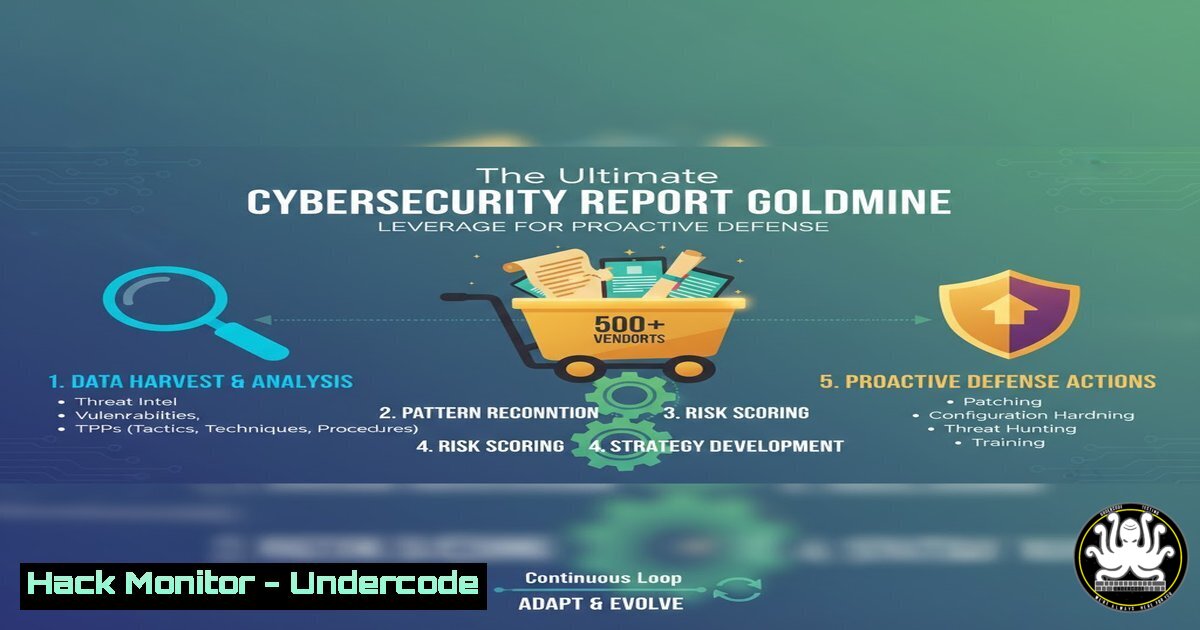
Introduction:
The cybersecurity landscape is constantly evolving, demanding continuous learning and adaptation from professionals. An invaluable resource has emerged in the form of a curated compilation of over 500 annual security reports from leading vendors across AI, AppSec, Cloud, and Threat Intelligence. This collection provides unparalleled, data-driven insights directly from the front lines of cyber defense, offering a strategic advantage to those who know how to utilize it effectively.
Learning Objectives:
- Learn how to systematically analyze vendor threat reports to extract actionable intelligence.
- Understand how to integrate findings from these reports into your existing security controls and tooling.
- Develop a proactive defense strategy informed by the latest threat actor TTPs (Tactics, Techniques, and Procedures) and vulnerability trends.
You Should Know:
1. Sourcing and Categorizing the Intelligence
The initial step is to acquire and organize the data. The primary repository, linked from the post, aggregates PDFs and blogs from dozens of top-tier companies. Effective use requires a methodical approach to categorization.
Step-by-step guide explaining what this does and how to use it.
Step 1: Acquisition. Navigate to the provided link (https://lnkd.in/g9Jieje7) and download the repository or bookmark the main directory.
Step 2: Triage by Domain. Create a folder structure on your local machine or shared drive that mirrors your security priorities. Example folders: AI_Security, Cloud_IaaS, AppSec_SDLC, Ransomware_Intel, Vulnerability_Data.
Step 3: Prioritize Reading. Not all reports are created equal. Prioritize reports from vendors whose technology stacks align with your own (e.g., Wiz and Orca for cloud, Veracode and Checkmarx for AppSec) and those with a strong reputation for empirical data, like Google, Sophos, and Red Canary.
2. Extracting Actionable Attack Patterns and TTPs
Vendor reports are treasure troves of specific Techniques, Tactics, and Procedures (TTPs) used by real-world threat actors. Mapping these to the MITRE ATT&CK framework is crucial for operationalizing the intelligence.
Step-by-step guide explaining what this does and how to use it.
Step 1: Identify Key Sections. Skim reports for chapters like “Threat Landscape,” “Incident Response Findings,” or “Adversary Playbooks.” These often contain detailed attack chains.
Step 2: Map to MITRE ATT&CK. For each described attack step, note the relevant MITRE technique ID. For example, a report detailing cloud credential theft via a malicious GitHub action would map to `T1528` (Steal Application Access Token) and potentially `T1552.001` (Unsecured Credentials: Credentials In Files).
Step 3: Update Detection Rules. Use this mapping to create or refine detection rules in your SIEM, EDR, or cloud security platform. For instance, to detect the aforementioned credential theft, you could create a Sigma rule or a Splunk query alerting on `gauth credential` writes to unexpected locations.
3. Leveraging Cloud-Specific Hardening Guides
Reports from cloud security leaders like Wiz, Sysdig, and Google Cloud Security often include specific misconfiguration statistics and hardening recommendations that go beyond generic benchmarks.
Step-by-step guide explaining what this does and how to use it.
Step 1: Focus on Prevalence Data. Look for charts stating “Top 5 AWS S3 Misconfigurations” or “Most Exploited Azure Service.” This tells you where to focus your scanning and remediation efforts first.
Step 2: Implement Hardening Commands. Many reports provide concrete commands. For example, a report might highlight the prevalence of publicly readable S3 buckets. You can use the AWS CLI to audit and rectify this:
 Find all S3 buckets with public read access
aws s3api list-buckets --query "Buckets[].Name" | jq -r '.[]' | while read bucket; do
if aws s3api get-bucket-acl --bucket "$bucket" | grep -q "http://acs.amazonaws.com/groups/global/AllUsers"; then
echo "Public Bucket: $bucket"
 Command to block all public access (remediation)
 aws s3api put-public-access-block --bucket "$bucket" --public-access-block-configuration BlockPublicAcls=true,IgnorePublicAcls=true,BlockPublicPolicy=true,RestrictPublicBuckets=true
fi
done
Note: Always test remediation commands in a non-production environment first.
4. Integrating AppSec Vulnerability Data into Your SDLC
Application security vendors like Veracode, Checkmarx, and Snyk publish reports detailing the most common and critical vulnerabilities they find in customer codebases. This data is perfect for tailoring your Secure Development Lifecycle (SDLC).
Step-by-step guide explaining what this does and how to use it.
Step 1: Identify Top Vulnerability Classes. Note the recurring vulnerability types (e.g., Cross-Site Scripting, Insecure Deserialization, Server-Side Request Forgery).
Step 2: Update SAST/SCA Rulesets. Ensure your Static Application Security Testing (SAST) and Software Composition Analysis (SCA) tools are configured to prioritize these vulnerability classes and that their rule sets are up-to-date.
Step 3: Develop Targeted Security Training. Create or source developer training modules specifically focused on the top 3-5 vulnerability classes identified in the reports. Use real code examples from the reports to illustrate safe and unsafe patterns.
5. Staying Ahead of AI Security Threats
With AI becoming integral to business operations, reports from vendors like Anthropic and HiddenLayer provide critical insights into novel attack vectors like model poisoning, data leakage, and adversarial machine learning.
Step-by-step guide explaining what this does and how to use it.
Step 1: Understand the Attack Surface. Read AI security reports to understand threats beyond traditional IT, such as prompt injection attacks, training data extraction, and model theft.
Step 2: Implement Input Sanitization and Monitoring. For applications using LLMs, implement robust input validation and sanitization to mitigate prompt injection. Monitor for anomalous queries that may be attempting to extract sensitive data or manipulate the model’s output.
Step 3: Harden Your MLOps Pipeline. Apply security controls to your machine learning operations pipeline. This includes scanning training data for poisoning, securing model registries, and ensuring integrity checks for model deployments.
6. Building a Proactive Threat Hunting Hypothesis
Threat hunting is not a random search; it’s a hypothesis-driven investigation. These reports provide the data needed to form powerful hunting hypotheses based on what is actively targeting other organizations.
Step-by-step guide explaining what this does and how to use it.
Step 1: Formulate a Hypothesis. Based on a ransomware report, you might form a hypothesis: “An adversary is using `Living-off-the-Land` techniques, specifically the `certutil` utility, for payload decoding within our environment.”
Step 2: Craft a Hunting Query. Use your EDR or SIEM to search for anomalous use of these binaries. A simple YARA rule for a memory scan or an EDR query could look for `certutil` with specific decode commands.
 Example EDR query concept (pseudo-code)
process == "certutil.exe" && command_line contains "-decode" || command_line contains "-urlcache"
Step 3: Document and Operationalize. If your hunt confirms the activity, document the findings. If it doesn’t, refine your hypothesis and hunting methodology. Successful hunts should lead to new automated detections.
What Undercode Say:
- This consolidated repository is arguably one of the most efficient ways to conduct open-source threat intelligence (OSINT) for defenders, compressing thousands of hours of research into a single, accessible location.
- The true value is not in passive reading but in the active operationalization of the data—translating statistical trends into hardened configurations, refined detection rules, and informed security strategies.
Analysis: The aggregation of these reports signifies a shift towards a more transparent and collaborative security community. However, the volume itself presents a challenge: information overload. The differentiation between a junior and a senior security professional will increasingly be measured by their ability to curate, distill, and act upon this firehose of information. The reports from cloud-native vendors are particularly critical, as they reflect the rapid evolution of attack techniques in modern, dynamic environments that traditional perimeter-based defenses cannot comprehend. Failing to leverage these free, high-quality resources is a significant strategic misstep for any security team.
Prediction:
In the next 12-18 months, we will see a direct correlation between organizations that systematically consume and act on this type of aggregated vendor intelligence and their resilience against automated and large-scale cyber attacks. The adversarial use of AI, as highlighted in several of these reports, will accelerate, leading to more personalized and persuasive phishing and social engineering at scale. Furthermore, cloud supply chain attacks will emerge as a dominant threat vector, with attackers increasingly targeting weak links in the CI/CD pipelines and third-party integrations that underpin modern cloud applications. The insights from the 2024 reports provide the necessary blueprint to begin building defenses against these imminent threats.
🎯Let’s Practice For Free:
IT/Security Reporter URL:
Reported By: Clintgibler %F0%9D%90%80%F0%9D%90%B0%F0%9D%90%9E%F0%9D%90%AC%F0%9D%90%A8%F0%9D%90%A6%F0%9D%90%9E – Hackers Feeds
Extra Hub: Undercode MoN
Basic Verification: Pass ✅


