Listen to this Post
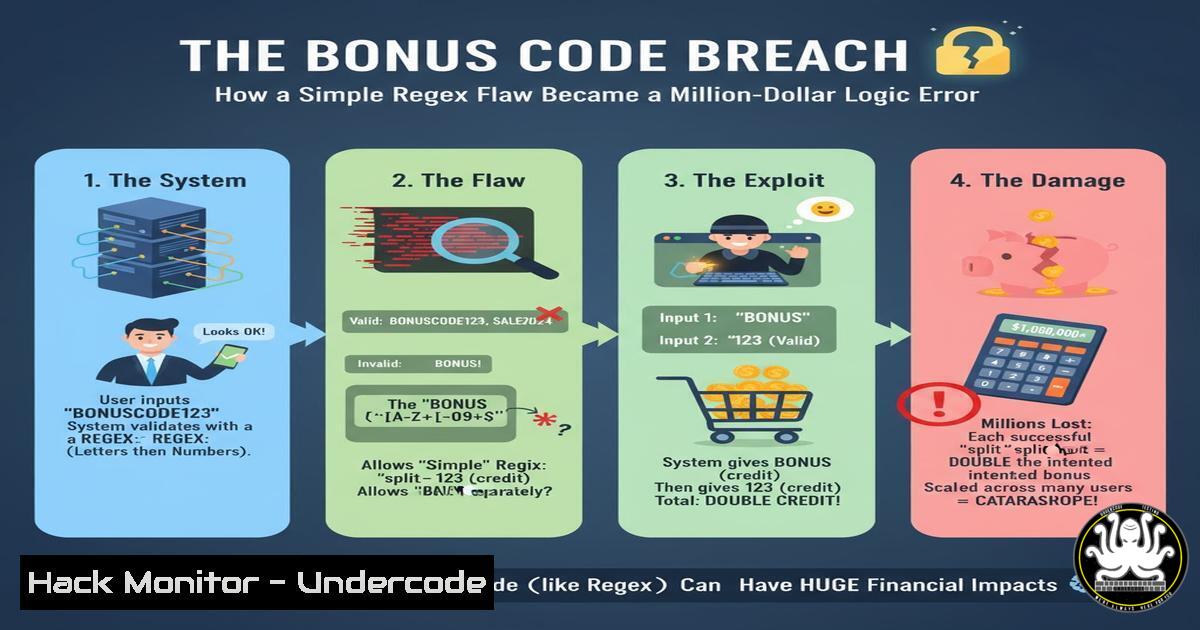
Introduction:
In the intricate world of application security, the most devastating vulnerabilities are often not complex buffer overflows or zero-day exploits, but simple logic errors in input validation. A recent discovery by a security researcher highlights a critical flaw in a bonus code mechanism, where weak client-side validation and a missing server-side cross-site request forgery (CSRF) check created a perfect storm for automated exploitation. This incident serves as a stark reminder that robust security requires a defense-in-depth approach, far beyond superficial client-side checks.
Learning Objectives:
- Understand how improper regex implementation can create exploitable attack surfaces.
- Learn to automate payload generation and testing using Python and Burp Suite Intruder.
- Comprehend the critical role of server-side validation and CSRF protection in securing web applications.
You Should Know:
1. Deconstructing the Vulnerable Validation Rule
The core of this vulnerability lies in a deceptively simple JSON validation rule. The system was configured to accept a bonus code that matched the pattern `[a-z0-9]+` with a case-insensitive flag, and had a fixed length of 10 characters.
Step-by-step guide explaining what this does and how to use it:
The regex `[a-z0-9]+` allows for any combination of lowercase letters and numbers. The `+` quantifier means “one or more,” but it’s effectively constrained by the separate `length` rule. The major flaw is the case-insensitive flag i. This means the pattern `[a-z0-9]` also matches uppercase letters A-Z, creating a character set of a-zA-Z0-9. This significantly increases the number of possible combinations, but the lack of rate limiting is the true failure. To test the strength of such a pattern, you can calculate the keyspace: (26 lowercase + 26 uppercase + 10 digits)^10. This is a massive number, but without rate limiting, an attacker can systematically test a subset of possibilities until a valid code is found.
2. Weaponizing Python for Payload Generation
The researcher used a minimal Python script to generate a wordlist for a brute-force attack. This script efficiently creates potential valid codes based on the known rules.
Step-by-step guide explaining what this does and how to use it:
The script leverages Python’s `string` and `random` modules.
– `string.ascii_letters` provides all lowercase and uppercase letters (abcdefghijklmnopqrstuvwxyzABCDEFGHIJKLMNOPQRSTUVWXYZ).
– `string.digits` provides the numbers 0 through 9.
– Combining them creates the full character set allowed by the flawed regex.
– The `random.choice()` function selects 10 random characters from this set to form a single code.
– The loop generates 500 such codes.
import random
import string

def generate_bonus_code():
 Define the character set: a-z, A-Z, 0-9
chars = string.ascii_letters + string.digits
 Join 10 randomly chosen characters into a single string
return ''.join(random.choice(chars) for _ in range(10))

Generate a list of 500 bonus codes
bonus_codes = [generate_bonus_code() for _ in range(500)]

Print each code on a new line, suitable for a wordlist
for code in bonus_codes:
print(code)
To use this, save the code to a file like `bonus_code_generator.py` and run it from your terminal, redirecting the output to a file: python3 bonus_code_generator.py > payloads.txt. This `payloads.txt` file is now ready to be used in an attack tool.
3. Orchestrating the Attack with Burp Suite Intruder
Burp Suite’s Intruder tool is the engine for automating the HTTP requests with the generated payloads.
Step-by-step guide explaining what this does and how to use it:
1. Intercept: Use Burp Suite’s Proxy to intercept a legitimate request to submit a bonus code.
2. Send to Intruder: Right-click the intercepted request and select “Send to Intruder”.
3. Positions Tab: Clear any existing payload positions. Highlight the value of the bonus code parameter in the request body (e.g., "bonus_code":"ABC123def4") and click “Add §”. This tells Intruder where to insert your payloads.
4. Payloads Tab: Select “Payload type” as “Simple list”. Click “Load…” and select the `payloads.txt` file you generated with the Python script.
5. Start Attack: Click the “Start attack” button. This will launch a new window that fires off HTTP requests, each with a different bonus code from your list.
6. Analysis: Monitor the results for HTTP status codes. A `200 OK` on a request with a specific payload indicates a successful submission, potentially revealing a valid, claimable bonus code. The absence of rate limiting means all 500 (or 10,000) requests will be processed in quick succession.
4. Bypassing CSRF Token Validation
A critical finding was the server’s failure to validate the `X-CSRF-Token` header, a common defense mechanism against Cross-Site Request Forgery attacks.
Step-by-step guide explaining what this does and how to use it:
CSRF tokens are designed to prove that a request originated from an intended user session on the legitimate site. The server should reject any state-changing request (like claiming a bonus) that lacks a valid, session-tied token.
– Testing the Bypass: In the Burp Intruder request, you can manipulate the `X-CSRF-Token` header.
– Modification: Change the token value to a random string. If the request is still accepted, the token is not being validated.
– Deletion: Remove the `X-CSRF-Token` header entirely from the request. If the server still processes the bonus claim, the protection is completely ineffective.
– The only validation that was working was the session cookie. Removing the `Cookie` header correctly resulted in an error, confirming that the application state was tied to the session, but the critical action (bonus claim) was not.
5. Implementing Robust Server-Side Defenses
The exploit is only possible due to failures in server-side logic. Here’s how to fix it.
Step-by-step guide explaining what this does and how to use it:
– Strong Server-Side Validation: Do not rely on client-side rules. The server must have its own logic.
 Example Python (Flask) validation
import re

def validate_bonus_code(code):
 Check length first
if len(code) != 10:
return False
 Check against a strict regex (no case-insensitive flag, use explicit character set)
if not re.match(r'^[a-z0-9]{10}$', code):
return False
 Check against a database of valid, unclaimed codes
if not is_valid_and_unclaimed_code_in_db(code):
return False
return True
– Enforce Strict CSRF Protection: Every state-changing POST request must validate a cryptographically strong token associated with the user’s session. Frameworks like Django, Spring Security, and others do this by default.
– Implement Rate Limiting: Use a web application firewall (WAF) or application-level logic to limit requests per user, session, or IP address.
 Example using fail2ban on Linux to block an IP making excessive requests
 You would configure a filter for HTTP 200 responses on the bonus endpoint in your server logs
 fail2ban would then ban the IP address using iptables/nftables
sudo systemctl status fail2ban
What Undercode Say:
- The Illusion of Client-Side Security: Client-side validation is purely a user experience feature, not a security control. It can always be bypassed. All validation logic must be duplicated and enforced on the server.
- Complexity is the Enemy of Security: The combination of a permissive regex, missing CSRF check, and absent rate limiting created a trivial-to-exploit vulnerability. A defense-in-depth strategy, where multiple controls must fail for a breach to occur, is non-negotiable.
This case is a classic example of security theater. The application had the appearance of security with a CSRF token and validation rules, but a shallow implementation rendered them useless. For a large company, this often stems from siloed development, where the front-end and back-end teams do not have a shared security model, or from a lack of thorough penetration testing that specifically looks for logic flaws. The future impact of such “simple” hacks will be amplified as more business logic is driven by AI and microservices. Automated systems, if not meticulously designed, will be highly susceptible to these same classes of logic manipulation, potentially leading to mass-scale fraud, data poisoning, and resource drain attacks that are difficult to attribute and mitigate.
🎯Let’s Practice For Free:
IT/Security Reporter URL:
Reported By: Sans1986 Keeplearning – Hackers Feeds
Extra Hub: Undercode MoN
Basic Verification: Pass ✅


