Listen to this Post
Introduction:
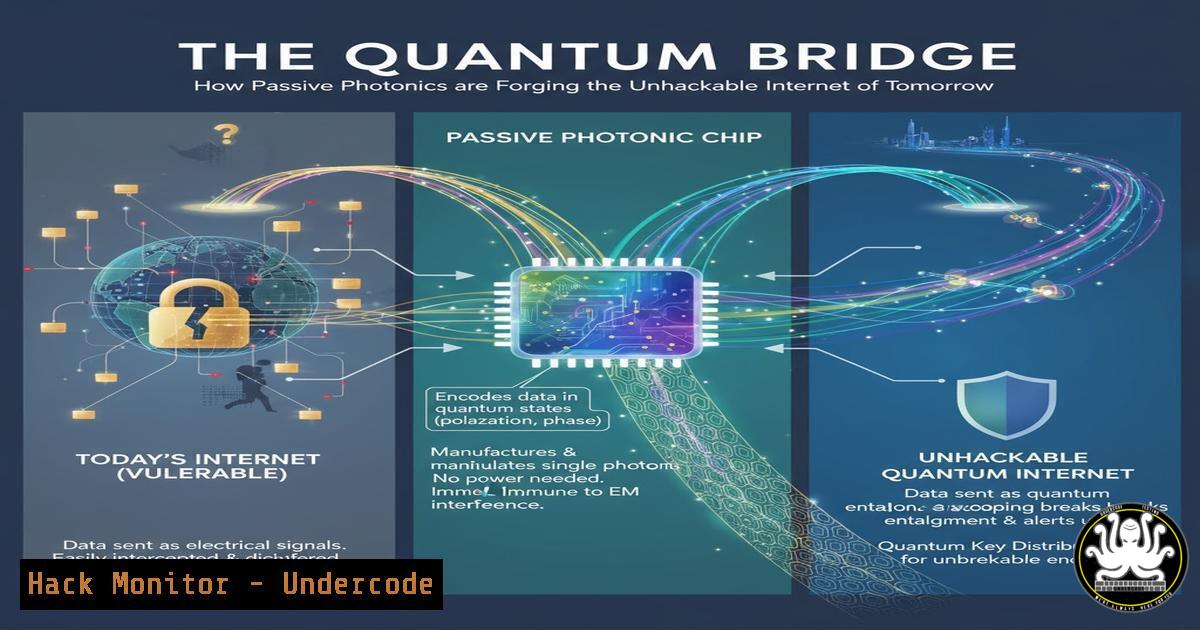
The frontier of cybersecurity is rapidly expanding beyond software and into the fundamental physics of light. Recent breakthroughs in photonic chips, which can passively convert laser light into multiple colors, are not just a laboratory curiosity; they represent a foundational leap for quantum networking and cryptography. This technology moves us closer to a future where data transmission is inherently secure by the laws of quantum mechanics, rendering many current cyber threats obsolete.
Learning Objectives:
- Understand the core mechanism of passive wavelength conversion and its advantage over active systems.
- Explore the direct application of this technology in Quantum Key Distribution (QKD) and high-speed, secure data links.
- Learn the initial steps for integrating and simulating photonic-based security protocols in an IT environment.
You Should Know:
1. The Physics of Passive Security
The new chips from the Joint Quantum Institute (JQI) utilize a material property known as `third-order nonlinearity` (or the Kerr effect). When a single, high-power “pump” laser is fed into the chip, the material itself responds by generating new frequencies (colors) of light without any external control. This passive operation is the key to its robustness and reliability. Unlike active systems that require constant tuning and feedback, these chips are stable by design. From a cybersecurity perspective, this reduces the attack surface. There are no control electronics to hack, no software-defined parameters to manipulate, and no active components to fail under a denial-of-service attack aimed at the control system.
Step-by-step guide:
While you cannot build the chip itself, you can model the principle of frequency generation using a simulation tool like MATLAB or Python with NumPy/SciPy.
import numpy as np
import matplotlib.pyplot as plt

Simplified model of Four-Wave Mixing (a third-order nonlinear process)
def four_wave_mixing(pump_frequency, nonlinear_coefficient, length):
 Assume pump_frequency is in THz
 This is a highly simplified model for illustration
signal_freq = pump_frequency - 10e12  10 THz lower
idler_freq = pump_frequency + 10e12  10 THz higher
conversion_efficiency = (nonlinear_coefficient  length)2
return signal_freq, idler_freq, conversion_efficiency

pump = 193.0e12  Standard C-band telecom frequency (approx 1550 nm)
n2 = 0.1  Arbitrary nonlinear coefficient
L = 0.01  Chip length in meters

signal, idler, efficiency = four_wave_mixing(pump, n2, L)
print(f"Generated Signal: {signal/1e12:.2f} THz")
print(f"Generated Idler: {idler/1e12:.2f} THz")
print(f"Simulated Conversion Efficiency: {efficiency:.2%}")
This code demonstrates the core concept: from one input frequency, two others are generated predictably, forming the basis for multi-channel quantum communication.
2. Supercharging Quantum Key Distribution (QKD)
QKD is the most well-known application of quantum cryptography, allowing two parties to generate a shared, secret key with security guaranteed by quantum mechanics. Any eavesdropping attempt inevitably disturbs the quantum states and can be detected. Current QKD systems often use complex active components to manage different wavelengths for encoding and transmission. The new passive chips can generate these multiple, stable wavelengths from a single source. This simplifies the hardware, reduces costs, and dramatically increases the reliability and bitrate of the key exchange. A more robust and higher-speed QKD system means encryption keys can be rotated more frequently, enhancing security for the most sensitive data links.
Step-by-step guide:
To understand the environment where this would be deployed, you can set up a QKD simulation using the `qkd` module in a quantum computing framework like Qiskit.
 Install Qiskit (use a virtual environment)
pip install qiskit qiskit-aer
from qiskit import QuantumCircuit, Aer, transpile
from qiskit.visualization import plot_histogram
from qkd.bb84 import BB84

Simulate a simplified BB84 QKD protocol run
 In a real system, the different wavelengths generated by the photonic chip
 would be used to transmit these qubits over optical fiber.
num_qubits = 1000
bb84_protocol = BB84(simulator=Aer.get_backend('aer_simulator'))
alice_bits, alice_bases, bob_bases, bob_bits = bb84_protocol.run_protocol(num_qubits)

The protocol automatically sifts the keys
sifted_key_alice = bb84_protocol.sifted_key_alice
sifted_key_bob = bb84_protocol.sifted_key_bob

print(f"Length of sifted key: {len(sifted_key_alice)} bits")
 If keys match, a secure shared secret has been established.
print(f"Keys are identical: {sifted_key_alice == sifted_key_bob}")
- Architecting Dense Wavelength Division Multiplexing (DWDM) for Secure Data Links
Beyond QKD, these chips are a boon for classical network security. DWDM is a technology that combines multiple optical carrier signals on a single optical fiber by using different wavelengths. The passive photonic chip is a perfect, integrated source for a DWDM system. By generating multiple wavelengths on a single, stable chip, it allows for the creation of highly secure, point-to-point encrypted tunnels (using protocols like IPsec or MACsec) over each wavelength. The physical layer itself becomes more resilient and capable, supporting a greater number of parallel encrypted channels without the cost and power consumption of multiple individual lasers.
Step-by-step guide:
On a network engineer’s workstation, you can use GNS3 or a similar tool to design a network that utilizes such a physical layer. The key is to configure the logical encrypted tunnels on top of the physical interfaces.
 Example Linux command to create an IPsec tunnel (using strongSwan)
 This would run on routers at either end of the high-capacity optical link.

Install strongSwan
sudo apt-get install strongswan

Edit /etc/ipsec.conf to add a connection configuration
conn my-secure-dwdm-tunnel
left=192.168.1.1
right=192.168.1.2
leftsubnet=10.1.1.0/24
rightsubnet=10.1.2.0/24
authby=secret
ike=aes256-sha2_256-modp2048s256
esp=aes256-sha2_256
auto=start
4. Hardening the Physical Layer Against Eavesdropping
The most direct security benefit of quantum-based photonics is physical layer security. In traditional fiber optics, it is possible to tap a fiber and siphon off light without detection. With QKD and the single-photon sources these chips could enable, any measurement of the photon by an eavesdropper changes its state. This is the core principle of quantum indeterminacy applied to security. The new chips don’t create this property, but they provide a reliable, integrable, and cost-effective way to build systems that leverage it. This moves security from a mathematical assumption (that factoring large numbers is hard) to a physical law.
Step-by-step guide:
Security teams should begin threat modeling that includes physical layer attacks. Use a tool like `nmap` to audit your network and understand which links are critical and physically exposed.
 Scan a target range to map your network. Identify critical backbone links.
nmap -sn 10.0.100.0/24

For a specific server, check for unexpected open ports that could indicate a tap or compromise.
nmap -sS -A -p- <critical_server_ip>

Use Wireshark to analyze traffic on a key interface, looking for anomalies.
sudo wireshark -i eth0 -k
The goal is to identify which data links would be prime candidates for an upgrade to a quantum-secured physical layer once this technology becomes commercially available.
5. Future-Proofing Your IT Strategy
The convergence of AI, quantum computing, and photonics is not a distant future—it’s underway. AI agents and automation platforms will be the primary consumers of the massive, secure bandwidth these chips enable. For CIOs and CISOs, the strategy should involve “crypto-agility”—the ability to transition to new cryptographic standards. This includes tracking developments from standards bodies like NIST on post-quantum cryptography (PQC) and understanding how quantum networking can be integrated to protect against “harvest now, decrypt later” attacks, where adversaries collect encrypted data today to decrypt it once a large-scale quantum computer is built.
Step-by-step guide:
Start integrating PQC into your development and testing environments now. Libraries like OpenSSL are beginning to support PQC algorithms.
 Check if your version of OpenSSL supports any post-quantum algorithms.
openssl list -public-key-algorithms | grep -i dilithium

In a development branch of your application, test a PQC library like liboqs.
git clone https://github.com/open-quantum-safe/liboqs
cd liboqs
mkdir build && cd build
cmake .. -DCMAKE_INSTALL_PREFIX=/usr/local/liboqs
make -j
sudo make install
This proactive step ensures your systems are prepared for the transition, which will be accelerated by hardware breakthroughs like the JQI photonic chips.
What Undercode Say:
- The End of the Active Attack Surface in Hardware: The shift from active, electronically controlled photonic systems to passive, physics-driven ones represents a paradigm shift. It removes an entire class of vulnerabilities related to control logic, firmware, and power manipulation.
- Democratization of Quantum-Secure Links: By drastically reducing the cost and complexity of the core components, this technology will make QKD and other quantum-based security measures accessible beyond government and finance, eventually becoming standard in enterprise and cloud data centers.
The analysis is clear: cybersecurity is becoming a physical science. While the industry has spent decades layering complex logical defenses on top of a vulnerable physical layer, this innovation flips the script. It builds security directly into the medium of transmission. The immediate impact is on the high-end of secure communications, but the long-term trajectory points to a fundamental redesign of network infrastructure. The role of the CISO will soon require a working knowledge of quantum photonics to properly evaluate and defend the next-generation corporate network.
Prediction:
Within the next 5-7 years, we will see the first commercially viable, chip-scale quantum encryption modules based on this passive photonic technology integrated into major cloud providers’ backbone networks. This will create a two-tier internet: a standard, “best-effort” public internet and a premium, quantum-secured private backbone for sensitive data and critical infrastructure. This will not immediately render current encryption obsolete, but it will set a new gold standard for data-in-transit security, forcing nation-states and sophisticated cybercriminals to invest even more heavily in quantum decryption capabilities, thereby accelerating the entire quantum cybersecurity arms race.
🎯Let’s Practice For Free:
IT/Security Reporter URL:
Reported By: Trey Rutledge – Hackers Feeds
Extra Hub: Undercode MoN
Basic Verification: Pass ✅


